answer.
Ask question
Login Signup
Ask question
All categories
  • English
  • Mathematics
  • Social Studies
  • Business
  • History
  • Health
  • Geography
  • Biology
  • Physics
  • Chemistry
  • Computers and Technology
  • Arts
  • World Languages
  • Spanish
  • French
  • German
  • Advanced Placement (AP)
  • SAT
  • Medicine
  • Law
  • Engineering
timama
12 days ago
9

What is the torque τa about axis a due to the force f⃗ ? express the torque about axis a at cartesian coordinates (0,0)?

Physics
1 answer:
Yuliya22 [2.4K]12 days ago
5 0

Response:

\tau_a = F a sin \theta

Explanation:

Torque is defined as:

\tau = F d sin \theta

where

F is the force's magnitude,

d represents the distance from where the force is applied to the center of rotation,

\theta and is the angle between the force's direction and d.

In this question, we have:

F, the force

a, the distance of applying the force from the center (0,0)

\theta, and the angle between the force's direction and a.

Thus, the torque is

\tau_a = F a sin \theta

You might be interested in
Mosses don't spread by dispersing seeds; they disperse tiny spores. The spores are so small that they will stay aloft and move w
Keith_Richards [2268]

Solution:

Em_{f} / Em₀ = 0.30

Explanation:

In this problem, we apply the connection between mechanical energy, kinetic energy, and gravitational potential energy.

      K = ½ m v²

      U = mgh

We assess the mechanical energy at two positions:

Initial. Lower

    Em₀ = K = ½ m v²

At its highest point

    Em_{f} = U = mg and

Now let's compute

    Em₀ = ½ m 3.6²

    Em₀ = m 6.48

    Em_{f} = m 9.8 × 0.2

    Em_{f} = m 1.96

Thus the energy lost is given by:

    Em_{f} / Em₀ = m 1.96 / m 6.48

   Em_{f} / Em₀ = 0.30

This means that 30% of the sun's energy is transformed into potential energy.

There are various conversion possibilities.

This energy changes into thermal energy affecting the spores and air, since it cannot be regained.

8 0
14 days ago
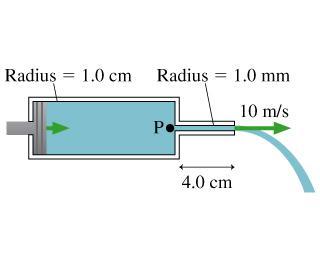
What is the gauge pressure of the water right at the point p, where the needle meets the wider chamber of the syringe? neglect t
Yuliya22 [2446]

Details that are not provided: the problem figure is included.

We can address the exercise by applying Poiseuille's law. This law indicates that for a fluid flowing in a laminar manner within a confined pipe,

\Delta P = \frac{8 \mu L Q}{\pi r^4}

where:

\Delta P represents the pressure difference across the two ends

\mu denotes the viscosity of the fluid

L signifies the length of the pipe

Q=Av indicates the volumetric flow rate, where A=\pi r^2 is the cross-sectional area of the tube and v refers to the fluid's velocity

r stands for the pipe's radius.

This law can be utilized for the needle, allowing us to compute the pressure difference between point P and the needle's end. In this scenario, we have:

\mu=0.001 Pa/s is the dynamic viscosity of water at 20^{\circ}

L=4.0 cm=0.04 m

Q=Av=\pi r^2 v= \pi (1 \cdot 10^{-3}m)^2 \cdot 10 m/s =3.14 \cdot 10^{-5} m^3/s

and r=1 mm=0.001 m

Substituting these values into the formula yields:

\Delta P = 3200 Pa

This pressure difference specifies the value between point P and the needle's termination. As the end of the needle is under atmospheric pressure, the gauge pressure at point P, relative to atmospheric pressure, is exactly 3200 Pa.

8 0
1 month ago
Considering the activity series given for nonmetals, what is the result of the below reaction? Use the activity series provided.
ValentinkaMS [2433]

Response: The result would be no reaction.

Clarification:

7 0
9 days ago
Read 2 more answers
A careful photographic survey of Jupiter’s moon Io by the spacecraft Voyager 1 showed active volcanoes spewing liquid sulfur to
Sav [2230]

Answer:

529.15 m/s

Explanation:

h = Highest point = 70000 m

g = Gravitational acceleration = 2 m/s²

m = Sulfur's mass

Since both potential and kinetic energies are conserved

mgh=\dfrac{1}{2}mv^2\\\Rightarrow h=\dfrac{v^2}{2g}\\\Rightarrow v=\sqrt{2gh}\\\Rightarrow v=\sqrt{2\times 2\times 70000}\\\Rightarrow v=529.15\ m/s

The velocity at which the liquid sulfur exited the volcano is 529.15 m/s

7 0
24 days ago
A book that weighs 0.35 kilograms is kept on a shelf that’s 2.0 meters above the ground. A picture frame that weighs 0.5 kilogra
Softa [2035]
Upon calculating, I'm nearly certain that the answer is "...to a height of 1.4 meters." Happy to assist!:)
4 0
9 days ago
Read 2 more answers
Other questions:
  • A bowling pin is thrown vertically upward such that it rotates as it moves through the air, as shown in the figure. Initially, t
    5·1 answer
  • 3. A 3.0 × 10⁻³ kg copper penny drops a distance of 50.0 m to the ground. If 65 percent of the initial potential energy goes int
    6·1 answer
  • How many electrons must be removed from a neutral, isolated conducting sphere to give it a positive charge of 8.0 x 10 8 C? [Q=n
    14·1 answer
  • An antibaryon composed of two antiup quarks
    12·1 answer
  • A superhero swings a magic hammer over her head in a horizontal plane. The end of the hammer moves around a circular path of rad
    11·1 answer
  • An overhang hollow shaft carries a 900 mm diameter pulley, whose centre is 250 mm from the centre of the nearest bearing. The we
    10·1 answer
  • The acceleration due to gravity for any object, including 1 washer on the string, is always assumed to be m/s2. The mass of 3 wa
    7·2 answers
  • A cart of mass M is attached to an ideal spring that can stretch and compress equally well. The cart and spring rest on a smooth
    10·1 answer
  • un tanque de gasolina de 40 litros fue llenado por la noche, cuando la temperatura era de 68 grados farenheit. Al dia siguiente
    12·1 answer
  • Jeff's body contains about 5.46 L of blood that has a density of 1060 kg/m3. Approximately 45.0% (by mass) of the blood is cells
    8·2 answers
Add answer
Login
Not registered? Fast signup
Signup
Login Signup
Ask question!