answer.
Ask question
Login Signup
Ask question
All categories
  • English
  • Mathematics
  • Social Studies
  • Business
  • History
  • Health
  • Geography
  • Biology
  • Physics
  • Chemistry
  • Computers and Technology
  • Arts
  • World Languages
  • Spanish
  • French
  • German
  • Advanced Placement (AP)
  • SAT
  • Medicine
  • Law
  • Engineering
denis23
12 days ago
7

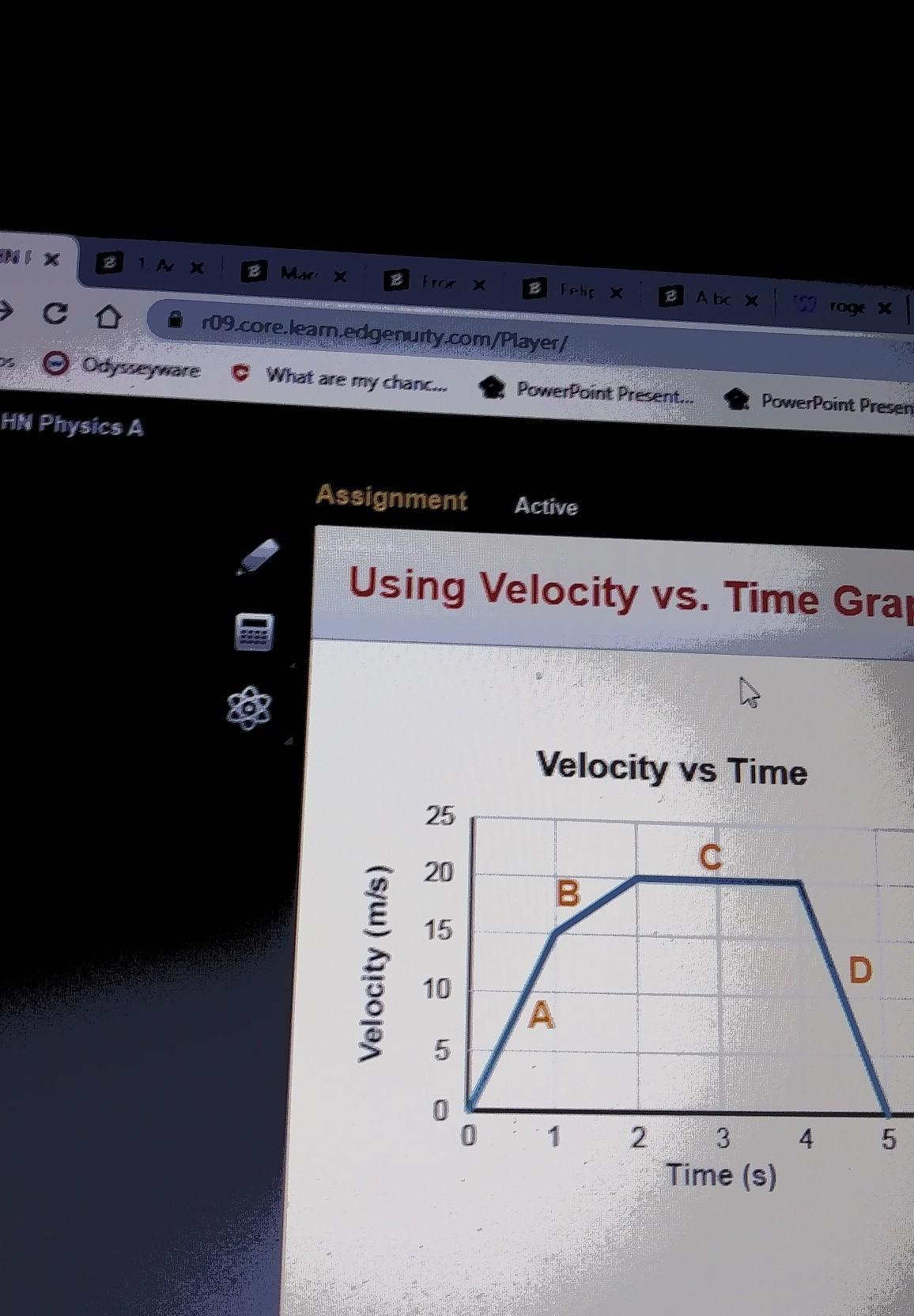
The acceleration of segment D is m/s2. Rank segments A, B , C from least accelerations to greatest acceleration. Least

Physics
2 answers:
Ostrovityanka [2.2K]12 days ago
8 0

Answer:

D, C, B, A

Explanation:

The derivative from a velocity-time graph provides the acceleration value.

Segment A

\frac{dy}{dx} = \frac{15m/s}{1s} = 15m/s^2

Segment B

\frac{dy}{dx} = \frac{5m/s}{1s} = 5m/s^2

Segment C

\frac{dy}{dx} = \frac{0m/s}{2s} = 0m/s^2

Segment D

\frac{dy}{dx} = \frac{-20m/s}{1s} = -20m/s^2

Sorted from the lowest to the highest acceleration:

D, C, B, A

Keith_Richards [2.2K]12 days ago
7 0

Segment D is -20 m/s squared

C

B

A

I concluded this after completing the calculations.

You might be interested in
If the position of an object is zero at one instant, what is true about the velocity of that object?
ValentinkaMS [2425]
If the position of an object is zero at a particular moment, this does not provide any indication about its velocity. It might simply be moving through that point, and you observed it exactly when it was at zero.
6 0
29 days ago
On a hot summer day, you decide to make some iced tea. First, you brew 1.50 LL of hot tea and leave it to steep until it has rea
Yuliya22 [2438]

Explanation:

Please refer to the attachment for the solution.

6 0
10 days ago
A 5.00-A current runs through a 12-gauge copper wire (diameter 2.05 mm) and through a light bulb. Copper has 8.5 * 1028 free ele
Maru [2360]

Answer:

a)n= 3.125 x 10^{19 electrones.

b)J= 1.515 x 10^{6 A/m²

c)V_{d =1.114 x 10^{4m/s

d) ver explicación

Explanation:

La corriente 'I' = 5A =>5C/s

diámetro 'd'= 2.05 x 10^{-3 m

radio 'r' = d/2 => 1.025 x 10^{-3 m

número de electrones 'n'= 8.5 x 10^{28}

a) La cantidad de electrones que pasan por la bombilla cada segundo se determina mediante:

I= Q/t

Q= I x t => 5 x 1

Q= 5C

Como sabemos que: Q= ne

donde e es la carga del electrón, es decir, 1.6 x 10^{-19C

n= Q/e => 5/ 1.6 x 10^{-19

n= 3.125 x 10^{19 electrones.

b) La densidad de corriente 'J' en el cable se calcula como

J= I/A => I/πr²

J= 5 / (3.14 x (1.025x 10^{-3)²)

J= 1.515 x 10^{6 A/m²

c) La velocidad típica 'V_{d' de un electrón se expresa como:

V_{d = \frac{J}{n|q|}

    =1.515 x 10^{6 / 8.5 x 10^{28} x |-1.6 x 10^{-19|

V_{d =1.114 x 10^{4m/s

d) De acuerdo con estas ecuaciones,

J= I/A

V_{d = \frac{J}{n|q|} =\frac{I}{nA|q|}

Si utilizaras un cable de doble diámetro, ¿cuáles de las respuestas anteriores cambiarían? ¿Aumentarían o disminuirían?

5 0
1 month ago
Read 2 more answers
Two planets having equal masses are in circular orbit around a star. Planet A has a smaller orbital radius than planet B. Which
serg [2593]

Answer:

Explanation:

To approach this problem, we need to understand two key concepts.

First, the gravitational force on an object in orbit equals its mass multiplied by centripetal acceleration.

Secondly, Newton's law of universal gravitation defines the force between two masses: Fg = mMG/r², where Fg denotes gravitational force, m and M signify the masses, G represents the gravitational constant, and r indicates the distance separating the two masses.

Thus:

Fg = m v²/r

mMG/r² = m v²/r

v² = MG/r

Potential energy for each planet is expressed as:

PE = mgr = m (MG/r²) r = mMG/r

Kinetic energy for each planet is computed as:

KE = 1/2 mv² = 1/2 m (MG/r) = 1/2 mMG/r

Total mechanical energy is calculated as:

ME = PE + KE = 3/2 mMG/r

Since both planets share the same mass, the only variable is their orbital radius. Consequently, Planet A, with a smaller radius, possesses greater potential, kinetic, and mechanical energy.

6 0
1 month ago
A sculptor has asked you to help electroplate gold onto a brass statue. You know that the charge carriers in the ionic solution
Maru [2360]

Answer:

Explanation:

Amount of gold deposited = 0.5 g

Gold's molar mass = 197 g/mol

Time duration, t = 6 hours

= 6 × 3600

= 12600 s

Calculation of moles: mass/molar mass

= 0.5/197

= 0.00254 mole

Assuming

Au --> Au+ + e-

Faraday's constant = 9.65 x 10^4 C mol-1

Charge, Q = 96500 × 0.00254

= 244.924 C

Relation: Q = I × t

Thus, I = 244.924/12600

= 0.011 A

= 11.34 mA.

6 0
8 days ago
Other questions:
  • 4 A wheel starts from rest and has an angular acceleration of 4.0 rad/s2. When it has made 10 rev determine its angular velocity
    13·1 answer
  • Soot particles ("black carbon aerosols" generally cause ________ of earth's atmosphere by ________ solar energy.
    10·1 answer
  • Reset the PhET simulation (using the button in the lower right) and set it up in the following manner: select Oscillate, select
    15·1 answer
  • "An empty cylindrical barrel is open at one end and rolls without slipping straight down a hill. The barrel has a mass of 19.0 k
    15·1 answer
  • The acceleration of the car with two washers added to the string would be what?
    14·2 answers
  • A spherical balloon has a radius of 6.95m and is filled with helium. The density of helium is 0.179 kg/m3, and the density of ai
    11·1 answer
  • A person holds a 4.0 kg block at position A shown above on the left, in contact with an uncompressed vertical spring with a spri
    9·1 answer
  • In a computer-based experiment to study diffraction, the width of the central diffraction peak is 15.20 mm. The wavelength of th
    6·1 answer
  • A bobsledder pushes her sled across horizontal snow to get it going, then jumps in. After she jumps in, the sled gradually slows
    5·1 answer
  • A rear window defroster consists of a long, flat wire bonded to the inside surface of the window. When current passes through th
    5·2 answers
Add answer
Login
Not registered? Fast signup
Signup
Login Signup
Ask question!