answer.
Ask question
Login Signup
Ask question
All categories
  • English
  • Mathematics
  • Social Studies
  • Business
  • History
  • Health
  • Geography
  • Biology
  • Physics
  • Chemistry
  • Computers and Technology
  • Arts
  • World Languages
  • Spanish
  • French
  • German
  • Advanced Placement (AP)
  • SAT
  • Medicine
  • Law
  • Engineering
wariber
18 days ago
12

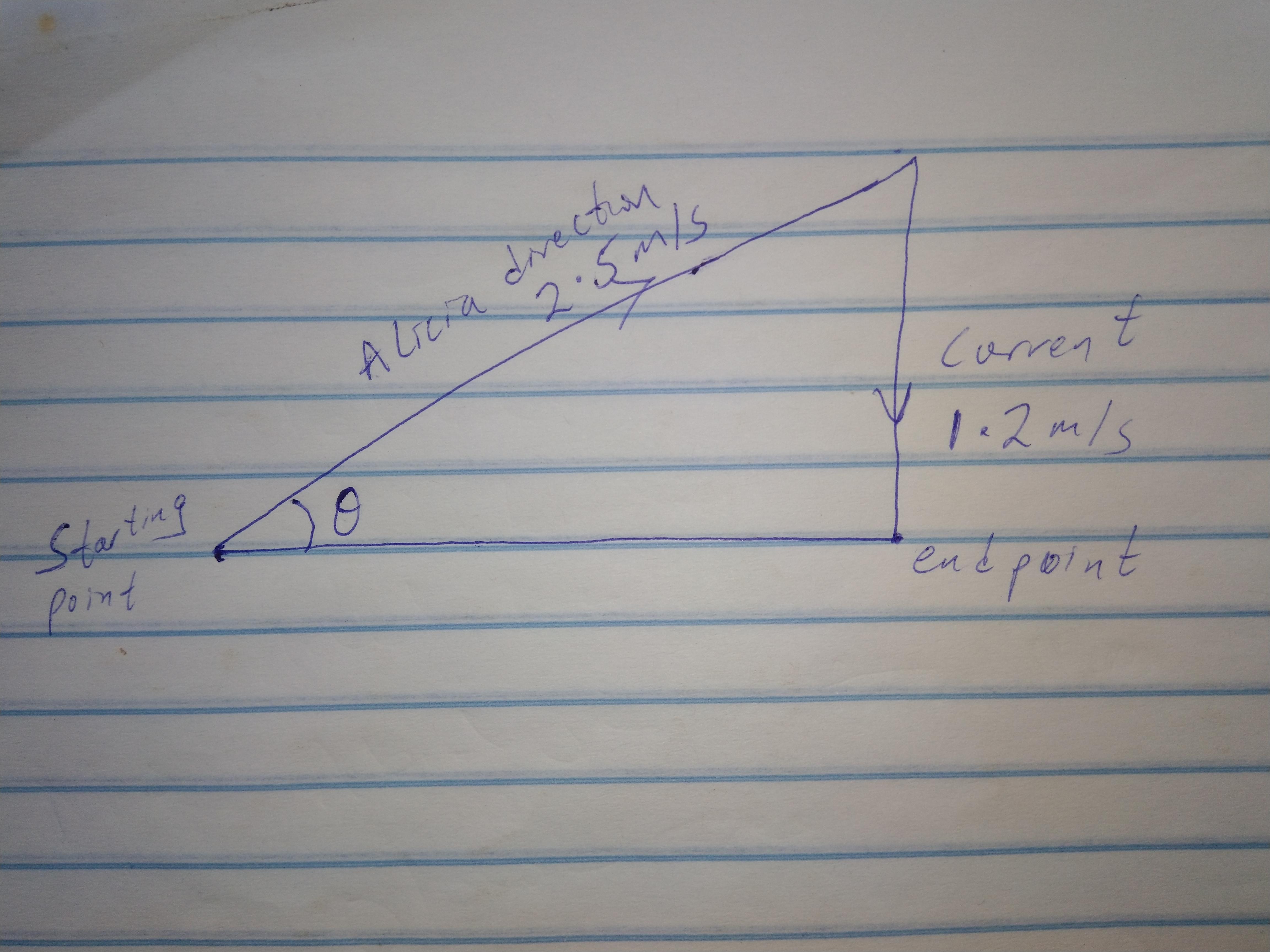
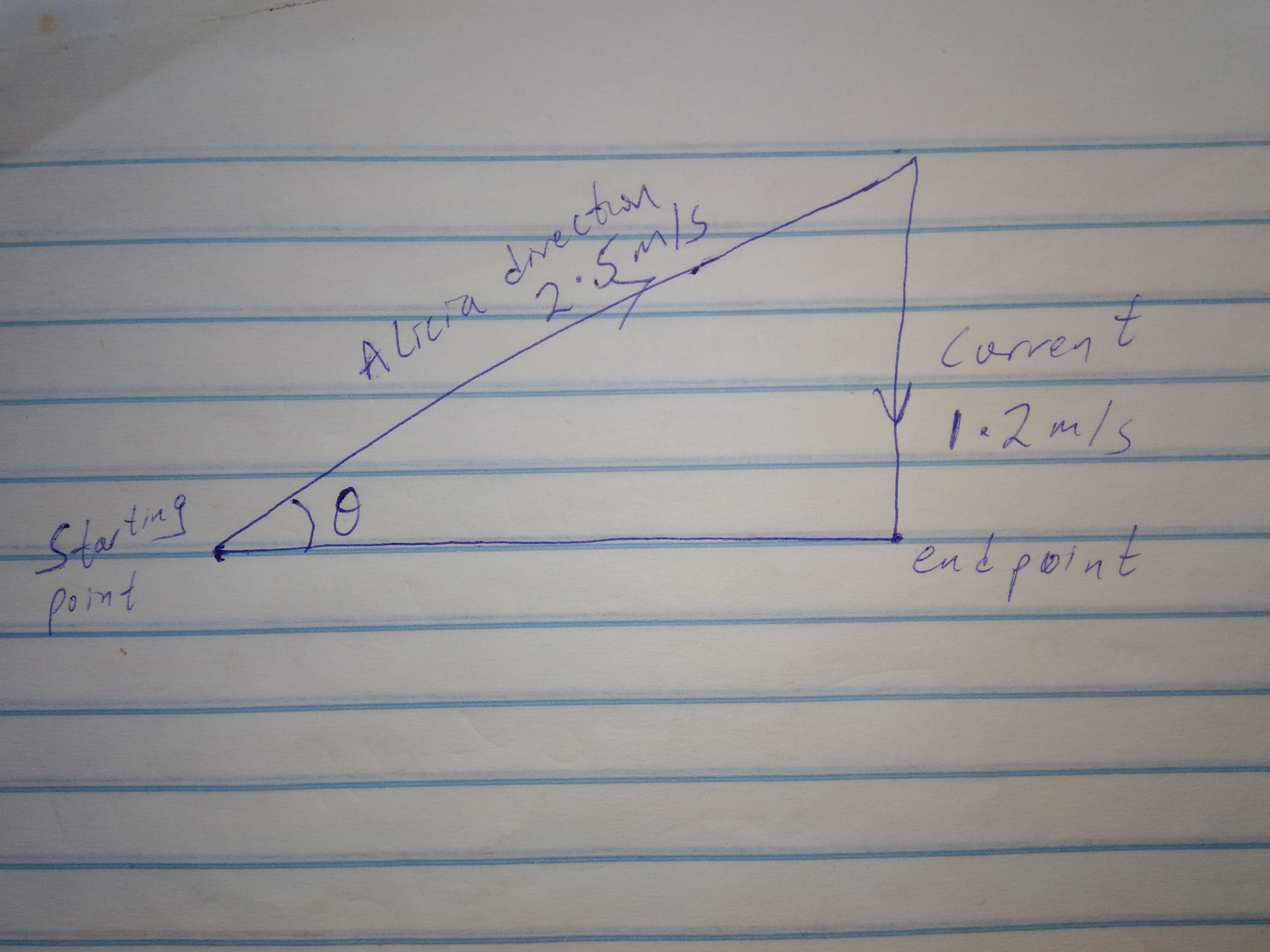
Alicia intends to swim to a point straight across a 100 m wide river with a current that flows at 1.2 m/s. She can swim 2.5 m/s

in still water. At what angle, measured from the upstream direction, must she swim upstream to achieve her goal

Physics
1 answer:
Sav [2.2K]18 days ago
4 0

Answer:

θ = 61.3°

Alicia must swim at an angle of 61.3°

Explanation:

Parameters given include:

Width of the river = 100 m

Alicia's speed in still water = 2.5 m/s

Speed of river's current = 1.2 m/s

The angle she needs to swim can be determined by combining the velocities, taking into account the current's influence.

Her swimming speed aimed against the current must offset the current's velocity;

2.5cosθ - 1.2 = 0

2.5cosθ = 1.2

cosθ = 1.2/2.5

θ = cosinverse(1.2/2.5)

θ = 61.3°

You might be interested in
A locomotive is accelerating at 1.6 m/s2. it passes through a 20.0-m-wide crossing in a time of 2.4 s. after the locomotive leav
kicyunya [2264]

Response:

Once it has crossed, the locomotive requires 17.6 seconds to achieve a speed of 32 m/s.

Details:

  The locomotive's acceleration is 1.6 m/s^2

  The duration taken to pass the crossing is 2.4 seconds.

  We can apply the motion equation, v = u + at, where v represents final velocity, u indicates initial velocity, a denotes acceleration, and t signifies time.

  When the speed reaches 32 m/s, we have v = 32 m/s, u = 0 m/s, and a= 1.6 m/s^2.

   32 = 0 + 1.6 * t

    t = 20 seconds.

  Therefore, the locomotive attains a speed of 32 m/s after 20 seconds, and it passes the crossing in 2.4 seconds.

Thus, after clearing the crossing, it takes an additional 17.6 seconds to reach the speed of 32 m/s.

6 0
26 days ago
Read 2 more answers
A supersonic nozzle is also a convergent–divergent duct, which is fed by a large reservoir at the inlet to the nozzle. In the re
Softa [2035]

Answer:

155.38424 K

2.2721 kg/m³

Explanation:

P_1 = Reservoir pressure = 10 atm

T_1 = Reservoir temperature = 300 K

P_2 = Exit pressure = 1 atm

T_2 = Exit temperature

R_s = Specific gas constant = 287 J/kgK

\gamma = Specific heat ratio = 1.4 for air

Assuming isentropic flow

\frac{T_2}{T_1}=\frac{P_2}{P_1}^{\frac{\gamma-1}{\gamma}}\\\Rightarrow T_2=T_1\times \frac{P_2}{P_1}^{\frac{\gamma-1}{\gamma}}\\\Rightarrow T_2=00\times \left(\frac{1}{10}\right)^{\frac{1.4-1}{1.4}}\\\Rightarrow T_2=155.38424\ K

Flow temperature at exit is 155.38424 K

Density at exit can be derived using the ideal gas equation

\rho_2=\frac{P_2}{R_sT_2}\\\Rightarrow \rho=\frac{1\times 101325}{287\times 155.38424}\\\Rightarrow \rho=2.2721\ kg/m^3

Flow density at exit measures 2.2721 kg/m³

4 0
1 month ago
The acceleration of segment D is m/s2. Rank segments A, B , C from least accelerations to greatest acceleration. Least
Ostrovityanka [2208]

Answer:

D, C, B, A

Explanation:

The derivative from a velocity-time graph provides the acceleration value.

Segment A

\frac{dy}{dx} = \frac{15m/s}{1s} = 15m/s^2

Segment B

\frac{dy}{dx} = \frac{5m/s}{1s} = 5m/s^2

Segment C

\frac{dy}{dx} = \frac{0m/s}{2s} = 0m/s^2

Segment D

\frac{dy}{dx} = \frac{-20m/s}{1s} = -20m/s^2

Sorted from the lowest to the highest acceleration:

D, C, B, A

8 0
12 days ago
Read 2 more answers
A 5.8 × 10⁴-watt elevator motor can lift a total weight of 2.1 × 10⁴ newtons with a maximum constant speed of
Keith_Richards [2263]
Power is defined as the speed at which work is performed on an object. Like all rates, power is measured in relation to time. It reflects how quickly a task is completed. Two identical tasks can be executed at varying speeds - one slower and the other faster. The equation P = Fv can be used, where P symbolizes power, F denotes force, and V represents average velocity. Calculating the average velocity gives us V = P/F, or V = (5.8 x 10^4 W) / (2.1 x 10^4 N), resulting in V = 2.8 m/s.
8 0
1 month ago
Derive an algebraic equation for the vertical force that the bench exerts on the book at the lowest point of the circular path i
Keith_Richards [2263]

a)

i) 120 s

ii) 1.57 m/s

b)

i) Refer to the attached diagram

ii) Up

c) N=mg+m\frac{v_b^2}{R}

d) Greater than

Explanation:

The problem does not provide full details: consult the attachments for the complete text.

a)

The revolution period of the book equals the total duration needed for the book to make one full revolution.

By examining the graph, we can approximate the revolution period by calculating the time difference between two successive points of the book's motion that share the same shape.

We could use the time difference between two adjacent crests to estimate the period. The first crest is observed at t = 90 s, and the following crest appears at t = 210 s.

This results in the revolution period being

T = 210 - 90 = 120 s

ii)

The tangential speed of the book is computed as the ratio of the distance traveled over one revolution (i.e., the circumference of the wheel) to the revolution period.

Mathematically:

v_b=\frac{2\pi R}{T}

where

R represents the wheel radius

T = 120 s indicates the period

Based on the graph, the book reaches a maximum at x = +30 m and a minimum at x = -30 m, giving the diameter of the wheel as

d = +30 - (-30) = 60 m

This means the radius calculates to

R = d/2 = 30 m

So, the final speed is

v_b=\frac{2\pi (30)}{120}=1.57 m/s

b)

i) Please consult the attached free-body diagram for the book when at its lowest point.

Two forces act on the book at the lowest position:

- The weight of the book, represented as

W=mg

where m denotes the book's mass and g stands for gravitational acceleration. This force functions downward.

- The normal force the bench exerts on the book is represented by N. This force acts upward.

ii)

While at its lowest position, the book maintains a horizontal motion at constant speed.

Nevertheless, the book is undergoing acceleration. Acceleration is defined as the rate of velocity change, which is vectorial, having both speed and direction. While the speed remains unchanged, the direction changes (upward), indicating the book has upward net acceleration.

According to Newton's second law, the net vertical force acting on the book corresponds with the vertical acceleration:

F=ma

where F = net force, m = mass, a = acceleration. Thus, if a is non-zero, the upward net force must exist in line with the direction of the acceleration.

c)

As discussed in part b), there are two forces influencing the book at the lowest point:

- The weight, W=mg, directed downward

- The normal force from the bench, N, directed upward

Given that the book is in uniform circular motion, the net force must match the centripetal force m\frac{v_b^2}{R}, leading us to the equation:

N-mg=m\frac{v_b^2}{R}

where

v_b represents the speed of the book

R stands for the radius of the circular path.

We derive an expression for the normal force:

N=mg+m\frac{v_b^2}{R}

d)

As per the discussions in parts c) and d):

- The normal force acting on the book at its lowest point becomes

N=mg+m\frac{v_b^2}{R}

- The weight (gravitational force) of the book is

W=mg

Upon comparing these two equations, we conclude:

N>W

Thus, it is evident that the normal force exerted by the bench exceeds the weight of the book.

4 0
1 month ago
Other questions:
  • The magnitude of the Poynting vector of a planar electromagnetic wave has an average value of 0.939 W/m2. The wave is incident u
    15·1 answer
  • An infinitely long cylinder of radius R has linear charge density λ. The potential on the surface of the cylinder is V0, and the
    9·1 answer
  • HELP ASAP! GIVING BRAINLIEST!
    13·2 answers
  • A thin electrical heating element provides a uniform heat flux qo" to the outer surface of a duct through which air flows. The d
    7·1 answer
  • Which occurrence would contradict the big bang theory?
    14·2 answers
  • John is going to use a rope to pull his sister Laura across the ground in a sled through the snow. He is pulling horizontally wi
    13·1 answer
  • A 70kg man spreads his legs as shown calculate the tripping force​
    6·1 answer
  • A strip 1.2 mm wide is moving at a speed of 25 cm/s through a uniform magnetic field of 5.6 t. what is the maximum hall voltage
    11·1 answer
  • A rod 12.0 cm long is uniformly charged and has a total charge of -20.0 µc. determine the magnitude and direction of the electri
    9·2 answers
  • You are waiting to turn left into a small parking lot. a car approaching from the opposite direction has a turn signal on. you s
    14·1 answer
Add answer
Login
Not registered? Fast signup
Signup
Login Signup
Ask question!