answer.
Ask question
Login Signup
Ask question
All categories
  • English
  • Mathematics
  • Social Studies
  • Business
  • History
  • Health
  • Geography
  • Biology
  • Physics
  • Chemistry
  • Computers and Technology
  • Arts
  • World Languages
  • Spanish
  • French
  • German
  • Advanced Placement (AP)
  • SAT
  • Medicine
  • Law
  • Engineering
lana66690
11 days ago
10

A block moves at 5 m/s in the positive x direction and hits an identical block, initially at rest. A small amount of gunpowder h

ad been placed on one of the blocks. The explosion does not harm the blocks but it doubles their total kinetic energy. After the explosion the blocks move along the x axis and the incident block?

Physics
1 answer:
Yuliya22 [2.4K]11 days ago
6 0

Answer:

Speeds of 1.83 m/s and 6.83 m/s

Explanation:

Based on the law of conservation of momentum,

mv_o=m(v_1 + v_2)where m represents mass, v_o is the initial speed before impact, v_1 and v_2 are the velocities of the impacted object after the collision and of the originally stationary object after the impact.

5m=m(v_1 +v_2)

Thus, v_1+v_2=5

After the collision, the kinetic energy doubles, therefore:

2m*(0.5mv_o)=0.5m(v_1^{2}+v_2^{2})

2v_o^{2}=v_1^{2} + v_2^{2}

Substituting the initial velocity of 5 m/s provides the equation needed to proceed.v_o

2*(5^{2})= v_1^{2} + v_2^{2}We know that v_1+v_2=5 leads to v_1=5-v_2

50=(5-v_2)^{2}+ v_2^{2}

50=25+v_2^{2}-10v_2+v_2^{2}

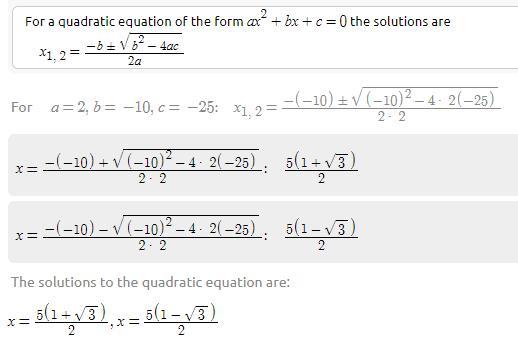
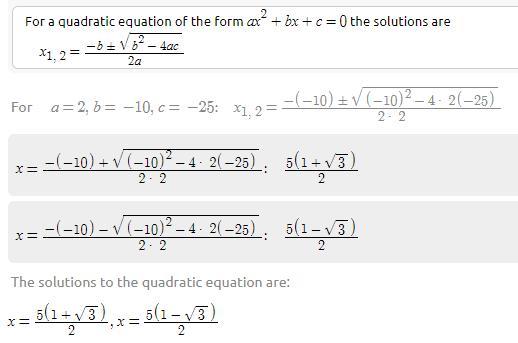
2v_2^{2}-10v_2-25=0

Using the quadratic formula leads us to solve for the speeds after the explosion, specifically where a=2, b=-10, and c=-25. v_2=6.83 m/s

By substituting the values, the solution yields results for the speeds of the blocks, which are ultimately 1.83 m/s and 6.83 m/s.
You might be interested in
Steel blocks A and B, which have equal masses, are at TA = 300 oC and T8 = 400 oC. Block C, with mc - 2mA, is at TC = 350 oC. Bl
serg [2593]

Answer:

b) TA = TB = TC

Explanation:

  • When the blocks are brought into contact and isolated from the environment, they will exchange heat until they achieve thermal equilibrium.
  • During this exchange, the hotter body will lose heat, which will be gained by the cooler body.
  • The equilibrium state will be established once this equation is satisfied:

       \Delta Q = c_{st}* m_{A} * (T_{fin} - T_{0A} ) = c_{st}* m_{B} * (T_{0B} - T_{fin} )

  • Substituting the initial temperatures T₀A = 300º C and T₀B = 400ºC, while simplifying for equal block masses mA = mB, enables us to solve for the final temperature, Tfin:

       (400 \ºC - T_{fin}) = (T_{fin} - 300 \ºC) \\ \\ 2* T_{fin} = 700\ºC\\ \\ T_{fin} = 350\ºC

  • At equilibrium, when both blocks combine, they will yield a uniform final temperature of 350ºC.
  • When block C, also at this temperature, makes contact, all three blocks will simultaneously reflect this final temperature of 350 ºC.
  • Therefore, option b) is correct.
8 0
26 days ago
A 50-g cube of ice, initially at 0.0°C, is dropped into 200 g of water in an 80-g aluminum container, both initially at 30°C.
Ostrovityanka [2204]

Answer:

b. 9.5°C

Explanation:

m_i = Ice mass = 50 g

T_i = Initial temperature of water and aluminum = 30°C

L_f = Latent heat of fusion = 3.33\times 10^5\ J/kg^{\circ}C

m_w = Water mass = 200 g

c_w = Water's specific heat = 4186 J/kg⋅°C

m_{Al} = Aluminum mass = 80 g

c_{Al} = Aluminum's specific heat = 900 J/kg⋅°C

The equation governing heat exchange in the system is presented by

m_i(L_f+c_wT)+m_wc_w(T-T_i)+m_{Al}c_{Al}=0\\\Rightarrow 0.05\times (3.33\times 10^5+4186\times T)+0.2\times 4186(T-30)+0.08\times 900(T-30)=0\\\Rightarrow 1118.5T-10626=0\\\Rightarrow T=\dfrac{10626}{1118.5}\\\Rightarrow T=9.50022\ ^{\circ}C

The final equilibrium temperature calculates to 9.50022°C

4 0
29 days ago
two kittens are on opposite sides of a field, 250 m apart. kitten the runs at a constant speed of 25 m/s due east on a collision
ValentinkaMS [2425]

Set the initial location of kitten A on the left side of the field (designated as point A) at the origin, running east which is the positive direction. Kitten B starts at position {x_B}_0=250\,\mathrm m, while kitten A’s beginning spot is {x_A}_0=0\,\mathrm m.

Kitten A moves with a velocity of v_A=25\,\dfrac{\mathrm m}{\mathrm s}, and kitten B with v_B=-12\,\dfrac{\mathrm m}{\mathrm s}. Their positions over time are described by

x_A=\left(25\,\dfrac{\mathrm m}{\mathrm s}\right)t

x_B=250\,\mathrm m+\left(-12\,\dfrac{\mathrm m}{\mathrm s}\right)t

The collision occurs when the positions are the same, i.e. when x_A=x_B. Solving this gives

\left(25\,\dfrac{\mathrm m}{\mathrm s}\right)t=250\,\mathrm m+\left(-12\,\dfrac{\mathrm m}{\mathrm s}\right)t

\implies\left(37\,\dfrac{\mathrm m}{\mathrm s}\right)t=250\,\mathrm m

\implies t=\dfrac{250\,\mathrm m}{37\,\frac{\mathrm m}{\mathrm s}}=6.76\,\mathrm s

Which results in approximately 6.8 seconds, considering significant figures.

3 0
1 month ago
A 1.47-newton baseball is dropped from a height of 10.0 meters and falls through the air to the ground. The kinetic energy of th
Sav [2217]

Answer:

The peak mechanical energy transformed into internal energy throughout the descent is 26.7 joules.

Explanation:

Potential Energy (PE) is calculated as the weight of the baseball multiplied by the height, which gives us 1.47N × 10m = 14.7Nm or 14.7 joules.

The kinetic energy (KE) is recorded as 12 joules.

The maximum mechanical energy that converts to internal energy during the fall can be expressed as PE + KE = 14.7 joules + 12 joules = 26.7 joules.

8 0
26 days ago
Read 2 more answers
A steel guitar string with a diameter of 0.300 mm and a length of 70.0 cm is stretched by 0.500 mm while being tuned. How much f
Softa [2029]

Answer:

The required force to stretch the steel guitar string by 0.500 mm is 10.1 N

Explanation:

The steel guitar string diameter is 0.300 mm and its length measures 70.0 cm. To calculate the force required for the specified elongation using Young's modulus, one would apply the relevant formulas, yielding 10.1 N.

8 0
8 days ago
Other questions:
  • Uzupełnij zdania właściwymi sformułowaniami. Wyobraź sobie, że między linę a siodełko karuzeli łańcuchowej wmontowany jest siłom
    8·1 answer
  • The loudness of a sound is inversely proportional to the square of your distance from the source of the sound. if your friend is
    12·2 answers
  • Compare the momentum of a 6,300-kg elephant walking 0.11 m/s and a 50-kg dolphin swimming 10.4 m/s. your answer
    9·1 answer
  • A bus took 8 hours to travel 639 km. For the first 5 hours, it
    5·1 answer
  •  A bartender slides a beer mug at 1.50 m/s toward a customer at the end of a frictionless bar that is 1.20 m tall. The customer
    7·1 answer
  • A 600 kg car is at rest, and then accelerates to 5 m/s.
    10·1 answer
  • Which statements correctly describe forces? Check all that apply.
    10·2 answers
  • A box weighing 46 newtons rests on an incline that makes an angle of 25° with the horizontal. What is the magnitude of the compo
    5·1 answer
  • An isolated charged point particle produces an electric field with magnitude E at a point 2 m away. At a point 1 m from the part
    7·1 answer
  • A rod 12.0 cm long is uniformly charged and has a total charge of -20.0 µc. determine the magnitude and direction of the electri
    9·2 answers
Add answer
Login
Not registered? Fast signup
Signup
Login Signup
Ask question!
