Answer:
Below is the code relevant to this question:
n=input("Enter the first 12 digits of an ISBN-13 as a string:")#this defines isbn as the input variable
if len(n)!=12: #this if statement checks if the input is 12 digits long
print("incorrect input") #outputs an error message
elif n.isdigit()==False: #this else if statement checks if the input is all digits
print("incorrect input") #outputs an error message
else:#defining the else block
s=0 #initializes the integer variable s to 0
for i in range(12):#a loop to sum the input digits
if i%2==0: #checks if the index is even
s=s+int(n[i])#adds even digits to s
else: #this else block handles odd indices
s=s+int(n[i])*3 #adds odd digits multiplied by 3 to s
s=s%10#calculates the remainder
s=10-s#finds the complement of the remainder
if s==10: #checks if s equals 10
s=0#sets s to zero if the condition is met
n=n+s.__str__() #final output is generated
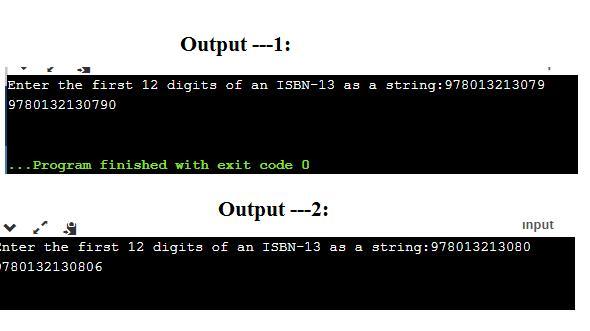
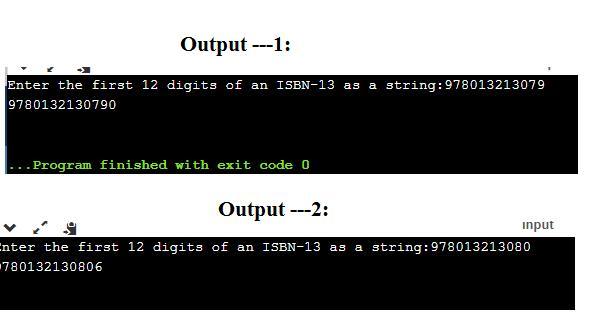
Output:
please find attached file.
Explanation:The Python code above uses the variable "n" to accept user input as a string and utilizes conditional statements to validate the input length and composition, as outlined below:
- The if block verifies that the length is exactly 12; if it isn't, an error message will be displayed.
- The else if block checks if the input is numeric; if it's not, an error notification is printed.
- In the else block, a for loop computes the sum for even and odd index digits (with odd index digits being multiplied by 3), which are then added to the variable s.
- Finally, the remainder is calculated and adjusted based on whether it equals 10; if true, a 0 is appended to n, or else, the calculated value is used.