answer.
Ask question
Login Signup
Ask question
All categories
  • English
  • Mathematics
  • Social Studies
  • Business
  • History
  • Health
  • Geography
  • Biology
  • Physics
  • Chemistry
  • Computers and Technology
  • Arts
  • World Languages
  • Spanish
  • French
  • German
  • Advanced Placement (AP)
  • SAT
  • Medicine
  • Law
  • Engineering
morpeh
17 days ago
5

When the volume of gas is changed from 3.75 to 6.52 L , the temperature will change from 100.0 K to how many k?

Chemistry
1 answer:
eduard [2.4K]17 days ago
3 0

Greetings!

We are dealing with an isobaric transformation, which involves a mass under pressure that retains a consistent pressure; as the temperature rises, the volume enlarges, and conversely, as the temperature lowers, the volume contracts and vice versa.

Here are the pertinent values:

V1 (initial volume) = 3.75 L

V2 (final volume) = 6.52 L

T1 (initial temperature) = 100 K

T2 (final temperature) =? (in Kelvin)

We'll apply the given values to the isobaric transformation formula (Gay-Lussac), check it out:

\dfrac{V_1}{T_1} =\dfrac{V_2}{T_2}

\dfrac{3.75}{100} =\dfrac{6.52}{T_2}

3.75*T_2 = 100*6.52

3.75\:T_2 = 652

T_2 = \dfrac{652}{3.75}

\boxed{\boxed{T_2 \approx 173.86\:K}}\Longleftarrow(final\:temperature)\end{array}}\qquad\checkmark

I hope this is useful, regards... DexteR! =)

You might be interested in
What volume of gold would be equal in mass to a piece of copper with a volume of 141 ml? the density of gold is 19.3 g/ml; the d
alisha [2704]

We need to calculate the volume of Gold, assuming its mass matches that of copper.

Given information:

Density of Copper = 8.96 g/ml.
Volume of Copper = 141 ml.
Mass of Gold = Mass of Copper.
Density of Gold = 19.3 g/ml.

To find copper's mass, we use the density equation:
Density = mass/volume.

To find mass of copper:
Mass of copper = Density of Copper * Volume of Copper.
Mass of copper = 8.96 g/ml * 141 ml = 1263.36 g.
Thus,
Mass of gold = Mass of copper = 1263.36 g.
Now, using the density formula for gold to get its volume:
Volume of gold = Mass of gold / Density of gold.
Volume of gold = 1263.36 g / 19.3 g/ml = 65.46 mL.

Consequently, the volume of gold required to match the mass of copper is 65.46 mL.

8 0
1 month ago
Neither dry soil nor pure water conducts electricity. But wet soil will conduct electricity. Explain why this happens?
Alekssandra [2685]

Pure water lacks sufficient ions to conduct electricity. However, when metals like iron, zinc, and copper are present in moist soil, they can instigate electrolysis, which necessitates excess energy due to limited water's self-ionization. Consequently, wet soil can carry current as long as there are positive and negative ions. Water ions travel from the anode (positive side) to the cathode (negative side) to be oxidized and generate electricity.

<span> </span>

4 0
12 days ago
How many grams of mercury are present in a barometer that holds 6.5mL of mercury? ...?
alisha [2704]
<span>13.6
grams of mercury are present in a barometer that holds
per milliliter.
13.6*6.5 = 88.4</span>
3 0
1 month ago
Read 2 more answers
A 500 mL sample of a 0.100 M formate buffer, pH 3.75, is treated with 5 mL of 1.00 M KOH. What is the pH following this addition
lions [2629]

Answer: The solution's pH post KOH addition is 3.84

Explanation:

Given information:

pH of buffer = 3.75

pK_a of formic acid = 3.75

Employing the Henderson-Hasselbalch equation for formate buffer:

pH=pK_a+\log(\frac{[HCOO-]}{[HCOOH]})

Substituting values into the above equation yields:

3.75=3.75+\log(\frac{[HCOO-]}{[HCOOH]})\\\\\log(\frac{[HCOO-]}{[HCOOH]})=0\\\\\frac{[HCOO-]}{[HCOOH]}=1

[HCOO-]=[HCOOH]

Additional given information:

Concentration of formate buffer = 0.100 M

[HCOO-]+[HCOOH]=0.1

[HCOO-]=[HCOOH]=0.05M

As the buffer volume remains constant, the concentration reflects the moles of formate ions and formic acid.

To find the number of moles based on the specified molarity, utilize the following equation:

\text{Molarity of the solution}=\frac{\text{Moles of solute}\times 1000}{\text{Volume of solution (in mL)}}

Molarity of KOH = 1.00 M

Volume of solution = 5 mL

Incorporating these values into the equation gives:

1.00M=\frac{\text{Moles of KOH}\times 1000}{5mL}\\\\\text{Moles of KOH}=0.005mol

The reaction between formic acid and KOH can be represented as:

                  HCOOH+KOH\rightarrow HCOO^-+H_2O

Initial:       0.05    0.005               0.05

Final:         0.045          -                0.055          

The total volume of solution = 500 + 5 = 505 mL = 0.505 L    (Note:  1 L = 1000 mL)

To determine the pH of the acidic buffer, we can use the provided equation from the Henderson Hasselbalch:

pH=pK_a+\log(\frac{[salt]}{[acid]})

pH=pK_a+\log(\frac{[HCOO^-]}{[HCOOH]})

Given information:

pK_a = the negative logarithm of formic acid's dissociation constant = 3.75

[HCOO^-]=\frac{0.055}{0.505}

[HCOOH]=\frac{0.045}{0.505}

pH =?

Substituting values into the equation results in:

pH=3.75+\log(\frac{0.055/0.505}{0.045/0.505})\\\\pH=3.84

Consequently, the pH of the solution following KOH addition is 3.84

3 0
1 month ago
Determine the quantity (g) of pure CaCl2 in 7.5 g of CaCl2•9H2O. Show your work.
eduard [2491]
The amount of pure CaCl_2 present in 7.5 g of CaCl_2.9H_2O equals 3.0 g.
3 0
17 days ago
Other questions:
  • Write the chemical formula for iridium(III) nitride?
    12·1 answer
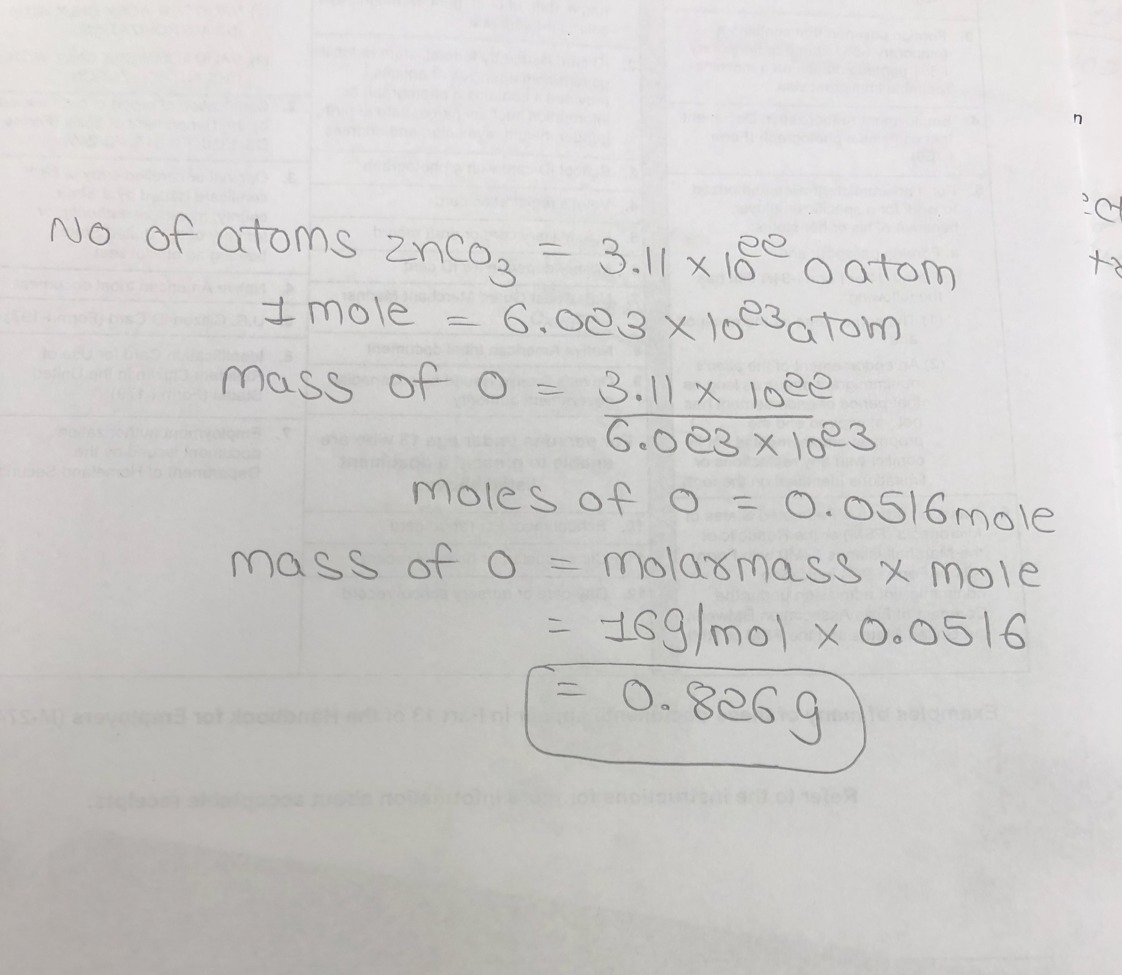
  • An oxygen atom has a mass of and a glass of water has a mass of . Use this information to answer the question below. Be sure you
    11·1 answer
  • A 25.0 g sample of an alloy was heated to 100.0 oC and dropped into a beaker containing 90 grams of water at 25.32 oC. The tempe
    10·1 answer
  • 6.An acid-base indicator is usually a weak acid with a characteristic color in the protonated and deprotonated forms. Because br
    14·1 answer
  • A 0.89% (w/v) sodium chloride solution is referred to as physiological saline solution because it has the same concentration of
    14·1 answer
  • A researcher wants to show the effects of slight changes in pH on the reproductive rates of fish in a lake. Why would a table be
    12·2 answers
  • The ideal gas law tends to become inaccurate when Group of answer choices the pressure is raised and the temperature is lowered.
    5·1 answer
  • H2PO4-(aq) ⇆ H+(aq) + HPO42-( which ion plays the role of hydrogen ion donor and which one plays the hydrogen ion acceptor in BP
    14·1 answer
  • One hour of bicycle riding can require 500-900 kcal of energy, depending on the speed, the terrain, and the weight of the racer.
    14·1 answer
  • A 25.0-mL sample of a 1.20 M potassium chloride solution is mixed with 15.0 mL of a 0.900 M lead(II) nitrate solution and this p
    12·1 answer
Add answer
Login
Not registered? Fast signup
Signup
Login Signup
Ask question!