answer.
Ask question
Login Signup
Ask question
All categories
  • English
  • Mathematics
  • Social Studies
  • Business
  • History
  • Health
  • Geography
  • Biology
  • Physics
  • Chemistry
  • Computers and Technology
  • Arts
  • World Languages
  • Spanish
  • French
  • German
  • Advanced Placement (AP)
  • SAT
  • Medicine
  • Law
  • Engineering
Shalnov
6 days ago
14

A four-cylinder, four-stroke internal combustion engine has a bore of 3.7 in. and a stroke of 3.4 in. The clearance volume is 16

% of the cylinder volume at bottom dead center and the crankshaft rotates at 2400 RPM. The processes within each cylinder are modeled as an air-standard Otto cycle with a pressure of 14.5 lbf/in. 2 and a temperature of 60 8 F at the beginning of compression. The maximum temperature in the cycle is 5200 8 R.
Based on this model,
1- Write possible Assumptions no less than three assumptions
2- Draw clear schematic for this problem
3- Determine possible Assumptions no less than three assumptions
4- Draw clear schematic for this problem.
5- calculate the net work per cycle, in Btu, and the power developed by the engine, in horsepower.

Engineering
1 answer:
iogann1982 [279]6 days ago
8 0
1) The three possible assumptions are

a) All processes are internally reversible

b) Air, as the working fluid, circulates in a closed-loop

cycle

c) Combustion is represented as a heat-adding process

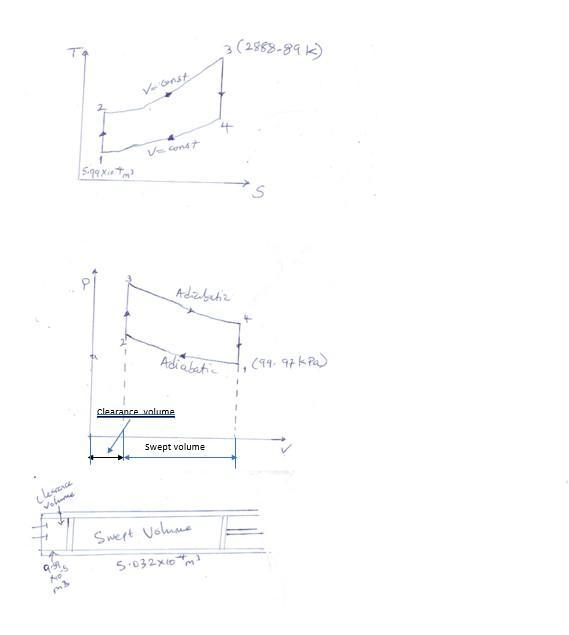
2) Diagrams are included

5) The net work per cycle is 845.88 kJ/kg

The horsepower produced is approximately 45374 hP

Explanation:

1) The three valid assumptions are

a) All processes are internally reversible

b) Air, the working fluid, moves continuously in a closed-loop

cycle

c) The combustion process is set as a heat addition step

2) Diagrams for illustration are provided

5) The cylinder bore diameter measures 3.7 in., equating to 0.09398 m

The stroke length is 3.4 in., approximately 0.08636 m.

The cylinder volume is calculated as v₁= 0.08636 ×(0.09398²)/4 = 5.99×10⁻⁴ m³

The clearance volume amounts to 16% of the cylinder volume = 0.16×5.99×10⁻⁴ m³

The clearance volume, v₂  is 9.59 × 10⁻⁵ m³

p₁ is 14.5 lbf/in.² = 99973.981 Pa

T₁ equals 60 F = 288.706 K

\dfrac{T_{2}}{T_{1}} = \left (\dfrac{v_{1}}{v_{2}} \right )^{K-1}

For the Otto cycle's T-S diagram,

T₂ calculates to 288.706*6.25^{0.393} = 592.984 K

The peak temperature is T₃ = 5200 R = 2888.89 K

\dfrac{T_{3}}{T_{4}} = \left (\dfrac{v_{4}}{v_{3}} \right )^{K-1}

T₄ resolves to 2888.89 / 6.25^{0.393} = 1406.5 K

Work performed, W = c_v×(T₃ - T₂) - c_v×(T₄ - T₁)

0.718×(2888.89  - 592.984) - 0.718×(1406.5 - 288.706) = 845.88 kJ/kg

The power generated in the Otto cycle = W×Cycle per second

= 845.88 × 2400 / 60  = 33,835.377 kW = 45373.99 ≈ 45374 hP.
You might be interested in
A manometer measures a pressure difference as 40 inches of water. Take the density of water to be 62.4 lbm/ft3.What is this pres
mote1985 [204]

Answer:

1.444 psi

Explanation:

5 0
1 month ago
All MOS devices are subject to damage from:________
Viktor [230]

Answer:

d. all of these

Explanation:

Electrostatic discharge typically generates a high voltage in a localized area, leading to increased current and heat. It can create craters in an MOS device, damage bond wires, or result in other forms of impairment. Essentially, MOS devices are vulnerable to harm from "all of these."

6 0
22 days ago
Consider a rectangular fin that is used to cool a motorcycle engine. The fin is 0.15m long and at a temperature of 250C, while t
Kisachek [217]

Answer:

q' = 5826 W/m

Explanation:

Given:-

- The length of the fin in question, L = 0.15 m

- The fin's surface temperature, Ts = 250°C

- The velocity of free stream air, U = 80 km/h

- The air temperature, Ta = 27°C

- The flow is parallel over both sides of the fin, assuming turbulent flow conditions throughout.

Find:-

What is the heat removal rate per unit width of the fin?

Solution:-

- Steady state conditions are assumed, along with negligible radiation and turbulent flow conditions.

- From Table A-4, we gather air properties (T = 412 K, P = 1 atm ):

    Dynamic viscosity, v = 27.85 * 10^-6 m²/s  

    Thermal conductivity, k = 0.0346 W / m.K

    Prandtl number Pr = 0.69

- Compute the Nusselt Number (Nu) corresponding to - turbulent conditions - using the relevant relationship as follows:

                          Nu = 0.037*Re_L^\frac{4}{5} * Pr^\frac{1}{3}

Where,    Re_L: Average Reynolds number for the entire length of fin:

                          Re_L = \frac{U*L}{v} \\\\Re_L = \frac{80*\frac{1000}{3600} * 0.15}{27.85*10^-^6} \\\\Re_L = 119688.80909

Consequently,


Nu = 0.037*(119688.80909)^\frac{4}{5} * 0.69^\frac{1}{3}\\\\Nu = 378

- The convective heat transfer coefficient (h) can now be derived from:

                          h = \frac{k*Nu}{L} \\\\h = \frac{0.0346*378}{0.15} \\\\h = 87 \frac{W}{m^2K}

- The heat loss rate q' per unit width can be established using the convection heat transfer formula and should be multiplied by (x2) since the airflow is present on both sides of the fin:

                          q' = 2*[h*L*(T_s - T_a)]\\\\q' = 2*[87*0.15*(250 - 27)]\\\\q' = 5826\frac{W}{m}

- Ultimately, the heat loss per unit width from the rectangular fin is q' = 5826 W/m

- The thermal loss per unit width (q') attributed to radiation:

                  q' = 2*a*T_s^4*L

Where, a signifies the Stefan-Boltzmann constant = 5.67*10^-8

                  q' = 2*5.67*10^-^8*(523)^4*0.15\\\\q' = 1273 \frac{W}{m}

- It is observed that radiation losses are not insignificant, accounting for 20% of thermal loss by convection. As the emissivity (e) of the fin is unspecified, this value is dismissed from the calculations as it pertains to the provided information.

7 0
4 days ago
An air duct heater consists of an aligned array of electrical heating elements in which the longitudinal and transverse pitches
Kisachek [217]

Answer:

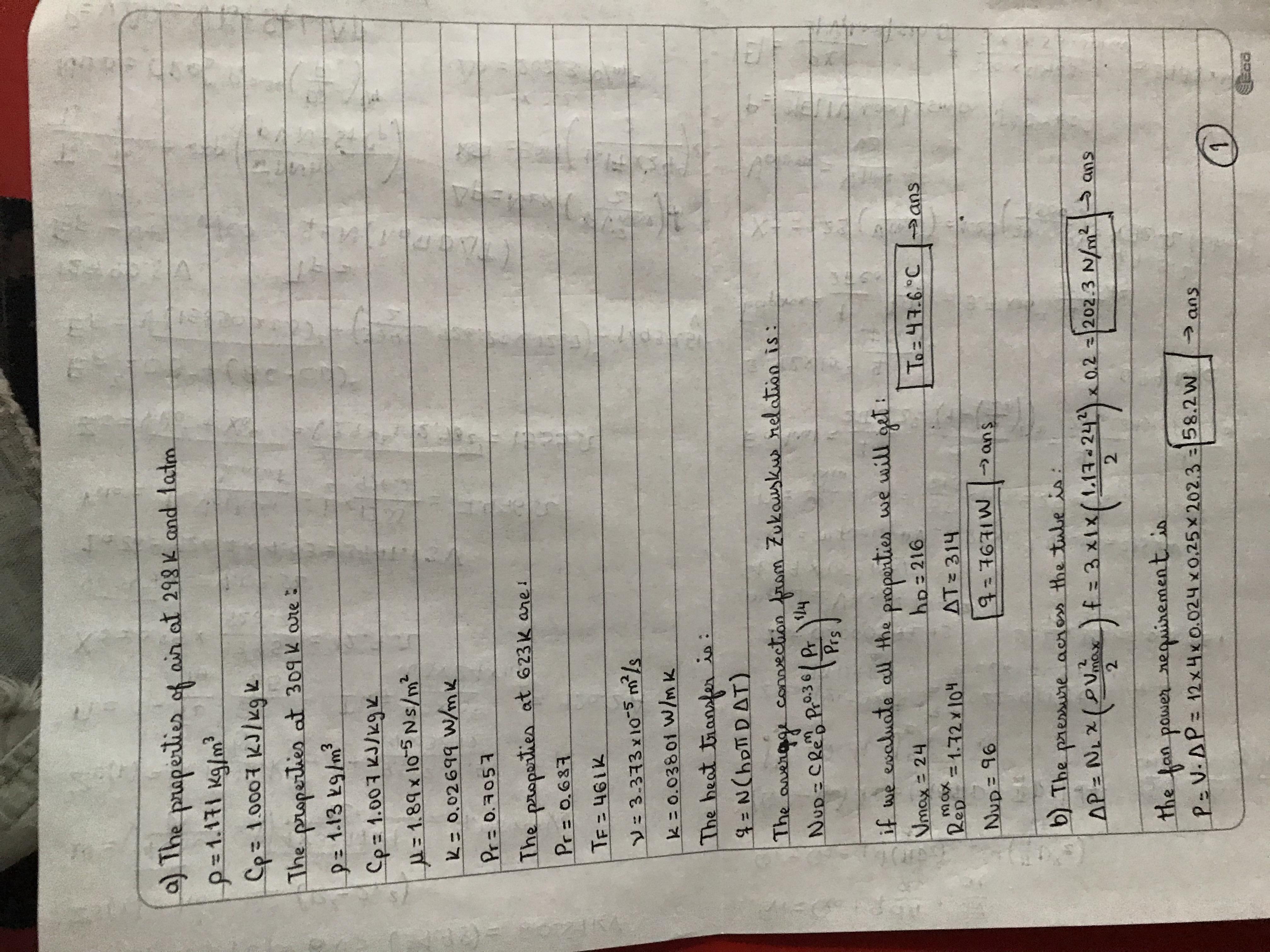
a) q = 7671 W

T0 = 47.6°C

b) ΔP = 202.3 N/m²

P = 58.2 W

c) hDarray = 2 times hD of an isolated element.

Explanation:

see the image for the solution.

4 0
15 days ago
The top 3 most popular male names of 2017 are Oliver, Declan, and Henry according to babynames. Write a program that modifies th
Viktor [230]

Answer:

The Python code is provided below with suitable comments

Explanation:

# convert list to set

male_names = set(['Oliver','Declan','Henry'])

# get name for removal and addition from user

remove_name = input("Enter remove name: ")

add_name = input("Enter add name: ")

# remove specified name from set

male_names.remove(remove_name)

# add new name to set

male_names.add(add_name)

# sort the resulting set

a = sorted(male_names)

# output the sorted set

print(a)

7 0
1 month ago
Other questions:
  • Who play 1v1 lol unblocked games 76
    8·2 answers
  • Degreasers can be broken down into two main categories
    9·2 answers
  • Given two input integers for an arrowhead and arrow body, print a right-facing arrow. Ex: If the input is 0 1, the output is
    8·1 answer
  • An 80-L vessel contains 4 kg of refrigerant-134a at a pressure of 160kPa. Determine (a) the temperature, (b) the quality, (c) th
    11·1 answer
  • As shown, a load of mass 10 kg is situated on a piston of diameter D1 = 140 mm. The piston rides on a reservoir of oil of depth
    9·1 answer
  • A long, circular aluminum rod is attached at one end to a heated wall and transfers heat by convection to a cold fluid.
    12·1 answer
  • 1 At a certain location, wind is blowing steadily at 10 m/s. Determine the mechanical energy of air per unit mass and the power
    11·1 answer
  • Radioactive wastes are temporarily stored in a spherical container, the center of which is buried a distance of 10 m below the e
    13·1 answer
  • The electrical panel schedules are located on EWR Plan number ___.
    13·1 answer
  • A center-point bending test was performed on a 2 in. x d in. wood lumber according to ASTM D198 procedure with a span of 4 ft an
    12·1 answer
Add answer
Login
Not registered? Fast signup
Signup
Login Signup
Ask question!