answer.
Ask question
Login Signup
Ask question
All categories
  • English
  • Mathematics
  • Social Studies
  • Business
  • History
  • Health
  • Geography
  • Biology
  • Physics
  • Chemistry
  • Computers and Technology
  • Arts
  • World Languages
  • Spanish
  • French
  • German
  • Advanced Placement (AP)
  • SAT
  • Medicine
  • Law
  • Engineering
PSYCHO15rus
2 months ago
9

For the scotch yoke mechanism shown, the acceleration of point a is defined by the relation a = −1.08sinkt − 1.44coskt, where a

and t are expressed in m/s2 and seconds, respectively, and k = 3 rad/s. knowing that x = 0.16 m and v = 0.36 m/s when t = 0, determine the velocity and position of point a when t =0.35 s. (round the final answers to one decimal place.)
Mathematics
1 answer:
AnnZ [12.3K]2 months ago
4 0
<span>At t=0.35s, the position is 0.2 m. At the same time, the velocity is -0.2 m/s. In collegiate mathematics, the term "acceleration" implies that you are working with the second derivative of a function that describes the position of point a. To determine the velocity, you're looking for the first derivative of that function, and for the position, you're interested in the function itself. Let's compute the necessary anti-derivatives. f''(t) = -1.08 sin(kt) - 1.44 cos(kt) Taking the integral of f''(t) with respect to t yields: f'(t) = (1.08 cos(kt) - 1.44 sin(kt))/k + C To find C, we know that v = 0.36 m/s at t=0. Let's substitute: f'(t) = (1.08 cos(kt) - 1.44 sin(kt))/k + C 0.36 = (1.08 cos(3*0) - 1.44 sin(3*0))/3 + C 0.36 = (1.08 cos(0) - 1.44 sin(0))/3 + C 0.36 = (1.08*1 - 1.44*0)/3 + C 0.36 = 0.36 + C 0 = C Thus, we have f'(t) = (1.08 cos(kt) - 1.44 sin(kt))/k. Now we will find the actual function by integrating once more: f(t) = (1.08 sin(kt) + 1.44 cos(kt))/k^2 + C Now let’s find out C: f(t) = (1.08 sin(kt) + 1.44 cos(kt))/k^2 + C 0.16 = (1.08 sin(3*0) + 1.44 cos(3*0))/3^2 + C 0.16 = (1.08 sin(0) + 1.44 cos(0))/9 + C 0.16 = (1.08*0 + 1.44*1)/9 + C 0.16 = 1.44/9 + C 0.16 = 0.16 + C 0 = C Thus, C = 0, and the position function is expressed as: f(t) = (1.08 sin(kt) + 1.44 cos(kt))/k^2. Using the position and velocity functions, we can now find the desired results: Position: f(t) = (1.08 sin(kt) + 1.44 cos(kt))/k^2 f(t) = (1.08 sin(3*0.35) + 1.44 cos(3*0.35))/3^2 f(t) = (1.08 sin(1.05) + 1.44 cos(1.05))/9 f(t) = (1.08*0.867423226 + 1.44*0.497571048)/9 f(t) = (0.936817084 + 0.716502309)/9 f(t) = 1.653319393/9 f(t) = 0.183702155. Thus, at t=0.35s, the position of point a is 0.2 m. Now calculating the velocity: f'(t) = (1.08 cos(kt) - 1.44 sin(kt))/k f'(t) = (1.08 cos(3*0.35) - 1.44 sin(3*0.35))/3 f'(t) = (1.08 cos(1.05) - 1.44 sin(1.05))/3 f'(t) = (1.08*0.497571048 - 1.44*0.867423226)/3 f'(t) = (0.537376732 - 1.249089445)/3 f'(t) = -0.711712713/3 f'(t) = -0.237237571. Therefore, the velocity at t = 0.35s is -0.2 m/s</span>
You might be interested in
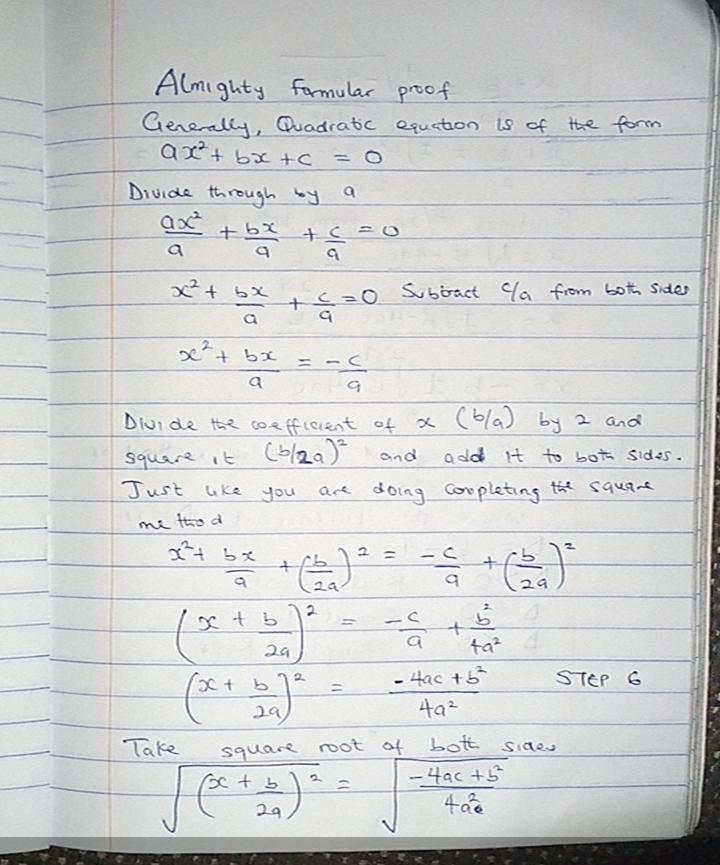
Two of the steps in the derivation of the quadratic formula are shown below. Step 6: StartFraction b squared minus 4 a c Over 4
babunello [11817]

Explanation:

Step-by-step clarification:

Referring to step 6

(b² — 4ac) / 4a² = (x + b/2a)²

The mistake in the question is that it should be (x + b/2a)²

According to step 7

±√(b² —4ac) /2a = x + b/2a

The error in the question is that it should be divided by 2a, not 1a.

1. The transition from step 6 to step 7 involves taking the square roots of both sides

(b² — 4ac) / 4a² = (x + b/2a)²

Taking the square of both sides

√(b²—4ac) / √4a² = √(x + b/2a)²

√(b²—4ac) / 2a = x + b/2a

This forms step 7 correctly.

Next, subtracting b/2a from both sides

√(b²—4ac) / 2a - b/2a= x + b/2a -b/2a

√(b²—4ac) / 2a — b/2a = x

(√(b²—4ac)  — b)/2a = x

x = [—b ± √(b²—4ac)] / 2a

This gives the desired formula.

The discriminant is D = b²—4ac.

6 0
3 months ago
Read 2 more answers
When the sun is at a certain angle in the sky, a 50-foot building will cast a -foot shadow. What is the length of the shadow in
Svet_ta [12734]

Answer:

0.40 feet

Step-by-step explanation:

For the first scenario, a 50-foot building casts a shadow of 1 foot. Let the angle of elevation of the sun from the shadow be denoted as θ.

Then:

Tan θ = \frac{opposite}{adjacent}

Tan θ = \frac{50}{1}

Tan θ = 50

⇒ θ = Tan^{-1} 50

      = 88.8542

      = 88.85^{o}

The elevation angle is roughly 88.85^{o}.

For a 20-foot pole,

Tan θ = \frac{opposite}{adjacent}

Tan 88.85^{o} = \frac{20}{x}

x = \frac{20}{Tan 88.85^{o} }

 = 0.4015

 = 0.40 feet

The length of the pole's shadow is 0.40 feet.

4 0
1 month ago
A statistics professor at a large university hypothesizes that students who take statistics in the morning typically do better t
Svet_ta [12734]

Answer:

The resulting value is 2.381

Step-by-step explanation:

Using the information presented in the question, we will calculate the evidence supporting the professor's hypothesis

Given that:

x₁ = 74,

n₁ = 36

s₁ = 8

x₂ = 68

n₂ = 36

s₂ = 10

The hypotheses can be outlined as:

The critical value is t₃₆+₃₆-₂,₀.₀₁ = t₇₀,₀.₀₁

thus,

t₃₆+₃₆-₂,₀.₀₁ = t₇₀,₀.₀ = 2.381

This implies a range of -2.381 to 2.381

Thus, we can support the professor's assertion.

5 0
1 month ago
There are S steps from the pedestal to the head of the Statue of Liberty.The number of steps in the Washington Monument is 27 le
Zina [12379]
The equation for the Washington Monument in terms of the steps for the Statue of Liberty is w = 6s - 27, which indicates that the variable should always come first. I hope this clarifies the answer, and you now know how to approach it. Wishing you a blessed and wonderful day, along with a great remainder of Black History Month!:-)
4 0
1 month ago
You have the opportunity to lease space for your business. The property owner has proposed a four-year lease with a rent of $29,
Inessa [12570]
$29,580. Breaking it down: 29000/4 equals 7250. So, 7250 plus 2% of 7250 calculates as follows: 7250 + (2/100) * 7250 gives us 7250 + 145, totaling $7395 with four payments resulting in $29,580.
6 0
2 months ago
Read 2 more answers
Other questions:
  • The employees of a company were surveyed on questions regarding their educational background (college degree or no college degre
    13·1 answer
  • The graphs below have the same shape. The equation of the blue graph is f(x)=x^2. Which of these is the equation of the red grap
    10·1 answer
  • A department store sells logo shirts at an original price of $20. Every month that a shirt doesn’t sell, the store reduces the s
    10·2 answers
  • One student from a high school will be selected at random. Let A be the event that the selected student is a student athlete, an
    6·2 answers
  • The zoo sold 250 admission tickets on Tuesday. Some of the tickets were child tickets and the rest were adult tickets. A child's
    12·1 answer
  • an auto transport truck holds 12 cars. A car dealer plans to bring in 1006 new cars in June and July. if an auto transport truck
    8·2 answers
  • A football quarterback enjoys practicing his long passes over 40 yards. He misses the first pass 40% of the time. When he misses
    12·2 answers
  • Randy divides (2x4 – 3x3 – 3x2 + 7x – 3) by (x2 – 2x + 1) as shown below. What error does Randy make? x squared minus 2 x + 1 St
    7·1 answer
  • How do you write 125.06 million dollars in at least four different ways.
    13·2 answers
  • Triangle G F E is cut by line segment H J. Line segment H J goes from side G E to F E. The length of G F is 4 x minus 4, the len
    13·1 answer
Add answer
Login
Not registered? Fast signup
Signup
Login Signup
Ask question!