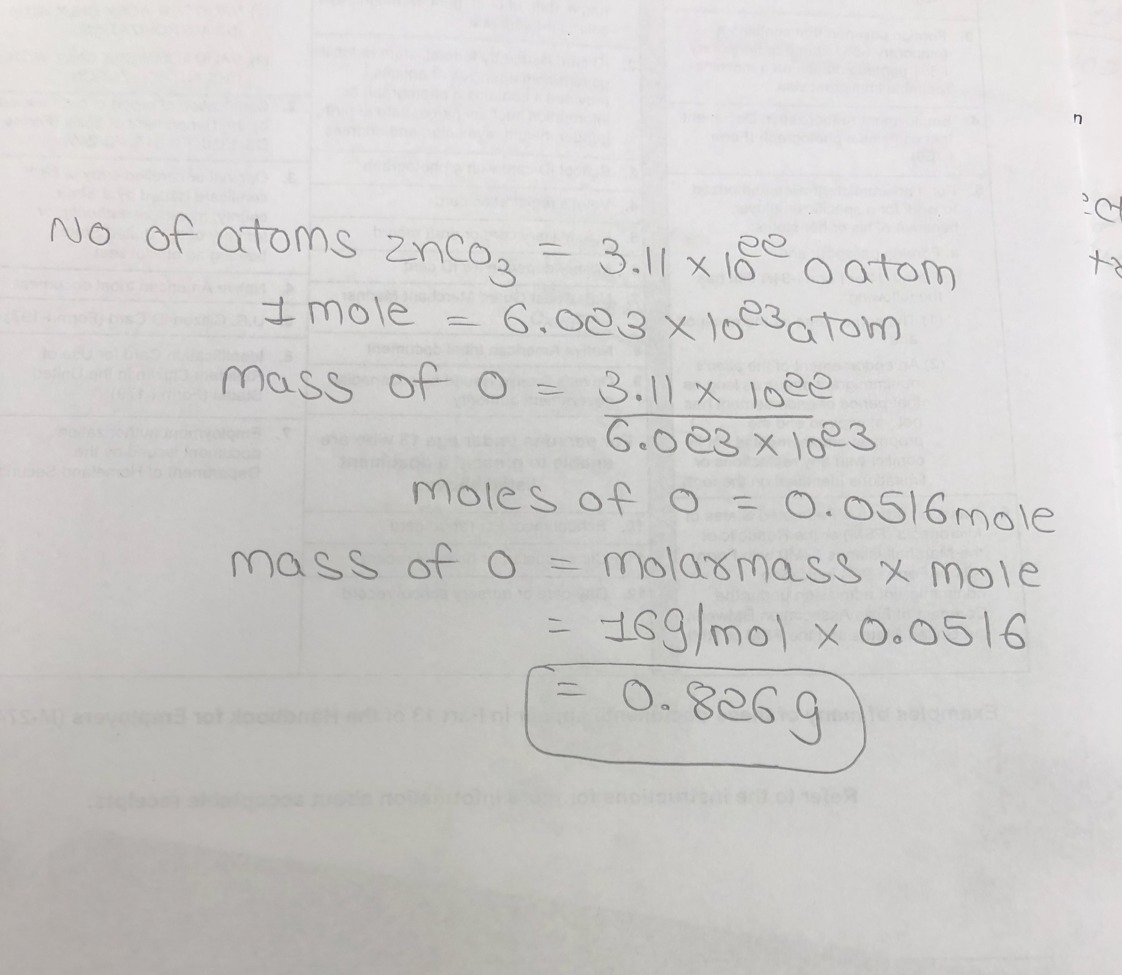
answer.
Ask question
Login Signup
Ask question
All categories
  • English
  • Mathematics
  • Social Studies
  • Business
  • History
  • Health
  • Geography
  • Biology
  • Physics
  • Chemistry
  • Computers and Technology
  • Arts
  • World Languages
  • Spanish
  • French
  • German
  • Advanced Placement (AP)
  • SAT
  • Medicine
  • Law
  • Engineering
Nezavi
17 days ago
13

Jessica has 12.7 moles of a compound for an experiment. How many particles of the compound does she have?

Chemistry
1 answer:
VMariaS [2.8K]17 days ago
6 0

The total number of particles present in 12.7 moles of the compound owned by Jessica is 7.65 x10^24 particles of the compound (response E)


Calculation Steps

The total number of particles is determined through Avogadro's Principle constant.


  • This principle states that Avogadro's 1 mole equals 6.02 x10^23 particles

So, how many particles correspond to 12.7 moles of the compound? particles\

By applying cross multiplication, the formula yields: particles of the compound= [12.7 moles x (6.02 x 10^23)] / 1 mole

= 7.65 x 10^24 particles of the compound (response E)
  • Note that
moles cancels each other out.

You might be interested in
Calculate the amount of work done against an atmospheric pressure of 1.00 atm when 500.0 g of zinc dissolves in excess acid at 3
Tems11 [2624]
The work done is 19.26 kJ.
5 0
1 day ago
A 0.0200 M NaCl solution was formed when 38.0 grams of NaCl was dissolved in enough water. What was the total volume of the solu
Tems11 [2624]

Start by determining the number of moles, which is obtained by dividing 38 grams by the molar mass of 58.43 g/mol. This calculation yields 0.65 moles. The concentration is calculated by dividing the number of moles by the volume in liters. Using this formula, we can derive the total volume by dividing the number of moles by the concentration. Thus, 0.65 moles divided by 0.02M (mol/L) results in a total volume of 32.5 L.

4 0
1 month ago
Read 2 more answers
A student adds 10.00 mL of a 2.0 M nitric acid solution to a 100.00 mL volumetric flask. Next, 50.00 mL of a 0.00500 M solution
Anarel [2728]

Answer:

0.20M of nitric acid

0.00250M of KSCN

Explanation:

In the case of nitric acid, the solution's dilution changes from 10.00mL to 100.00mL, resulting in a 1/10 dilution. Given the original concentration of nitric acid is 2.0M, the updated concentration becomes: 2.0M×(1/10)=0.20M of nitric acid

Similarly, the dilution of KSCN extends from 50.00mL to 100.00mL, equal to a 1/2 dilution. Consequently, the new concentration of KSCN turns out to be:

0.00500M × (1/2) = 0.00250M of KSCN

I hope it aids you!

5 0
14 days ago
Which of the following is transferred due to a temperature difference?
lions [2782]
Water transitions to ice when temperatures drop too low, while it turns into gas when temperatures rise too high.
Conversely, ice transforms back into water when heated, remaining unchanged if temperatures are too low.
Furthermore, gas transitions to water when cooled and can freeze into ice if cooled further, continuing this cycle.
I hope this clarifies things.
 
8 0
3 days ago
A typical deposit of cholesterol,C27H460,in an artery has a mass of 3.90mg.how many molecules of cholesterol are present in this
Anarel [2728]
The quantity is 6.074 X 10¹⁸ molecules. To calculate the molecular weight (MM) of the compound C₂₇H₄₆O, we use the formula: 27*(MM of C) + 46*(MM of H) + (MM of O). This leads to: 27*(12.0107) + 46* (1.00784) + (15.999) = 324.2889 + 46.36064 + 15.999 = 386.64854 g. The molar mass of any compound indicates the number of molecules found in one mole, which is 6.022 X 10²³ (Avogadro's number). So, if 386.64854 g of C₂₇H₄₆O consists of 6.022 X 10²³ cholesterol molecules, we can determine how many molecules are found in a deposit of 3.9mg or 0.0039g of C₂₇H₄₆O by using the unitary method. Number of molecules = 6.074 X 10¹⁸ molecules.
8 0
14 days ago
Other questions:
  • How many carbon atoms are contained in 84.3 g of ethyne (c2h2)?
    13·1 answer
  • 1. Bailey wants to find out which frozen solid melts the fastest: soda, gatorade, or orange juice. She pours each of the three l
    15·2 answers
  • The decomposition of nitramide, O2NNH2, in water has the chemical equation and rate law O2NNH2(aq)⟶N2O(g)+H2O(l)rate=k[O2NNH2][H
    13·1 answer
  • Write a hypothesis for Part II of the lab, which is about the type of material an object is made of, and its ability to absorb o
    15·2 answers
  • A 0.652-g sample of a pure strontium halide reacts with excess sulfuric acid. the solid strontium sulfate formed is separated, d
    6·1 answer
  • Two substances in a mixture differ in density and particle size. These properties can be used to
    7·1 answer
  • If two solutions with concentrations of 0.4 M sugar and 0.7 M sugar respectively are separated by a semipermeable membrane, duri
    11·1 answer
  • Can one atom in this type of reaction win the "tug of war"? What might happen if it did?
    10·2 answers
  • During photosynthesis, sunlight shining on a plant is absorbed. Through several chemical reactions, the plant produces sugar, a
    13·2 answers
  • What volume of co2 gas at 645 torr and 800. k could be produced by the decomposition of 45.0 g of caco3? caco3(s) → cao(s) + co2
    8·1 answer
Add answer
Login
Not registered? Fast signup
Signup
Login Signup
Ask question!