answer.
Ask question
Login Signup
Ask question
All categories
  • English
  • Mathematics
  • Social Studies
  • Business
  • History
  • Health
  • Geography
  • Biology
  • Physics
  • Chemistry
  • Computers and Technology
  • Arts
  • World Languages
  • Spanish
  • French
  • German
  • Advanced Placement (AP)
  • SAT
  • Medicine
  • Law
  • Engineering
WINSTONCH
1 month ago
6

In an electricity experiment, a 1.0g plastic ball is suspended on a60-cm-long string and given an electric charge. A charged rod

brought near the ball exerts a horizontal electrical forceFelec on it, causing the ball to swing out to a 20deg.angle and remain there.
a. What is the magnitude of Felec ?
b.What is the tension in the string?
Physics
1 answer:
Ostrovityanka [3.2K]1 month ago
6 0

a) The magnitude of the electric force: 3.57\cdot 10^{-3} N

b) String tension: 0.010 N

Clarification:

a)

When a charged rod approaches the ball, it remains suspended at an incline. This allows us to analyze the forces acting in two perpendicular orientations:

- Horizontally, the electric force F_Eacts in one direction, and the tension component in the string opposes it, T sin \thetadenoted by T, which is the angle relative to the vertical\theta=20^{\circ}

- Vertically, the weight of the ball mgacts downward (with m=1.0 g = 0.001 kgas the ball's mass and g=9.8 m/s^2as gravitational acceleration), while the tension component acts upward T cos \theta

Consequently, since the ball is in equilibrium, the following two equations can be established:

T sin \theta =F_E\\Tcos \theta = mg

Dividing the two equations gives

tan \theta=\frac{F_E}{mg}

and solving for the electric force yields

F_E=mg tan \theta=(0.001)(9.8)tan 20^{\circ}=3.57\cdot 10^{-3} N

b)

To derive the tension in the string, one can use either of the above equations; for example, the equation for the horizontal component,

T sin \theta =F_E

Where

is the electric force

is the angle relative to vertical F_E=3.57\cdot 10^{-3} NThe tension in the string can be calculated as follows:

\theta=20^{\circ}

Discover more about electric force:

You might be interested in
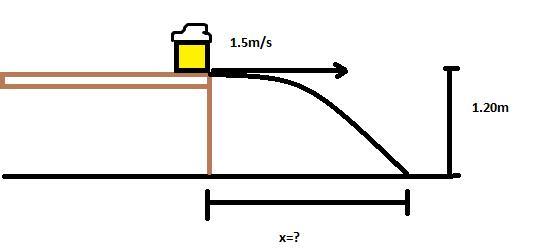
 A bartender slides a beer mug at 1.50 m/s toward a customer at the end of a frictionless bar that is 1.20 m tall. The customer
serg [3582]

Response:

a) The mug makes contact with the ground 0.7425m from the bar's end. b) |V|=5.08m/s θ= -72.82°

Clarification:

To address this issue, we begin with a diagram depicting the situation. (refer to the attached illustration).

a)

The illustration shows that the problem involves motion in two dimensions. To determine how far from the bar the mug lands, we need to find the time the mug remains airborne by examining its vertical motion.

To compute the time, we utilize the following formula with the known values:

y_{f}=y_{0}+v_{y0}t+\frac{1}{2}at^{2}

We have y_{f}=0 and v_{y0}=0, allowing us to simplify the equation to:

0=y_{0}+\frac{1}{2}at^{2}

Now, we can calculate for t:

-y_{0}=\frac{1}{2}at^{2}

-2y_{0}=at^{2}

\frac{-2y_{0}}{a}=t^{2}

t=\sqrt{\frac{-2y_{0}}{a}}

We know y_{0}=1.20m and a=g=-9.8m/s^{2}

The negative gravity indicates the downward motion of the mug. Hence, we substitute these values into the provided formula:

t=\sqrt{\frac{-2(1.20m)}{(-9.8m/s^{2})}}

Which results in:

t=0.495s

This time helps us evaluate the horizontal distance the mug traverses. Since:

V_{x}=\frac{x}{t}

Solving for x, we have:

x=V_{x}t

Substituting the known values yields:

x=(1.5m/s)(0.495s)

This calculates to:

x=0.7425m

b) With the time determining when the mug strikes the ground established, we can find the final velocity in the vertical direction using the formula:

a=\frac{v_{f}-v_{0}}{t}

The initial vertical velocity being zero simplifies our calculations:

a=\frac{v_{f}}{t}

Thus, we can determine the final velocity:

V_{yf}=at

Given that the acceleration equates to gravity (showing a downward effect), we substitute that alongside the previously found time:

V_{yf}=(-9.8m/s^{2})(0.495s)

This leads to:

V_{yf}=-4.851m/s

Now, we ascertain the velocity components:

V_{xf}=1.5m/s and V_{yf]=-4.851m/s

Next, we find the speed by calculating the vector's magnitude:

|V|=\sqrt{V_{x}^{2}+V_{y}^{2}}

<pThus:

|V|=\sqrt{(1.5m/s)^{2}+(-4.851m/s)^{2}

Yielding:

|V|=5.08m/s

Lastly, to ascertain the impact direction, we apply the equation:

\theta = tan^{-1} (\frac{V_{y}}{V_{x}})

<pFulfilling this provides:

\theta = tan^{-1} (\frac{-4.851m/s}{(1.5m/s)})

<pLeading to:

\theta = -72.82^{o}

4 0
2 months ago
State two advantages of a lead-acid accumulator over a leclanche cell​
kicyunya [3294]

Respuesta:

Se pueden recargar.

Poseen una vida útil mayor.

Son reutilizables.

Explicación:

Las baterías de plomo-ácido y las pilas Leclanché son tipos de células electroquímicas.

Las pilas Leclanché son células primarias. Estas células producen reacciones químicas que generan corriente eléctrica de manera irreversible.

Por su parte, las baterías de plomo-ácido son células secundarias que permiten la reversibilidad de la corriente eléctrica generada.

Esto hace que las baterías de plomo-ácido sean reutilizables, con mayor durabilidad y un tiempo de vida más prolongado.

5 0
2 months ago
A woman living in a third-story apartment is moving out. Rather than carrying everything down the stairs, she decides to pack he
inna [3103]
Let T be the force exerted on the rope by her. This force induces tension in the rope, which exerts an upward force on the crates, while the weight of the crate pulls downward. Thus, the net force acting on the crate can be expressed as mg - T, acting in the downward direction. According to Newton's law, we can set up the equation: mg - T = ma. Given that a = 0 (the speed remains constant), this simplifies our equation to mg - T = 0, which leads to T = mg. Therefore, T = 25 x 9.8 = 245 N, indicating that the force she needs to apply is 245 N.
5 0
1 month ago
Consider the uniform electric field \vec{E} =(4000~\hat{j}+3000~\hat{k})~\text{N/C} ​E ​⃗ ​​ =(4000 ​j ​^ ​​ +3000 ​k ​^ ​​ ) N/
kicyunya [3294]

Answer:

Electric flux is calculated as \phi=31562.63\ Nm^2/C

Explanation:

We start with the given parameters:

The electric field impacting the circular surface is E=(4000j+3000k)\ N/C

Our objective is to ascertain the electric flux passing through a circular region with a radius of 1.83 m situated in the xy-plane. The area vector is oriented in the z direction. The formula for electric flux is expressed as:

\phi=E{\cdot}A

\phi=(4000j+3000k){\cdot}Ak

Applying properties of the dot product, we calculate the electric flux as:

\phi=3000\times Ak

\phi=3000\times \pi (1.83)^2

\phi=31562.63\ Nm^2/C

Consequently, the electric flux for the circular area is \phi=31562.63\ Nm^2/C. Thus, this represents the required answer.

4 0
2 months ago
The magnitude of the electric current is inversely proportional to the _____ of the circuits in R2D2.
Keith_Richards [3271]
The essential principle for this question is Ohm’s Law: V=IR, I=V/R, R=V/I. Therefore, the answer is (3) Resistance, as it is inversely related to Current (I=V/R).
4 0
1 month ago
Other questions:
  • Gamma rays may be used to kill pathogens in ground beef. One irradiation facility uses a 60Co source that has an activity of 1.0
    6·1 answer
  • f a stadium pays $11,000 for labor and $7,000 for parking, what would the stadium's parking revenue have to be if the stadium is
    5·2 answers
  • A convex mirror with a focal length of 0.25 m forms a 0.080 m tall image of an automobile at a distance of 0.24 m behind the mir
    7·2 answers
  • An Object moving at a velocity of 30 m/s slows to a stop in 7 seconds. What was its acceleration
    12·1 answer
  • A motorist inflates the tires of her car to a pressure of 180 kPa on a day when the temperature is -8.0° C. When she arrives at
    9·1 answer
  • Now Abel and Kato use what they learned to answer the following problem. The initial speed of a tennis ball is 54 m/s and the la
    11·1 answer
  • Two thermometers are calibrated, one in degrees Celsius and the other in degrees Fahrenheit.
    14·1 answer
  • A plane has an average air speed (this is the speed the plane moves through air) of 750 mph. The plane flies a route of 5000 mil
    14·1 answer
  • What is the total flux φ that now passes through the cylindrical surface? enter a positive number if the net flux leaves the cyl
    15·1 answer
  • How is earth outer layer different from a cracked hard-boiled egg?
    11·1 answer
Add answer
Login
Not registered? Fast signup
Signup
Login Signup
Ask question!