answer.
Ask question
Login Signup
Ask question
All categories
  • English
  • Mathematics
  • Social Studies
  • Business
  • History
  • Health
  • Geography
  • Biology
  • Physics
  • Chemistry
  • Computers and Technology
  • Arts
  • World Languages
  • Spanish
  • French
  • German
  • Advanced Placement (AP)
  • SAT
  • Medicine
  • Law
  • Engineering
wolverine
14 days ago
15

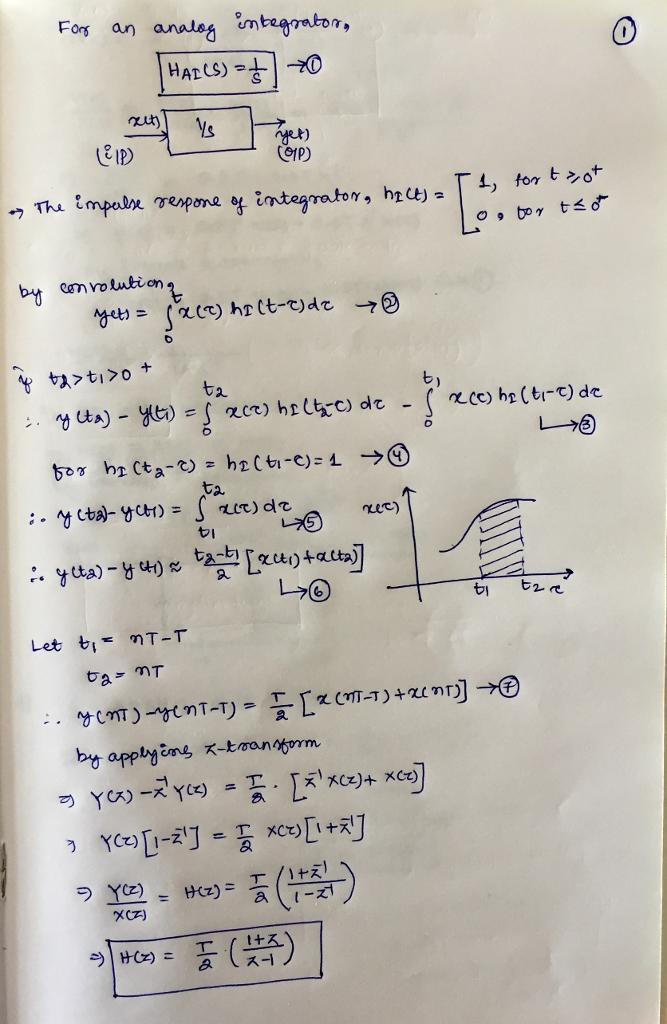
Design a digital integrator using the impulse invariance method. Find and give a rough sketch of the amplitude response, and com

pare it with that of the ideal integrator. If this integrator is used primarily for integrating audio signals (whose bandwidth is 20 kHz), determine a suitable value for T.

Engineering
1 answer:
mote1985 [299]14 days ago
8 0
50 μsec.
You might be interested in
Consider a rectangular fin that is used to cool a motorcycle engine. The fin is 0.15m long and at a temperature of 250C, while t
Kisachek [356]

Answer:

q' = 5826 W/m

Explanation:

Given:-

- The length of the fin in question, L = 0.15 m

- The fin's surface temperature, Ts = 250°C

- The velocity of free stream air, U = 80 km/h

- The air temperature, Ta = 27°C

- The flow is parallel over both sides of the fin, assuming turbulent flow conditions throughout.

Find:-

What is the heat removal rate per unit width of the fin?

Solution:-

- Steady state conditions are assumed, along with negligible radiation and turbulent flow conditions.

- From Table A-4, we gather air properties (T = 412 K, P = 1 atm ):

    Dynamic viscosity, v = 27.85 * 10^-6 m²/s  

    Thermal conductivity, k = 0.0346 W / m.K

    Prandtl number Pr = 0.69

- Compute the Nusselt Number (Nu) corresponding to - turbulent conditions - using the relevant relationship as follows:

                          Nu = 0.037*Re_L^\frac{4}{5} * Pr^\frac{1}{3}

Where,    Re_L: Average Reynolds number for the entire length of fin:

                          Re_L = \frac{U*L}{v} \\\\Re_L = \frac{80*\frac{1000}{3600} * 0.15}{27.85*10^-^6} \\\\Re_L = 119688.80909

Consequently,


Nu = 0.037*(119688.80909)^\frac{4}{5} * 0.69^\frac{1}{3}\\\\Nu = 378

- The convective heat transfer coefficient (h) can now be derived from:

                          h = \frac{k*Nu}{L} \\\\h = \frac{0.0346*378}{0.15} \\\\h = 87 \frac{W}{m^2K}

- The heat loss rate q' per unit width can be established using the convection heat transfer formula and should be multiplied by (x2) since the airflow is present on both sides of the fin:

                          q' = 2*[h*L*(T_s - T_a)]\\\\q' = 2*[87*0.15*(250 - 27)]\\\\q' = 5826\frac{W}{m}

- Ultimately, the heat loss per unit width from the rectangular fin is q' = 5826 W/m

- The thermal loss per unit width (q') attributed to radiation:

                  q' = 2*a*T_s^4*L

Where, a signifies the Stefan-Boltzmann constant = 5.67*10^-8

                  q' = 2*5.67*10^-^8*(523)^4*0.15\\\\q' = 1273 \frac{W}{m}

- It is observed that radiation losses are not insignificant, accounting for 20% of thermal loss by convection. As the emissivity (e) of the fin is unspecified, this value is dismissed from the calculations as it pertains to the provided information.

7 0
25 days ago
A piston–cylinder assembly contains propane, initially at 27°C, 1 bar, and a volume of 0.2 m3. The propane undergoes a process t
Viktor [391]
The work completed is -19.7 KJ, and the heat transferred amounts to 17.4 KJ. Given the temperature is 27°C and the volume is 0.2 m³, with pressure shifting from 1 bar to 4 bar, we recognize the equation pV¹°¹ is a constant. From the superheated propane table, the corresponding specific volume and internal energy values at initial conditions allow us to assess the work and heat transfer between state changes.
8 0
14 days ago
Number pattern Write a recursive method called print Pattern() to output the following number pattern. Given a positive integer
alex41 [359]

Response:

Refer to the explanation

Clarification:

Code:

import java.util.Scanner;

public class NumberPattern {

public static int x, count;

public static void displayNumPattern(int num1, int num2) {

if (num1 > 0 && x == 0) {

System.out.print(num1 + " ");

count++;

displayNumPattern(num1 - num2, num2);

} else {

x = 1;

if (count >= 0) {

System.out.print(num1 + " ");

count--;

if (count < 0) {

System.exit(0);

}

displayNumPattern(num1 + num2, num2);

}

}

}

public static void main(String[] args) {

Scanner scnr = new Scanner(System.in);

int num1;

int num2;

num1 = scnr.nextInt();

num2 = scnr.nextInt();

displayNumPattern(num1, num2);

}

}

See attached example output

3 0
1 month ago
Read 2 more answers
A pressurized 2-m-diameter tank of water has a 10-cm-diameter orifice at the bottom where water discharges to the atmosphere. Th
grin007 [323]

Answer:

A fluid is a material that maintains continuous and permanent deformity when a shearing stress is applied.

• The pressure at a given point in a fluid remains unaffected by the direction of the surface that intersects this point; this pressure is isotropic.

• The force generated by pressure p acting on one side of a minimal surface area dA defined by a unit normal vector n can be expressed as −pndA.

• The speed at which pressure is conveyed through a fluid matches the speed of sound.

• The units employed vary based on the selected system, incorporating measures such as feet, seconds, newtons, and pascals. On the other hand, a dimension refers to a more abstract idea, encompassing terms like mass, length, and time.

• The specific gravity (SG) of a solid or liquid is the proportion of its density compared to that of water at the identical temperature.

• A Newtonian fluid is characterized by the viscous stress being directly proportional to the strain rate (velocity gradient). The viscosity, µ, is a property of the fluid that varies with temperature.

• At the boundary between solid and fluid, the velocities of both the fluid and solid coincide; this situation is referred to as the “no-slip condition.” Consequently, with high Reynolds numbers (>> 1), boundary layers develop near the solid surface. In those layers, significant velocity gradients occur, resulting in crucial viscous influences.

• At the junction of two distinct fluids, surface tension may play a significant role. Surface tension leads to the emergence of phenomena like meniscus, drops, bubbles, and capillary rise seen in narrow tubes since it can counterbalance pressure variations across the interface.

5 0
10 days ago
In which of the following branches of engineering is the practice not restricted?
iogann1982 [368]
a) civil engineering.
6 0
13 days ago
Read 2 more answers
Other questions:
  • A Carnot heat engine receives heat from a reservoir at 900oC at a rate of 800 kJ/min and rejects the waste heat to the ambient a
    13·1 answer
  • 3.24 Program: Drawing a half arrow (Java) This program outputs a downwards facing arrow composed of a rectangle and a right tria
    12·1 answer
  • A certain full-wave rectifier has a peak output voltage of 30 V. A 50 mF capacitor-input filter is connected to the rectifier. C
    6·1 answer
  • A pitfall cited in Section 1.10 is expecting to improve the overall performance of a computer by improving only one aspect of th
    6·1 answer
  • A tank contains initially 2500 liters of 50% solution. Water enters the tank at the rate of 25 iters per minute and the solution
    13·1 answer
  • Soap is a very interesting chemical. We even discussed it on the discussion board. How does it work, exactly?
    7·1 answer
  • At a certain elevation, the pilot of a balloon has a mass of 120 lb and a weight of 119 lbf. What is the local acceleration of g
    6·1 answer
  • The electrical panel schedules are located on EWR Plan number ___.
    13·1 answer
  • At what forward voltage does a diode conduct a current equal to 10,000 Is ? In terms of Is , what current flows in the same diod
    14·1 answer
  • A thin-walled tube with a diameter of 6 mm and length of 20 m is used to carry exhaust gas from a smoke stack to the laboratory
    7·1 answer
Add answer
Login
Not registered? Fast signup
Signup
Login Signup
Ask question!