answer.
Ask question
Login Signup
Ask question
All categories
  • English
  • Mathematics
  • Social Studies
  • Business
  • History
  • Health
  • Geography
  • Biology
  • Physics
  • Chemistry
  • Computers and Technology
  • Arts
  • World Languages
  • Spanish
  • French
  • German
  • Advanced Placement (AP)
  • SAT
  • Medicine
  • Law
  • Engineering
Nastasia
1 month ago
10

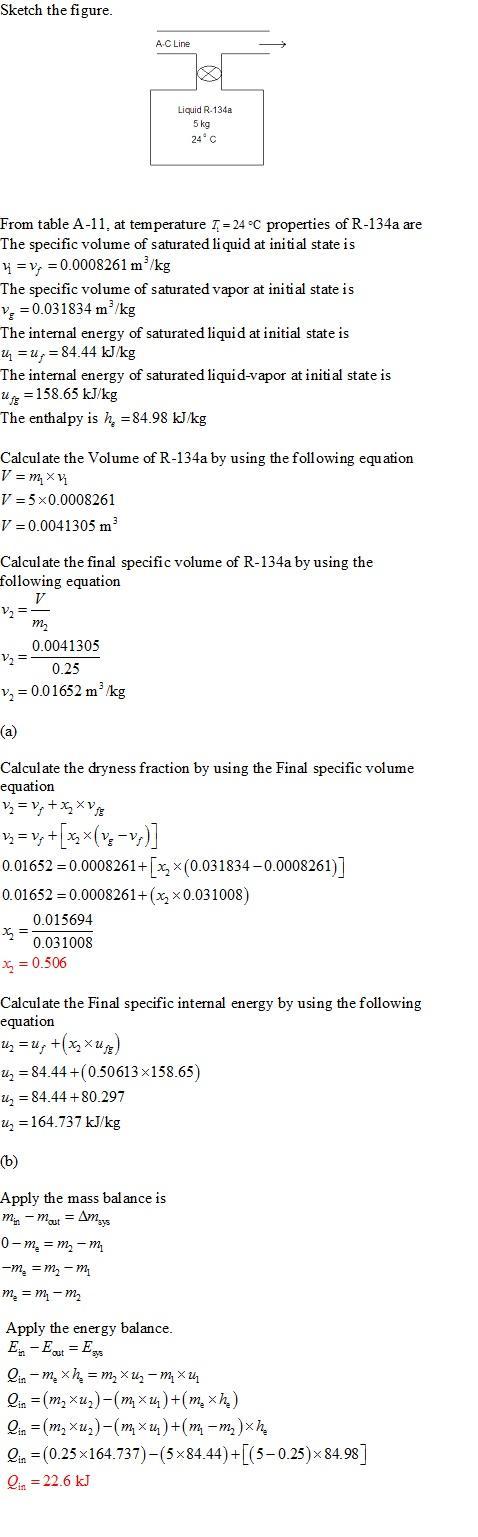
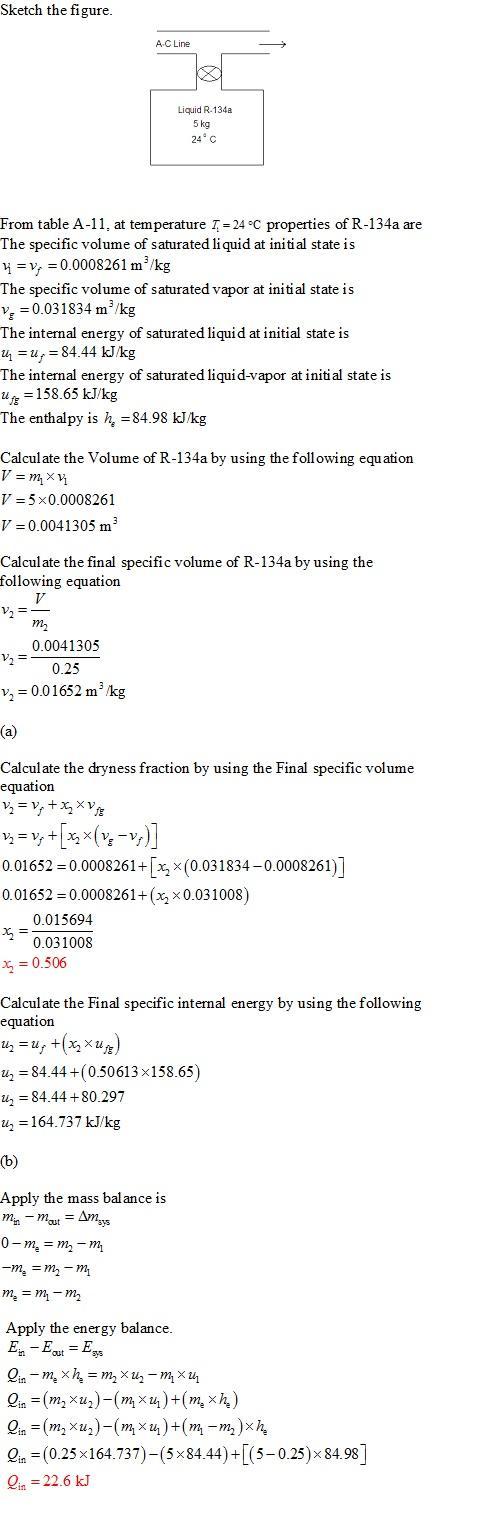
An air-conditioning system is to be filled from a rigid container that initially contains 5 kg of liquid R-134a at 24°C. The val

ve connecting this container to the air-conditioning system is now opened until the mass in the container is 0.24 kg, at which time the valve is closed. During this time, only liquid R-134a flows from the container. Presuming that the process is isothermal while the valve is open, determine the final quality of the R-134a in the container and the total heat transfer.

Engineering
1 answer:
grin007 [323]1 month ago
6 0

Answer: a) U2 = 164.737kJ/kg

b) Q2 = 22.6kJ

Explanation: see attachment below

You might be interested in
A copper-constantan thermocouple is to be used to measure temperatures between 0 and 200°C. The e.m.f. at 0°C is 0 mV, at 100°C
Kisachek [356]
3.941%
5 0
1 month ago
Steam flows at steady state through a converging, insulated nozzle, 25 cm long and with an inlet diameter of 5 cm. At the nozzle
iogann1982 [368]

Answer:

The velocity at exit U_2 is 578.359 m/s

The exit diameter d_e is 1.4924 cm

Explanation:

Provided data includes:

Length of the nozzle L = 25 cm

Inlet diameter d_i = 5 cm

At the nozzle entrance (state 1): Temperature T_1 = 325 °C, Pressure P_1 = 700 kPa, Velocity U_1 = 30 m/s, Enthalpy H_1 = 3112.5 kJ/kg, Volume V_1 = 388.61 cm³/gAt the nozzle exit (state 2): Temperature T_2 = 250 °C, Pressure P_2 = 350 kPa, Velocity U_2, Enthalpy H_2 = 2945.7 kJ/kg, Volume V_2 = 667.75 cm³/g To determine:a. Exit Velocity U_2b. Exit Diameter d_e

a.The Energy Equation can be represented by:ΔH + ΔU² / 2 + gΔz = Q + WAssuming Q = W = Δz = 0Substituting the values yields:

(H_2 - H_1) + (U²_2 - U²_1)  / 2 = 0From which we can derive U_2 = sqrt((2* (H_1 - H_2 )) + U²_1) with the calculations leading to U_2 = sqrt ( 2 * 10^3 * (3112.5 -2945.7) + 900) yielding U_2 = 578.359 m/s

b.

Using mass balance approach, we have U_1 * A_1 / V_1 = U_2 * A_2 / V_2

Here, A = π*d² / 4

This leads to U_1 * d_i² / V_1 = U_2 * d_e² / V_2, thus d_e = d_i * sqrt((U_1 / U_2) * (V_2 / V_1)). Hence, d_e = 5 * sqrt((30 / 578.359) * (667.75 / 388.61)) computes to d_e = 1.4924 cm
6 0
2 months ago
The rate of flow of water in a pump installation is 60.6 kg/s. The intake static gage is 1.22 m below the pump centreline and re
mote1985 [299]

Answer:

The power of the pump is 23.09 kW.

Explanation:

Parameters

gravitational constant, g = 9.81 m/s^2

mass flow rate, \dot{m} = 60.6 kg/s

flow density, \rho = 1000 kg/m^3

efficiency of the pump, \eta = 0.74

output gauge pressure, p_o = 344.75 kPa

input gauge pressure, p_i = 68.95 kPa

cross-sectional area of output pipe, A_o = 0.069 m^2

cross-sectional area of input pipe, A_i = 0.093 m^2

height of discharge, z_o = 1.22 m - 0.61 m = 0.61 m (evaluated at pump’s maximum height of 1.22 m)

input height, z_i = 0 m

hydraulic power of the pump,P =? kW

Initially, the volumetric flow (Q) needs to be determined

Q = \frac{\dot{m}}{\rho}

Q = \frac{60.6 kg/s}{1000 kg/m^3}

Q = 0.0606 m^3/s

Next, compute the velocity (v) for both input and output

v_o = \frac{Q}{A_o}

v_o = \frac{0.0606 m^3/s}{0.069 m^2}

v_o = 0.88 m/s

v_i = \frac{Q}{A_i}

v_i = \frac{0.0606 m^3/s}{0.093 m^2}

v_i = 0.65 m/s

Subsequently, the total head (H) can be calculated

H = (z_o - z_i) + \frac{v_o^2 - v_i^2}{2 \, g} + \frac{p_o - p_i}{\rho \, g}

H = (0.61 m - 0 m) + \frac{{0.88 m/s}^2 - {0.65 m/s}^2}{2 \, 9.81 m/s^2} + \frac{(344.75 Pa-68.95 Pa)\times 10^3}{1000 kg/m^3 \, 9.81 m/s^2}

H = 28.74m

Finally, the computation of pump power is done as follows

P = \frac{Q \, \rho \, g \, H}{\eta}

P = \frac{0.0606 m^3/s \, 1000 kg/m^3 \, 9.81 m/s^2 \, 28.74m}{0.74}

P = 23.09 kW

6 0
2 months ago
Which of the following types of protective equipment protects workers who are passing by from stray sparks or metal while anothe
choli [298]

Answer:

Flame-resistant clothing and aprons

Explanation:

Workers involved with welding are generally mandated to wear flame-resistant clothing and aprons to shield them from various hazards, including heat, flames, burns, and potential radiation. In the context of welding, this gear protects individuals from flying sparks that can ignite and cause fires. Hence, such clothing helps to prevent accidents in these situations.

7 0
3 months ago
Other questions:
  • Who want to play "1v1 lol unblocked games 76"
    7·2 answers
  • Who play 1v1 lol unblocked games 76
    8·2 answers
  • Water is flowing in a metal pipe. The pipe OD (outside diameter) is 61 cm. The pipe length is 120 m. The pipe wall thickness is
    9·1 answer
  • A thin-film gold conductor for an integrated circuit in a satellite application is deposited from a vapor, and the deposited gol
    9·1 answer
  • Consider film condensation on a vertical plate. Will the heat flux be higher at the top or at the bottom of the plate? Why?
    5·1 answer
  • Suppose a steam locomotive is rated at 7500 horsepower. If its efficiency is 6%, how much wood must be burned in a 3-hour trip?
    11·1 answer
  • Gina is about to use a fire extinguisher on a small fire. What factor determines the type of extinguisher she should use
    9·2 answers
  • A 3-phase, 50 Hz, 110 KV overhead line has conductors placed in a horizontal plane 3 m apart. Conductor diameter is 2.5 cm. If t
    6·1 answer
  • An inventor claims to have devised a cyclical engine for use in space vehicles that operates with a nuclear fuel generated energ
    14·1 answer
  • 3 If, for a particular junction, the acceptor concentration is 1017/cm3 and the donor concentration is 1016/cm3 , find the junct
    6·1 answer
Add answer
Login
Not registered? Fast signup
Signup
Login Signup
Ask question!
