answer.
Ask question
Login Signup
Ask question
All categories
  • English
  • Mathematics
  • Social Studies
  • Business
  • History
  • Health
  • Geography
  • Biology
  • Physics
  • Chemistry
  • Computers and Technology
  • Arts
  • World Languages
  • Spanish
  • French
  • German
  • Advanced Placement (AP)
  • SAT
  • Medicine
  • Law
  • Engineering
Nutka1998
1 month ago
11

When a test charge q0 = 2 nC is placed at the origin, it experiences a force of 8 times 10-4 N in the positive y direction. What

is the electric field at the origin?
Physics
1 answer:
Softa [3K]1 month ago
3 0

Answer:

Electric field, E=4\times 10^5\ N/C

Explanation:

The following values are provided:

Magnitude of charge, q_o=2\ nC=2\times 10^{-9}\ C

Force experienced, F=8\times 10^{-4}\ N

To determine the electric field at the origin, the formula employed is:

F=q_o\times E

E=\dfrac{F}{q_o}

E=\dfrac{8\times 10^{-4}}{2\times 10^{-9}}

E=4\times 10^5\ N/C

Consequently, the electric field at the origin is 4\times 10^5\ N/C. Hence, this provides the sought solution.

You might be interested in
A sinusoidal electromagnetic wave of frequency 6.10×10¹⁴hz travels in vacuum in the +x direction. the magnetic field is parallel
Yuliya22 [3333]
Part a) The connection between the electric field and the magnetic field in an electromagnetic wave is
E=cB
where
E signifies the strength of the electric field
B indicates the strength of the magnetic field
c represents the speed of light
Using the equation, we determine:
E=cB=(3 \cdot 10^8 m/s)(5.80 \cdot 10^{-4} T)=1.74 \cdot 10^5 N/C

Part b) The text does not clarify the orientation of the magnetic field on the y-axis: I speculate it points in the y+ direction.
The direction of the electric field can be established using the right-hand rule, which states:
- the index finger shows the direction of E
- the middle finger indicates the orientation of B
- the thumb reveals the propagation direction of the wave
Because the wave propagates in the x+ direction, and the magnetic field in the y+ direction, we conclude that the electric field direction (index finger) must be z-.
7 0
2 months ago
-. What is the acceleration of 4 kg trolling bag pulled by a girl with a<br> force of 3 N?
inna [3103]

Answer:

Acceleration(a) = 0.75 m/s²

Explanation:

Given:

Force(F) = 3 N

Mass of object(m) = 4 kg

Find:

Acceleration(a)

Computation:

Force(F) = ma

3 = (4)(a)

Acceleration(a) = 3/4

Acceleration(a) = 0.75 m/s²

3 0
3 months ago
In an inertial frame of reference, a series of experiments is conducted. in each experiment, two or three forces are applied to
Yuliya22 [3333]
Objects will stay in a stationary position if the total force acting on them amounts to zero; this occurs when equal forces are applied in opposite directions. According to Newton's second law, if the net force on an object is zero, it will not move.
8 0
2 months ago
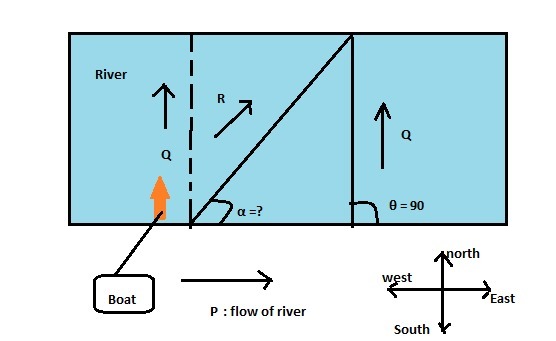
A person is rowing across the river with a velocity of 4.5 km/hr northward. The river is flowing eastward at 3.5 km/hr (Figure 4
Yuliya22 [3333]

Answer: Her velocity magnitude (v) relative to the shore is 5.70 km/h.

Explanation:

Let Q be the speed of the boat, and P be the speed of the river flow.

R represents the resultant velocity combining boat velocity and river current.

According to vector addition using the law of triangles:

R=\sqrt{P^2+Q^2+2PQCos\theta}

From the diagram:

P = 3.5 km/h, Q = 4.5 km/h

\theta= 90^o

R=\sqrt{P^2+Q^2+2PQCos\theta}=\sqrt{(3.5)^2+(4.5)^2+3.5\times 4.5\times cos90^o}=5.70

(Cos90^o=0),(sin 90^o=1)

\alpha =tan^{-1}\frac{Qsin\theta}{P+Qcos\theta}=tan^{-1}\frac{4.5 sin 90^o}{3.5+4.5 cos90^o}=tan^{-1}\frac{4.5}{3.5}=52.12^o

Therefore, her velocity magnitude relative to the shore is 5.70 km/h.

8 0
3 months ago
Other questions:
  • A ball is dropped from the top of a cliff. By the time it reaches the ground, all the energy in its gravitational potential ener
    14·1 answer
  • Use the momentum equation for photons found in this week's notes, the wavelength you found in #3, and Plank’s constant (6.63E-34
    14·2 answers
  • A shell is launched with a velocity of 100 m/s at an angle of 30.0° above horizontal from a point on a cliff 50.0 m above a leve
    13·1 answer
  • a 1250 kg car accelerates from rest to 6.13m/s over a distance of 8.58m calculate the average force of traction
    6·1 answer
  • Explain the versatility of epithelial tissue
    6·2 answers
  • A 5.0-g marble is released from rest in the deep end of a swimming pool. An underwater video reveals that its terminal speed in
    11·1 answer
  • Calculate the gravitational potential energy of the interacting pair of the Earth and a 11 kg block sitting on the surface of th
    10·1 answer
  • A 6.00-kg block starts from rest and slides down a frictionless incline. When the block has slid a distance 2.00 m, its speed is
    11·1 answer
  • A transverse standing wave is set up on a string that is held fixed at both ends. The amplitude of the standing wave at an antin
    8·1 answer
  • Hanging by a thread. Two metal spheres hang from nylon threads and attract each other when brought close together. (i) What can
    13·1 answer
Add answer
Login
Not registered? Fast signup
Signup
Login Signup
Ask question!