answer.
Ask question
Login Signup
Ask question
All categories
  • English
  • Mathematics
  • Social Studies
  • Business
  • History
  • Health
  • Geography
  • Biology
  • Physics
  • Chemistry
  • Computers and Technology
  • Arts
  • World Languages
  • Spanish
  • French
  • German
  • Advanced Placement (AP)
  • SAT
  • Medicine
  • Law
  • Engineering
schepotkina
2 months ago
5

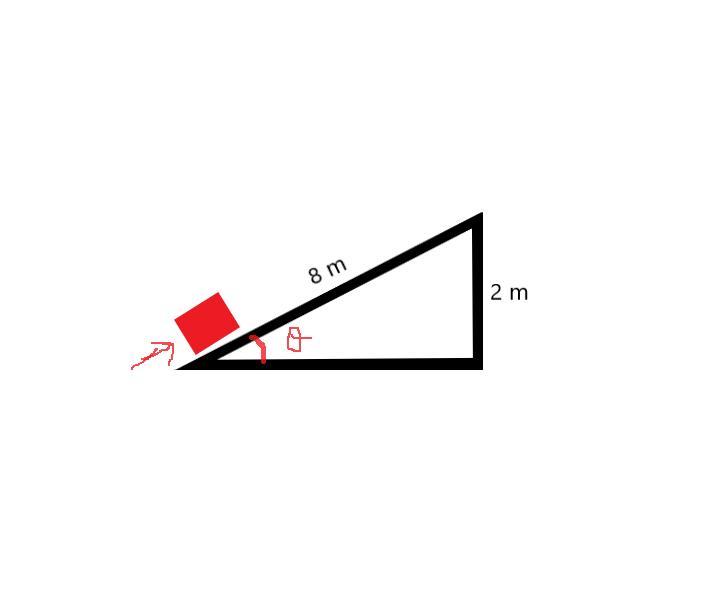
A frictionless inclined plane is 8.0 m long and rests on a wall that is 2.0 m high. How much force is needed to push a block of

ice weighing 300.0 N up the plane

Physics
1 answer:
serg [3.5K]2 months ago
7 0

Provided Information:

Length of inclined plane = 8 m

Height of inclined plane = 2 m

Weight of the ice block = 300 N

Required Information:

Force needed to push ice block = F =?

Answer:

Force needed to push the ice block = 75 N

Explanation:

The required force to push this ice block up an inclined plane is given by

F = Wsinθ

where W is the weight of the ice block and θ is the angle indicated in the attached image.

Using trigonometric ratios,

sinθ = opposite/hypotenuse

where the opposite side is the height of the inclined plane and the hypotenuse is the length of the inclined plane.

Thus, sinθ = 2/8

θ = sin⁻¹(2/8)

which leads to θ = 14.48°

Therefore, F = 300*sin(14.48)

results in F = 75 N

This indicates that a force of 75 N is necessary to push the ice block on the specified inclined plane.
You might be interested in
Define kinetic energy and thermal energy. Describe what happens to each as the temperature of a substances increases.
Keith_Richards [3271]
Kinetic energy refers to the energy an object possesses while in motion, whereas thermal energy corresponds to heat energy. In situations where heat increases in materials, such as a solid turning into a liquid, the molecules start to move more rapidly, resulting in a rise in kinetic energy.
4 0
2 months ago
Read 2 more answers
An infinite charged wire with charge per unit length lambda lies along the central axis of a cylindrical surface of radius r and
inna [3103]
The electric flux through the cylindrical surface surrounding the infinite charged wire is given by the formula ∅E = E x 2πrl. To analyze this, we consider an infinitely long straight wire with a uniform linear charge density of λ Cm⁻¹. The electric field at a distance r from this charge can be evaluated using a cylindrical Gaussian surface of radius r and length l, oriented along the wire. Only the curved surface of the cylinder contributes to the total flux since the other surfaces are perpendicular to E.
3 0
2 months ago
A circular surface with a radius of 0.057 m is exposed to a uniform external electric field of magnitude 1.44 × 10⁴ N/C. The mag
Softa [3030]

Answer:

57.94°

Explanation:

We understand that the formula for flux is

\Phi =E\times S\times COS\Theta

where Ф represents flux

           E indicates electric field

           S denotes surface area

        θ signifies the angle between the electric field direction and the surface normal.

It is given that Ф= 78 \frac{Nm^{2}}{sec}

                          E=1.44\times 10^{4}\frac{Nm}{C}

                          S=\pi \times 0.057^{2}

                         COS\Theta =\frac{\Phi }{S\times E}

 =   \frac{78}{1.44\times 10^{4}\times \pi \times 0.057^{2}}

 =0.5306

 θ=57.94°

4 0
3 months ago
An 800-N billboard worker stands on a 4.0-m scaffold weighing 500 N and supported by vertical ropes at each end. How far would t
Maru [3345]

Answer:

2.5 m

Explanation:

Billboard worker's weight = 800 N

Number of ropes = 2

Length of scaffold = 4 m

Weight of scaffold = 500 N

Tension present in rope = 550 N

The total torques will be

-800(4-x)-500\times 2+550\times 4=0\\\Rightarrow -800(4-x)=500\times 2-550\times 4\\\Rightarrow -800(4-x)=-1200\\\Rightarrow -x=\dfrac{1200}{800}-4\\\Rightarrow -x=-2.5\\\Rightarrow x=2.5\ m

The worker is positioned at 2.5 m

7 0
3 months ago
The crossbar of a goal post on a professional American football field sits at a height of 3.05 meters (10 feet) above the field.
Sav [3153]

Answer:

A. Yes, the ball clears the crossbar by 2.83 meters

Explanation:

This situation pertains to projectile motion.

The horizontal velocity component of the ball is calculated as 26 cos 35 = 21.3 m/s

The vertical velocity component is 26 sin 35 = 14.9 m/s

The time taken to travel the horizontal distance to the goalpost, which is 54.9 m, is:

= distance / horizontal speed

= 54.9 / 21.3

= 2.577 seconds.

The vertical distance achieved during this time is:

h = ut - 1/2 gt², where u is the initial vertical velocity, and t = 2.577 seconds.

h = 14.9 x 2.577 - 0.5 x 9.8 x (2.577)²

= 38.39 - 32.54

= 5.85 m

Thus, the ball surpasses the crossbar by 5.85 - 3.05 = 2.8 m

5 0
3 months ago
Other questions:
  • Explain why is not advisable to use small values of I in performing an experiment on refraction through a glass prism?
    8·1 answer
  • An object with charge q=−6.00×10⁻⁹C is placed in a region of uniform electric field and is released from rest at point A. After
    5·1 answer
  • If an electronic circuit experiences a loss of 3 decibels with an input power of 6 watts, what would its output power be, to the
    9·2 answers
  • Fiber optic (FO) cables are based upon the concept of total internal reflection (TIR), which is achieved when the FO core and cl
    8·1 answer
  • If you wanted to show the distance between earth and the moon on the same scale, about how far apart would you need to place the
    6·2 answers
  • A tortoise and hare start from rest and have a race. As the race begins, both accelerate forward. The hare accelerates uniformly
    11·1 answer
  • One beam of electrons moves at right angles to a magnetic field. the force on these electrons is 4.9 x 10⁻¹⁴ newtons. a second b
    13·1 answer
  • Lightning bolts can carry currents up to approximately 20 kA. We can model such a current as the equivalent of a very long, stra
    8·1 answer
  • A Hooke's law bowstring is stretched x meters until a force of f newtons is applied, and then held. By what factor will the elas
    13·1 answer
  • As a 1.0-kg object moves from point a to point b, it is acted upon by a single conservative force which does -40 j of work durin
    14·2 answers
Add answer
Login
Not registered? Fast signup
Signup
Login Signup
Ask question!
