answer.
Ask question
Login Signup
Ask question
All categories
  • English
  • Mathematics
  • Social Studies
  • Business
  • History
  • Health
  • Geography
  • Biology
  • Physics
  • Chemistry
  • Computers and Technology
  • Arts
  • World Languages
  • Spanish
  • French
  • German
  • Advanced Placement (AP)
  • SAT
  • Medicine
  • Law
  • Engineering
elena-14-01-66
10 days ago
10

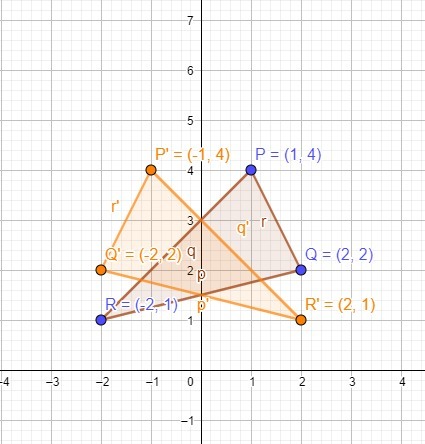
The coordinates of the vertices of △PQR are P(1, 4) , Q(2, 2) , and R(−2, 1) . The coordinates of the vertices of △P′Q′R′ are P′

(−1, 4) , Q′(−2, 2) , and R′(2, 1) .
Which statement correctly describes the relationship between △PQR and △P′Q′R′ ?

△PQR is congruent to △P′Q′R′ because you can map △PQR to △P′Q′R′ using a translation 2 units to the left, which is a rigid motion.
△PQR is congruent to △P′Q′R′ because you can map △PQR to △P′Q′R′ using a reflection across the y-axis, which is a rigid motion.
△PQR is not congruent to △P′Q′R′ because there is no sequence of rigid motions that maps △PQR to △P′Q′R′ .
△PQR is congruent to △P′Q′R′ because you can map △PQR to △P′Q′R′ using a reflection across the x-axis, which is a rigid motion.

Mathematics
You might be interested in
Find the rational form of 71.625​
Zina [12379]
71 5/8
7 0
2 months ago
The previous task asked you to select the rectangle that did not represent an enlargement of the given rectangle. explain how yo
AnnZ [12381]

El cuadro de proporciones debe reflejar dimensiones que sean comparables a las del rectángulo original. Es decir, las medidas de los rectángulos adicionales deben multiplicarse por un factor de escala para hacer el aumento. Revisé cada medida para confirmar si era un múltiplo del rectángulo original.


4 0
2 months ago
Read 2 more answers
Square T was translated by the rule (x + 2, y + 2) and then dilated from the origin by a scale factor of 3 to create square T″.
AnnZ [12381]

Answer: OPTION C.

Step-by-step explanation:

It is essential to consider the following:

Dilation:

  • A transformation where the image retains the same shape as the original but differs in size.
  • Dilation maintains the order of points.
  •  Measurements of angles remain unchanged.

Translation:

  • A transformation that keeps the image identical in size and shape to the original.
  • Translation preserves the ordering of points.
  • The angle measurements do not change.

Consequently, since Square T underwent translation followed by dilation to form Square T'', we conclude that the rationale explaining why they are similar is:

Translations and dilations maintain the order of points; thereby, the corresponding sides of squares T and T″ are proportional.

6 0
2 months ago
Read 2 more answers
Pete's dad usually deposits $25 into his bank account every week. for the next 8 weeks , he wants to deposit more than the usual
Svet_ta [12734]
Option B is correct, expressed as 8(25 + x) > 500; solving for x gives x > 37.50
8 0
3 months ago
Read 2 more answers
Other questions:
  • It is recommended that adults consume at least 1,000 mg of calcium every day. One ounce of whole milk contains about 25 mg of ca
    13·1 answer
  • The table shows ordered pairs of the function y = 16 + 0.5x .
    15·1 answer
  • Jessica is selling books during the summer to earn money for college. She earns a commission on each sale but has to pay for her
    12·2 answers
  • G = x-c/x solve for x
    14·2 answers
  • ) If the pattern shown continues, how many black keys appear on a portable keyboard with 49 white keys? Suggestion: use equivale
    12·2 answers
  • How many models of 100 do you need to model 3,200 explain
    11·2 answers
  • Which is the solution set of the compound inequality 3.5 x minus 10 greater-than negative 3 and 8 x minus 9 less-than 39 Negativ
    6·2 answers
  • A local college bookstore paid a net price of $12,500 for textbooks for the coming semester. The publisher offered a trade disco
    9·1 answer
  • A nationwide sample of influential Republicans and Democrats was asked as a part of a comprehensive survey whether they favored
    11·1 answer
  • Complete the coordinate proof of the theorem. Given: A B C D is a parallelogram. Prove: The diagonals of A B C D bisect each oth
    9·2 answers
Add answer
Login
Not registered? Fast signup
Signup
Login Signup
Ask question!