answer.
Ask question
Login Signup
Ask question
All categories
  • English
  • Mathematics
  • Social Studies
  • Business
  • History
  • Health
  • Geography
  • Biology
  • Physics
  • Chemistry
  • Computers and Technology
  • Arts
  • World Languages
  • Spanish
  • French
  • German
  • Advanced Placement (AP)
  • SAT
  • Medicine
  • Law
  • Engineering
Rama09
11 days ago
6

Kayla, a fitness trainer, develops an exercise that involves pulling a heavy crate across a rough surface. The exercise involves

using a rope to pull a crate of mass M = 45.0 kg along a carpeted track. Using her physics expertise, Kayla determines that the coefficients of kinetic and static friction between the crate and the carpet are μk = 0.410 and μs = 0.770, respectively. Next, Kayla has Ramon pull on the rope as hard as he can. If he pulls with a force of F = 325 N along the direction of the rope, and the rope makes the same angle of θ = 23.0 degrees with the floor, what is the acceleration of the box?

Physics
1 answer:
Yuliya22 [1.1K]11 days ago
5 0

Answer:

a = 3.784\,\frac{m}{s^{2}}

Explanation:

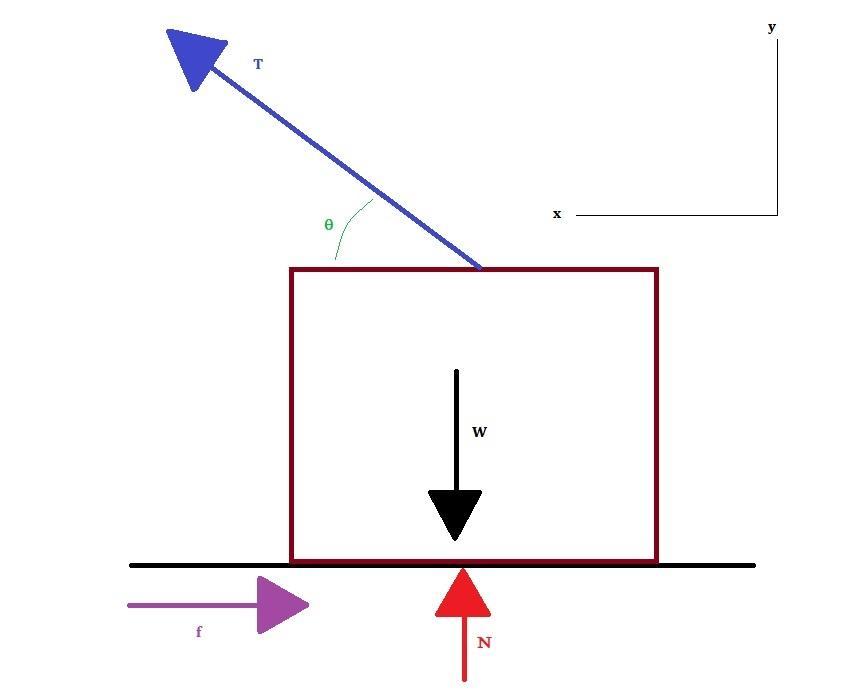
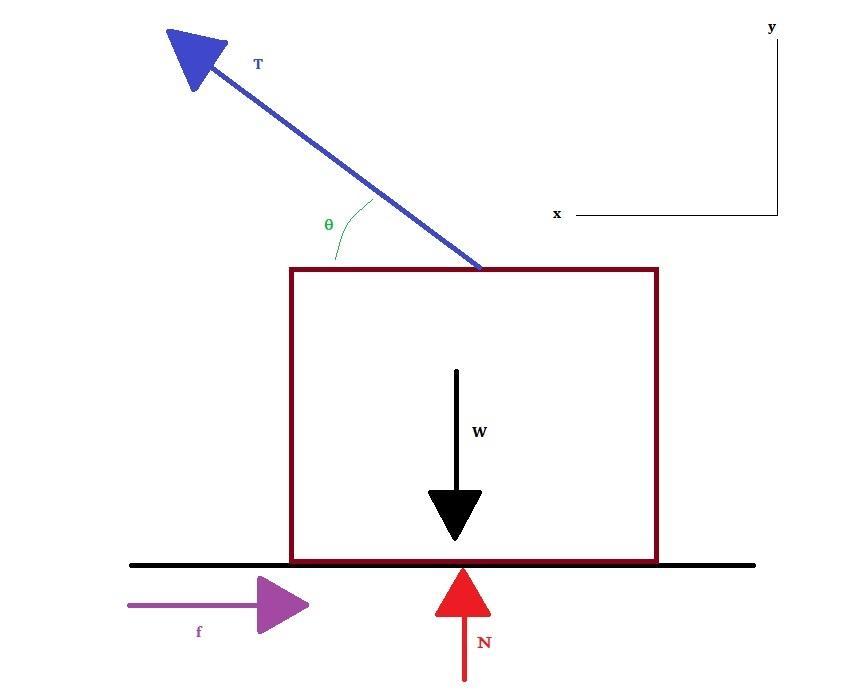
The Free Body Diagram depicting the assembly consisting of the crate and rope, alongside the reference axis, is illustrated in the image provided. Following is a presentation of the equilibrium equations:

\Sigma F_{x} = T\cdot \cos \theta - \mu\cdot N = m\cdot a

\Sigma F_{y} = T\cdot \sin \theta + N - m\cdot g = 0

Through some algebraic manipulation, the equations consolidate into a single expression:

N = m\cdot g - T\cdot \sin \theta

T\cdot \cos \theta - \mu \cdot (m\cdot g - T\cdot \sin \theta) =m\cdot a

T\cdot (\cos\theta + \mu \cdot \sin \theta) - \mu \cdot m \cdot g = m\cdot a

The minimum force necessary to initiate the crate's acceleration from a stationary state is:

T_{min} = \frac{m\cdot \mu_{s}\cdot g}{\cos \theta + \mu_{s} \cdot \sin \theta}

T_{min} = \frac{(45\,kg)\cdot (0.770)\cdot (9.807\,\frac{m}{s^{2}} )}{\cos 23^{\textdegree}+(0.770)\cdot \sin 23^{\textdegree}}

T_{min} = 278.223\,N

As indicated by T > T_{min}, the crate will experience acceleration due to tension. Thus, the crate will have an acceleration of:

a = \frac{T}{m}\cdot (\cos \theta + \mu_{k}\cdot \sin \theta)-\mu_{k}\cdot g

a = \frac{325\,N}{45\,kg}\cdot [\cos 23^{\textdegree}+(0.410)\cdot \sin 23^{\textdegree}]-(0.410)\cdot (9.807\,\frac{m}{s^{2}} )

a = 3.784\,\frac{m}{s^{2}}

You might be interested in
Three point charges are positioned on the x axis. If the charges and corresponding positions are +32 µC at x = 0, +20 µC at x =
Sav [1105]

Response:

Magnitude of the electrostatic force acting on the +32 µC charge, F_{net} = 12 N

Clarification:

Let q₁ = +32 µC, located at x₁ = 0

q₂ = +20 µC, positioned at x₂ = 40 cm = 0.4 m

q₃ = -60 µC, placed at x₃ = 60 cm = 0.6 m

Define the force magnitude on the +32 µC charge from the +20 µC charge as F₁ (the force on q₁ due to q₂).

F_{2} = \frac{kq_{1}q_{2} }{x_{2}^2 }

F_{2} = \frac{9 * 10^{9} * 32 * 10^{-6} * 20 * 10^{-6} }{0.4^2 }\\F_{2} = 36 N

Define the force magnitude on the +32 µC charge from the -60 µC charge as F₂ (the force on q₁ due to q₃).

F_{3} = \frac{kq_{1}q_{3} }{x_{3}^2 }

F_{3} = -\frac{9 * 10^{9} * 32 * 10^{-6} * 60 * 10^{-6} }{0.6^2 }\\F_{3} =-48 N

The resultant electrostatic force on the 32 µC charge is F_{net} = |F_{2} + F_{3}|

F_{net} =| 36 + (-48)| \\F_{net} =|- 12 N| \\ F_{net} = 12 N

7 0
1 day ago
Two planets having equal masses are in circular orbit around a star. Planet A has a smaller orbital radius than planet B. Which
serg [1198]

Answer:

Explanation:

To approach this problem, we need to understand two key concepts.

First, the gravitational force on an object in orbit equals its mass multiplied by centripetal acceleration.

Secondly, Newton's law of universal gravitation defines the force between two masses: Fg = mMG/r², where Fg denotes gravitational force, m and M signify the masses, G represents the gravitational constant, and r indicates the distance separating the two masses.

Thus:

Fg = m v²/r

mMG/r² = m v²/r

v² = MG/r

Potential energy for each planet is expressed as:

PE = mgr = m (MG/r²) r = mMG/r

Kinetic energy for each planet is computed as:

KE = 1/2 mv² = 1/2 m (MG/r) = 1/2 mMG/r

Total mechanical energy is calculated as:

ME = PE + KE = 3/2 mMG/r

Since both planets share the same mass, the only variable is their orbital radius. Consequently, Planet A, with a smaller radius, possesses greater potential, kinetic, and mechanical energy.

6 0
13 days ago
the flow energy of 124 L/min of a fluid passing a boundary to a system is 108.5 kJ/min. Determine the pressure at this point
serg [1198]

Answer:

The pressure measured at this moment is 0.875 mPa

Explanation:

Given that,

Flow energy = 124 L/min

Boundary to system P= 108.5 kJ/min

P=1.81\ kW

We are tasked with finding the pressure here

Applying the pressure formula

P=F\times v

P=A_{1}P_{1}\times v_{1}

Here, A_{1}v_{1}=Q_{1}

Where, v refers to velocity

Insert the values into the equation

1.81 =P_{1}\times0.124\times\dfrac{1}{60}

P_{1}=\dfrac{1.81\times60}{0.124}

P_{1}=875.80\ kPa

P_{1}=0.875\ mPa

Therefore, the pressure at this moment is 0.875 mPa

5 0
11 days ago
If you are anchored in a fixed spot, and a set of six waves pass underneath you during a 60 second time interval, what is the wa
Ostrovityanka [942]

Answer:

Explanation:

Within a duration of 60 seconds, six waves are observed.

With a total of 6 waves,

this equates to 3 wavelengths.

As a result,

the period for each wavelength is calculated as 60 divided by 3.

Thus, period = 20 seconds.

According to the frequency-period relationship,

f = 1 / T

f = 1 / 20

f = 0.05 Hz

5 0
2 days ago
What is the gauge pressure of the water right at the point p, where the needle meets the wider chamber of the syringe? neglect t
Yuliya22 [1153]

Details that are not provided: the problem figure is included.

We can address the exercise by applying Poiseuille's law. This law indicates that for a fluid flowing in a laminar manner within a confined pipe,

\Delta P = \frac{8 \mu L Q}{\pi r^4}

where:

\Delta P represents the pressure difference across the two ends

\mu denotes the viscosity of the fluid

L signifies the length of the pipe

Q=Av indicates the volumetric flow rate, where A=\pi r^2 is the cross-sectional area of the tube and v refers to the fluid's velocity

r stands for the pipe's radius.

This law can be utilized for the needle, allowing us to compute the pressure difference between point P and the needle's end. In this scenario, we have:

\mu=0.001 Pa/s is the dynamic viscosity of water at 20^{\circ}

L=4.0 cm=0.04 m

Q=Av=\pi r^2 v= \pi (1 \cdot 10^{-3}m)^2 \cdot 10 m/s =3.14 \cdot 10^{-5} m^3/s

and r=1 mm=0.001 m

Substituting these values into the formula yields:

\Delta P = 3200 Pa

This pressure difference specifies the value between point P and the needle's termination. As the end of the needle is under atmospheric pressure, the gauge pressure at point P, relative to atmospheric pressure, is exactly 3200 Pa.

8 0
12 days ago
Other questions:
  • A child runs at speed vc while an adult runs at speed va. if the adult gives the child a head start of distance d, how long will
    8·1 answer
  • In a later chapter we will be able to show, under certain assumptions, that the velocity v(t) of a falling raindrop at time t is
    6·1 answer
  • You are an industrial engineer with a shipping company. As part of the package- handling system, a small box with mass 1.60 kg i
    9·1 answer
  • A clever inventor has created a device that can launch water balloons with an initial speed of 85.0 m/s. Her goal is to pass a b
    8·1 answer
  • A hydraulic lift raises a 2000 kg automobile when a 500 N force is applied to the smaller piston. If the smaller piston has an a
    8·1 answer
  • A merry-go-round initially at rest at an amusement park begins to rotate at time t=0. The angle through which it rotates is desc
    10·1 answer
  • Two balls of unequal mass are hung from two springs that are not identical. The springs stretch the same distance as the two sys
    12·1 answer
  • A car drives off a cliff next to a river at a speed of 30 m/s and lands on the bank on theother side. The road above the cliff i
    11·1 answer
  • Two Resistances R1 = 3 Ω and R2 = 6 Ω are connected in series with an ideal battery supplying a voltage of ∆ = 9 Volts. Sketch t
    6·1 answer
  • A dipole of moment 0.5 e·nm is placed in a uniform electric field with a magnitude of 8 times 104 N/C. What is the magnitude of
    11·1 answer
Add answer
Login
Not registered? Fast signup
Signup
Login Signup
Ask question!