answer.
Ask question
Login Signup
Ask question
All categories
  • English
  • Mathematics
  • Social Studies
  • Business
  • History
  • Health
  • Geography
  • Biology
  • Physics
  • Chemistry
  • Computers and Technology
  • Arts
  • World Languages
  • Spanish
  • French
  • German
  • Advanced Placement (AP)
  • SAT
  • Medicine
  • Law
  • Engineering
Rina8888
1 month ago
13

Samples of three different compounds were analyzed and the masses of each element were determined. Compound Mass N (g) Mass O (g

) A 5.6 3.2 B 3.5 8.0 C 1.4 4.0 If you were John Dalton and had never heard of a mole, which of the following would you think were possible sets of formulas for the compounds A, B, and C, respectively? a. NO2, NO8, NO10
b. NO4, NO10, NO5
c. N2O, N2O4, N2O5
d. NO, NO2, NO4

Chemistry
2 answers:
Anarel [2.9K]1 month ago
6 0

The correct answer is: c. N2O, N2O4, N2O5.

According to the law of multiple proportions, also referred to as Dalton's Law, when two elements form compounds, the mass ratios of the second element that combine with a specific mass of the first yield small whole number ratios.

1) For NO, the mass ratio m(N): m(O) is 14: 16, simplified to 7: 8.

2) In N₂O, the ratio m(N): m(O) equates to 2·14: 16, which simplifies to 7: 4.

3) For NO₂, the masses yield m(N): m(O) = 14: 2·16, simplifying to 7: 16.

4) In N₂O₅, the ratio is (2·14): (5·16), which simplifies to 7: 20.

5) For NO₄, the mass ratio is m(N): m(O) = 14: (4·16), which simplifies to 7: 32.

6) N₂O₄ gives a ratio of m(N): m(O) as (2·14): (4·16), simplifying to 7: 16.

A) This means m(N): m(O) = 5.6 g: 3.2 g, simplifying results in 1.75: 1, which further translates to m(N): m(O) = 7: 4.

B) Here, m(N): m(O) is 3.5 g: 8.0 g. Dividing reveals a ratio of 1: 2.285, which alters to m(N): m(O) = 7: 16.

C) Lastly, for m(N): m(O) = 1.4 g: 4.0 g, then adjustments yield a ratio of m(N): m(O) = 7: 20.
KiRa [2.9K]1 month ago
5 0

The possible formula in Dalton's time (had never heard of a mole)

a. NO₂, NO₈, NO₁₀

c. N₂O, N₂O₄, N₂O₅

Further explanation

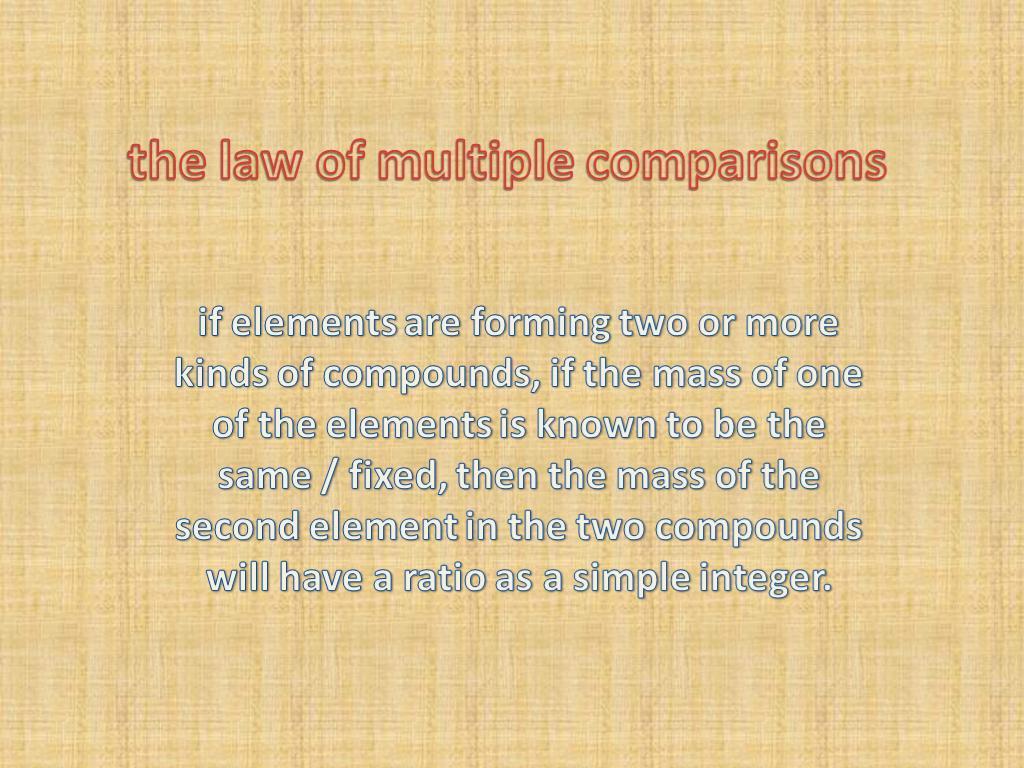
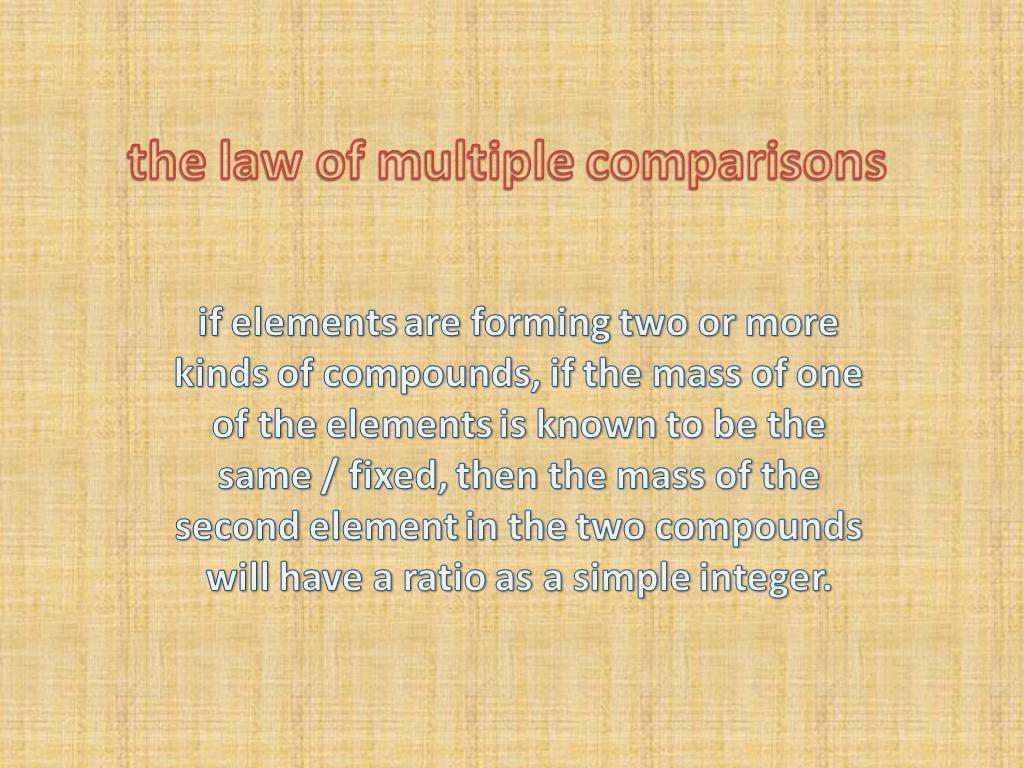
Dalton's law of multiple proportions asserts that when two or more types of compounds emerge from the same elements, if one element's mass remains unchanged, the other element's mass in the different compounds will be expressible as a simple integer ratio.

An analysis of the samples reveals the mass ratio of nitrogen and oxygen in the following compounds:

  • 1. Compound A: N: O = 5.6: 3.2 = 1.75: 1
  • 2. Compound B: N: O = 3.5: 8.0 = 1: 2.235
  • 3. Compound C: N: O = 1.4: 4.0 = 1: 2.8857

To reduce the numbers to simpler whole numbers, we multiply the ratio by 7, resulting in:

Compound A: 7: 4

Compound B: 7:16

Compound C: 7:20

This proportion clearly indicates that for every nitrogen atom, the ratios for oxygen are 4:16:20 = 1: 4: 5 (consistent with Dalton's theory)

Consequently, based on Dalton's views (which exclude the mole concept), the possible compounds can be:

a. NO₂, NO₈, NO₁₀

c. N₂O, N₂O₄, N₂O₅

If we apply the mole concept, which reveals the compounds' empirical formulas, the mole ratios of the compounds are as follows:

  • Compound A:

5.6 / 14: 3.2: 16 = 0.4: 0.2 = 2: 1

  • Compound B:

3.5 / 14: 8/16 = 0.25: 0.5 = 1: 2 = 2: 4

  • Compound C:

1.4 / 14: 4/16 = 0.1: 0.25 = 2: 5

Thus, by utilizing the mole concept, the relevant compounds are c. N₂O, N₂O₄, N₂O₅

Learn more

A sample of H₂SO₄

Keywords: Dalton, the law of multiple comparisons

You might be interested in
When small pieces of manganese oxide were added to a solution of hydrogen peroxide, water and oxygen were produced. Manganese ox
lions [2927]
In the reaction mentioned, increasing the solution's quantity probably increases the reaction rate. This is because a larger number of reactant molecules increases the likelihood of collisions, thereby accelerating the reaction rate. For instance, when manganese oxide is added to hydrogen peroxide, a greater amount of reactants leads to a faster reaction.
4 0
19 days ago
On occasion, it has been found that the oxidation of borneol doesn't go to completion (possibly because of poor stirring or insu
VMariaS [2998]

Response:

Examine the explanation

Explanation:

In this scenario, Nitrogen (N) experiences oxidation while Chlorine (Cl) undergoes reduction.

In response to your inquiry:

N is oxidized from an oxidation state of -3 to -1.

Cl is reduced from an oxidation state of +1 to -1.

At this point,

Borneol will likely exhibit a lower Rf due to its boiling point.

3 0
19 days ago
2.00 liters of hydrogen, originally at 25.0 °C and 750.0 mm of mercury, are heated until a volume of 20.0 liters and a pressure
eduard [2782]

Response:  The updated temperature stands at 10643 K

Clarification:

The combined gas law integrates Boyle's law, Charles's law, and Gay-Lussac's law.

The equation for this law is given by:

\frac{P_1V_1}{T_1}=\frac{P_2V_2}{T_2}

where,

P_1 = initial gas pressure = 750.0 mm Hg = 0.98 atm   (760mmHg=1atm)

P_2 = final gas pressure = 3.50 atm

V_1 = initial gas volume = 2.00 L

V_2 = final gas volume = 20.0 L

T_1 = initial gas temperature = 25.0^oC=273+25.0=298.0K

T_2 = final gas temperature =?

Now substituting all the stated values into the equation, we obtain:

\frac{0.98\times 2.00}{298.0K}=\frac{3.50\times 20.0}{T_2}

T_2=10643K

Thus, the new temperature results in 10643 K

6 0
1 month ago
Compaction is most significant as a lithification process for sedimentary rocks composed of sand-sized particles. True False
VMariaS [2998]

Response:

FALSE

Rationale:

Sedimentary rocks are defined as rocks formed through the processes of compaction and cementation. Initially, sediments derived from various locations must accumulate. Over time, these deposited sediments undergo substantial compaction due to the weight of the layers above. This process converts loose sediments into solid rock. This is the process through which sedimentary rocks, comprised of sand-sized particles, are formed. For instance, examples include Shale, Sandstone, and Mudstone.

Thus, both compaction and cementation are crucial in the formation of sedimentary rocks.

Therefore, the statement above is False.

8 0
1 month ago
a nurse practitioner orders Medrol to be given 1.5 mg/kg of body weight. if a child weighs 72.6lb and the available stock of Med
KiRa [2933]
The amount to administer to the child is 2,469 mL.
To convert to kilograms (kg), the child's weight in pounds (lb) is multiplied by 0.45359237: m(child) = 72.6 · 0.045359237 = 32.93 kg.
To find m(Medrol), the child's mass in kilograms is multiplied by 1.5 mg/kg.
Thus, m(Medrol) = 32.93 kg · 1.5 mg/kg = 49.39 mg.
The concentration of Medrol is d(Medrol) = 20.0 mg/mL.
To find the volume of Medrol needed, use V(Medrol) = m(Medrol) ÷ d(Medrol).
So, V(Medrol) = 49.39 mg ÷ 20 mg/mL = 2,469 mL.

8 0
1 month ago
Other questions:
  • How many carbon atoms are there in a 1.3-carat diamond? diamonds are a form of pure carbon. (1 carat?
    13·2 answers
  • Consider a general reaction A ( aq ) enzyme ⇌ B ( aq ) A(aq)⇌enzymeB(aq) The Δ G ° ′ ΔG°′ of the reaction is − 5.980 kJ ⋅ mol −
    15·1 answer
  • A gold wire has a diameter of 1.00 mm. What length of this wire contains exactly 1.00 mol of gold? (density of Au = 17.0 g/cm3)
    11·2 answers
  • Draw the four structures of the compounds with molecular formula C5H10O that contain a carbon-carbon double bond, an unbranched
    12·1 answer
  • In a voltaic cell made of a Ag strip and an Al strip immersed in 1.0 M aqueous AgNO_3 and Al(NO_3)_3 solutions, respectively, wi
    6·1 answer
  • If the pOH of vinegar is 9.45, what is its [OH− ]?
    11·2 answers
  • You have a mixture that contains 0.380 moles of Ne(g), 0.250 moles of He(g), and 0.500 moles CH4(g) at 400 K and 7.25 atm. What
    11·1 answer
  • 34.62 mL of 0.1510 M NaOH was needed to neutralize 50.0 mL of an H2SO4 solution. What is the concentration of the original sulfu
    9·1 answer
  • Sulfur, Tungsten, and Silver, they’ve got so much _______.
    14·1 answer
  • A robber is in a fast car, hurrying away from the scene of his crime. His car can go at 150 km/h. He will be safe if he can reac
    7·1 answer
Add answer
Login
Not registered? Fast signup
Signup
Login Signup
Ask question!