answer.
Ask question
Login Signup
Ask question
All categories
  • English
  • Mathematics
  • Social Studies
  • Business
  • History
  • Health
  • Geography
  • Biology
  • Physics
  • Chemistry
  • Computers and Technology
  • Arts
  • World Languages
  • Spanish
  • French
  • German
  • Advanced Placement (AP)
  • SAT
  • Medicine
  • Law
  • Engineering
Furkat
10 days ago
6

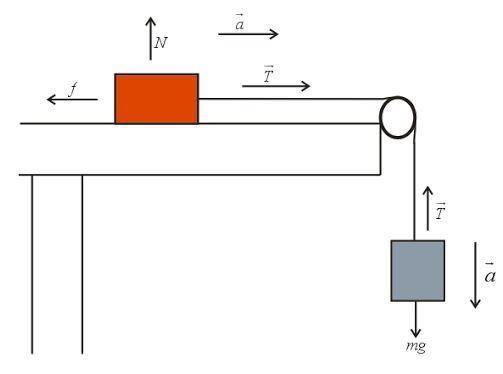
Find an expression for the acceleration a of the red block after it is released. use mr for the mass of the red block, mg for th

e mass of the gray block, and μk for the coefficient of kinetic friction between the table and the red block. express your answer in terms of mr, mg, μk, and g.

Physics
2 answers:
Keith_Richards [1K]10 days ago
6 0

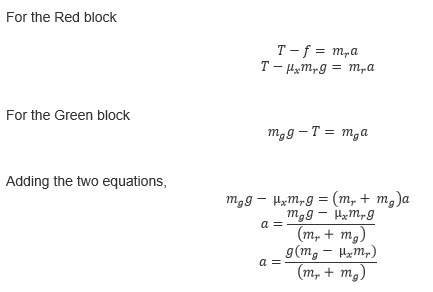
<span>Assuming the pulley operates without friction. Denote the tension as ‘T’. See the equation provided below.</span>

<span> </span>

Maru [1K]10 days ago
3 0

The formula for the acceleration of the red block once it is released from rest is

\fbox{\begin{minispace}\\{a = \dfrac{{\left( {{m_g} - \mu {m_r}} \right)g}}{\left( {{m_g} + {m_r}} \right)}}\end{minispace}}

Further Explanation:

The friction force opposing the movement of the red block on the table works against the direction of motion. The motion of the overall system, including the red and grey blocks, is directed downwards. Therefore, the tension in the string is lower than the weight of the grey block.

Given:

The mass of the red block is {m_r}.

The mass of the grey block is {m_g}.

The coefficient of friction between the red block and the table is \mu.

Concept:

The total force acting on the red block follows the direction of the system's motion and equates to the tension minus the friction force.

The total force acting on the red block is:

{m_r}a = T - f

Rearranging the above expression yields:

T = {m_r}a + f

Substituting \mu {m_r}g for f in the above equation gives:

\fbox{\begin\\T = {m_r}a + \mu {m_r}g\end{minispace}}                                                           …… (1)

Here,  T stands for the tension in the string, {m_r} represents the mass of the red block, a indicates the acceleration of the system, and g is the gravitational acceleration.

The total force affecting the grey block is in the direction of the system's motion and is the difference between the weight of the grey block and the tension in the string.

The total force acting on the grey block is:

{m_g}a = {m_g}g - T                                                                        …… (2)

Here, {m_g} denotes the mass of the grey block.

Substituting {m_r}a + \mu {m_r}g for T into equation (2) allows us to write:

{m_g}a = {m_g}g - \left( {{m_r}a + \mu {m_r}g} \right)

Rearranging the above expression gives:

{m_g}a + {m_r}a = {m_g}g - \mu {m_r}g

Simplifying the above expression results in:

\fbox{\begin{minispace}\\{a = \dfrac{{\left( {{m_g} - \mu {m_r}} \right)g}}{\left( {{m_g} + {m_r}} \right)}}\end{minispace}}

Learn more:

1. Change in momentum  

2. The motion of a object under friction

3. A ball descending under gravitational acceleration

Answer Details:

Grade: College

Subject: Physics

Chapter: Kinematics

Keywords:

Acceleration, friction, tension, system of two blocks, pulley mass system, motion, net force, string, block on the table, hanging block through a pulley, block being released from rest.
You might be interested in
What happens to the particles of a liquid when energy is removed from them?
Softa [913]

Response:

D: The distance among the particles diminishes

Clarification:

Removing energy reduces the activity of molecules, similar to how one slows down in cold temperatures (I believe).

3 0
10 days ago
A 5.8 × 10⁴-watt elevator motor can lift a total weight of 2.1 × 10⁴ newtons with a maximum constant speed of
Keith_Richards [1034]
Power is defined as the speed at which work is performed on an object. Like all rates, power is measured in relation to time. It reflects how quickly a task is completed. Two identical tasks can be executed at varying speeds - one slower and the other faster. The equation P = Fv can be used, where P symbolizes power, F denotes force, and V represents average velocity. Calculating the average velocity gives us V = P/F, or V = (5.8 x 10^4 W) / (2.1 x 10^4 N), resulting in V = 2.8 m/s.
8 0
10 days ago
Astronomers determine that a certain square region in interstellar space has an area of approximately 2.4 \times 10^72.4×10 ​7 ​
Sav [1105]

Answer:

1.5 × 10³⁶ light-years

Explanation:

A particular square area in interstellar space measures roughly 2.4 × 10⁷² (light-years)². To find the area of a square, the following formula is utilized:

A = l²

where,

A represents the area of the square

l denotes the length of one side of the square

Thus, l = √A = √2.4 × 10⁷² (light-years)² = 1.5 × 10³⁶ light-years

5 0
6 days ago
A Chevrolet Corvette convertible can brake to a stop from a speed of 60.0 mi/h in a distance of 123 ft on a level roadway. What
kicyunya [1025]

Response:

83.1946504051 m

Rationale:

u = Starting velocity = 60\ mph=\dfrac{60\times 1609.34}{3600}=26.82233\ m/s

s = Distance traveled = 123\ ft=\dfrac{123}{3.281}=37.4885705578\ m

\theta = Incline = 26^{\circ}

v^2-u^2=2as\\\Rightarrow a=\dfrac{v^2-u^2}{2s}\\\Rightarrow a=\dfrac{0^2-26.82233^2}{2\times 37.4885705578}\\\Rightarrow a=-9.5954230306\ m/s^2

Friction coefficient

\mu=-\dfrac{a}{g}\\\Rightarrow \mu=\dfrac{9.5954230306}{9.81}\\\Rightarrow \mu=0.978126710561

mg sin\theta - u mg cos\theta = ma\\\Rightarrow a=9.81(sin26-0.978126710561cos26)\\\Rightarrow a=-4.32382\ m/s^2

v^2-u^2=2as\\\Rightarrow s=\dfrac{v^2-u^2}{2a}\\\Rightarrow s=\dfrac{0^2-26.82233^2}{2\times -4.32382}\\\Rightarrow s=83.1946504051\ m

The calculated stopping distance is 83.1946504051 m

6 0
15 days ago
A rocket takes off vertically from the launch pad with no initial velocity but a constant upward acceleration of 2.25 m/s^2. At
kicyunya [1025]

Answer:

A) 328 m

B) 80.22 m/s

C) 8.18 sec

Explanation:

A)

The rocket's initial acceleration is 2.25 m/s²

Time until engine failure is 15.4 s

Initial velocity u during takeoff = 0 m/s

Distance covered while the engine is functional =?

We apply Newton's laws for this calculation

S = ut + \frac{1}{2}at^{2}

Here, S represents the distance traveled under the rocket's thrust

S = (0 x 15.4) + \frac{1}{2}(2.25 x 15.4^{2})

S = 0 + 266.81 m = 266.81 m

Before the engine fails, the final velocity can be found using:

v = u + at

v = 0 + (2.25 x 15.4) = 34.65 m/s

Once the engine fails, the rocket decelerates under gravitational pull at g = -9.81 m/s²  (acting downwards)

The upward initial velocity when freefall begins is v = 34.65 m/s

The final velocity is reached at peak height, where the rocket halts, therefore:

u = 0 m/s

The distance covered during this freefall will be s =?

Utilizing the equation

v^{2} = u^{2} + 2gs

0^{2} = 34.65^{2} + 2(-9.81 x s)

0 = 1200.6 - 19.62s

-1200.6 = -19.62s

s = -1200.6/-19.62 = 61.19 m

Thus,

Maximum Height = 266.81 m  + 61.19 m =  328 m

B)

At maximum height, the rocket’s initial upward velocity drops to 0 m/s (the rocket completely stops)

The descent occurs freely under g = 9.81 m/s² (acting downwards)

The distance covered during the fall will be 328 m

Final velocity v just prior to impact =?

Applying v^{2} = u^{2} + 2gs

v^{2} = 0^{2} + 2(9.81 x 328)

v^{2} = 0 + 6435.36

v = \sqrt{6435.36} = 80.22 m/s

The time taken before reaching the pad is found as follows

v = u + gt

80.22 = 0 + 9.81t

t = 80.22/9.81 = 8.18 sec

7 0
5 days ago
Other questions:
  • A group of physics students hypothesize that for an experiment they are performing, the speed of an object sliding down an incli
    13·2 answers
  • A small segment of wire contains 10 nC of charge. The segment is shrunk to one-third of its original length. A proton is very fa
    10·1 answer
  • The nucleus of an atom has all of the following characteristics except that it
    5·1 answer
  • A 10-turn conducting loop with a radius of 3.0 cm spins at 60 revolutions per second in a magnetic field of 0.50T. The maximum e
    8·1 answer
  • A cylindrical tank of methanol has a mass of 40 kgand a volume of 51 L. Determine the methanol’s weight, density,and specific gr
    10·1 answer
  • A merry-go-round initially at rest at an amusement park begins to rotate at time t=0. The angle through which it rotates is desc
    10·1 answer
  • A ball is dropped from the top of a cliff. By the time it reaches the ground, all the energy in its gravitational potential ener
    14·1 answer
  • A kangaroo jumps to a vertical height of 2.8 m. How long was it in the air before returning to earth
    9·1 answer
  • Energy is observed in two basic forms: potential and kinetic. Which of the following correctly matches these forms with a source
    7·1 answer
  • The resultant of the concurrent forces is 300 lb pointing up along the Y axis. Compute the values of F and the angle required to
    12·2 answers
Add answer
Login
Not registered? Fast signup
Signup
Login Signup
Ask question!