answer.
Ask question
Login Signup
Ask question
All categories
  • English
  • Mathematics
  • Social Studies
  • Business
  • History
  • Health
  • Geography
  • Biology
  • Physics
  • Chemistry
  • Computers and Technology
  • Arts
  • World Languages
  • Spanish
  • French
  • German
  • Advanced Placement (AP)
  • SAT
  • Medicine
  • Law
  • Engineering
DENIUS
3 months ago
6

In this problem you are to consider an adiabaticexpansion of an ideal diatomic gas, which means that the gas expands with no add

ition or subtraction of heat.
Assume that the gas is initially at pressure p0, volume V0, and temperature T0. In addition, assume that the temperature of the gas is such that you can neglect vibrational degrees of freedom. Thus, the ratio of heat capacities is γ=Cp/CV=7/5.

Note that, unless explicitly stated, the variable γ should not appear in your answers--if needed use the fact that γ=7/5 for an ideal diatomic gas.

Part A

Find an analytic expression for p(V), the pressure as a function of volume, during the adiabatic expansion.

Express the pressure in terms of V and any or all of the given initial values p0, T0, and V0.

Correct

p(V) =
p0(V0V)75

Part B

At the end of the adiabatic expansion, the gas fills a new volume V1, where V1>V0. Find W, the work done by the gas on the container during the expansion.

Express the work in terms of p0, V0, and V1. Your answer should not depend on temperature.

Part C

Find ΔU, the change of internal energy of the gas during the adiabatic expansion from volume V0 to volume V1.

Express the change of internal energy in terms of p0, V0, and/or V1.

Need Part B and C
Physics
1 answer:
Ostrovityanka [3.2K]3 months ago
6 0

Answer:

a)

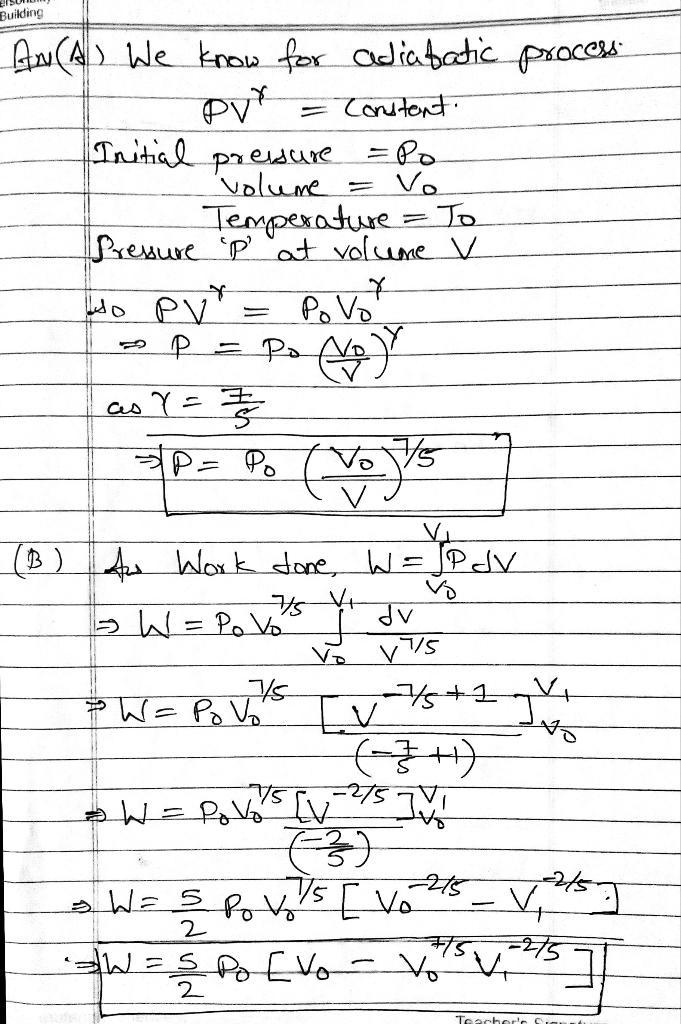
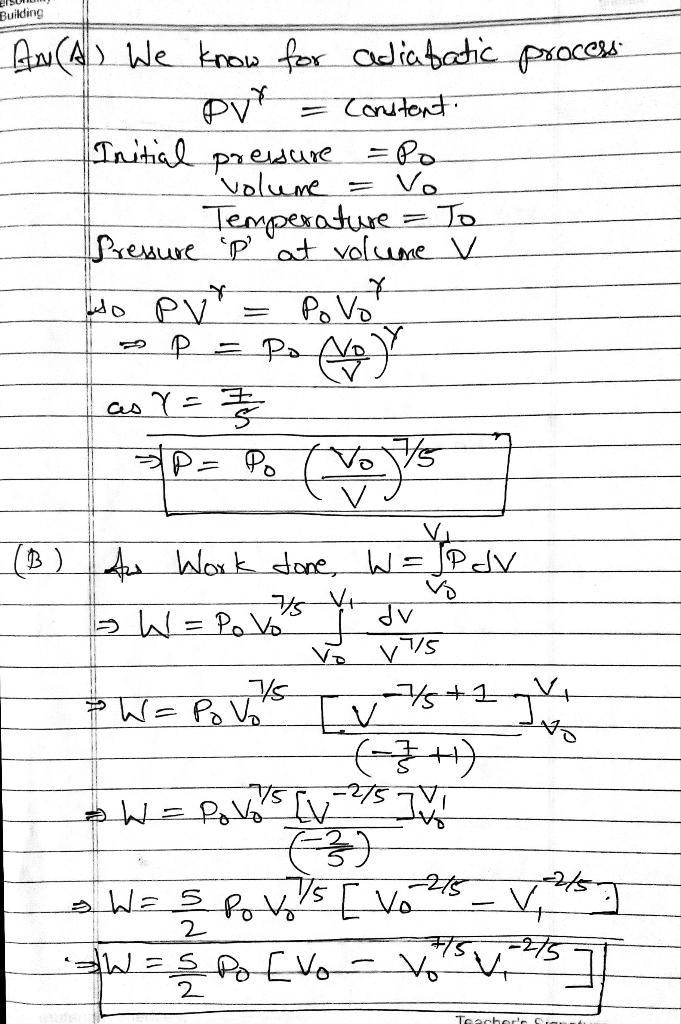
The analytic expression for p(V) is P(V) = P_{0}(\frac{V_{0}}{V})^{7/5}

b)

The work expression in terms of p0, V0, and V1 is

          W= \frac{5}{2} P_{0}[V_{0}-V_{0}^{7/5}V_{1}^{-2/5}]

c)

The alteration in internal energy of the gas

     \delta U = \frac{5}{2}P_{0}[V_{0}^{7/5}V_{1}^{-2/5}-V_{0}]

Explanation:

This explanation is presented in the first, second, and third sections of the material.

You might be interested in
An air hockey game has a puck of mass 30 grams and a diameter of 100 mm. The air film under the puck is 0.1 mm thick. Calculate
inna [3103]

Answer:

the time it takes after impact for the puck is 2.18 seconds

Explanation:

initially given information

mass = 30 g = 0.03 kg

diameter = 100 mm = 0.1 m

thickness = 0.1 mm = 1 ×10^{-4} m

dynamic viscosity = 1.75 ×10^{-5} Ns/m²

temperature of air = 15°C

to determine

time needed for the puck to reduce its speed by 10%

solution

we note that velocity changes from 0 to v

assuming initial velocity = v

therefore final velocity = 0.9v

implying a change in velocity is du = v

and clearance dy = h

shear stress acting on the surface is expressed as

= µ \frac{du}{dy}

therefore

= µ \frac{v}{h}............1

substituting the values

= 1.75 ×10^{-5} × \frac{v}{10^{-4}}

= 0.175 v

the area between the air and puck is given by

Area = \frac{\pi }{4} d^{2}

area = \frac{\pi }{4} 0.1^{2}

area = 7.85 × \frac{v}{10^{-3}} m²

thus, the force on the puck can be represented as

Force = × area

force = 0.175 v × 7.85 × 10^{-3}

force = 1.374 × 10^{-3} v

now applying Newton's second law

force = mass × acceleration

- force = mass \frac{dv}{dt}

- 1.374 × 10^{-3} v = 0.03 \frac{0.9v - v }{t}

solving for t = \frac{0.1 v * 0.03}{1.37*10^{-3} v}

the time needed after impact for the puck is 2.18 seconds

3 0
3 months ago
A locomotive is accelerating at 1.6 m/s2. it passes through a 20.0-m-wide crossing in a time of 2.4 s. after the locomotive leav
kicyunya [3294]

Response:

Once it has crossed, the locomotive requires 17.6 seconds to achieve a speed of 32 m/s.

Details:

  The locomotive's acceleration is 1.6 m/s^2

  The duration taken to pass the crossing is 2.4 seconds.

  We can apply the motion equation, v = u + at, where v represents final velocity, u indicates initial velocity, a denotes acceleration, and t signifies time.

  When the speed reaches 32 m/s, we have v = 32 m/s, u = 0 m/s, and a= 1.6 m/s^2.

   32 = 0 + 1.6 * t

    t = 20 seconds.

  Therefore, the locomotive attains a speed of 32 m/s after 20 seconds, and it passes the crossing in 2.4 seconds.

Thus, after clearing the crossing, it takes an additional 17.6 seconds to reach the speed of 32 m/s.

6 0
3 months ago
Read 2 more answers
A student is trying to classify an unidentified, solid gray material as a metal or a nonmetal. Which question will best help the
kicyunya [3294]
The most effective question for the student to determine whether the substance is metal or nonmetal would be option C.
8 0
2 months ago
Read 2 more answers
An object of mass 8.0 kg is attached to an ideal massless spring and allowed to hang in the Earth's gravitational field. The spr
inna [3103]
The derived frequency equals 2.63 Hz. Explanation: For an object weighing 8.0 kg with a spring stretching 3.6 cm, calculations involving the spring constant and oscillation frequency lead to this specific oscillation rate.
4 0
2 months ago
Read 2 more answers
In broad daylight, the size of your pupil is typically 3 mm. In dark situations, it expands to about 7 mm. How much more light c
Sav [3153]

Answer:

31.4 mm²

Explanation:

The ability of a telescope or eye to gather light can be expressed by the formula,

GDP=\pi } \frac{d^{2} }{4}

where d signifies the diameter of the pupil.

In bright daylight, the usual size of the pupil is 3 mm.

GDP_{b} =\pi \frac{3^{2} }{4}

Conversely, in darkness, the diameter typically enlarges to 7 mm.

GDP_{b} =\pi \frac{7^{2} }{4}

This indicates an increase in light-gathering capacity.

Increase=\pi \frac{49}{4} -\pi \frac{9}{4} \\Increase=31.4 mm^{2}

Thus, the amount of light the eye can capture is 31.4 mm².

3 0
3 months ago
Other questions:
  • Any ferrous metal object within or near the mri magnet has the potential of becoming a projectile. this is commonly referred to
    6·1 answer
  • A 248-g piece of copper is dropped into 390 mL of water at 22.6 °C. The final temperature of the water was measured as 39.9 °C.
    10·1 answer
  • In a game of egg-toss, you and a partner are throwing an egg back and forth trying not to break it. Given your knowledge of mome
    8·1 answer
  • A 25.0 g marble sliding to the right at 20.0 cm/s overtakes and collides elastically with a 10.0 g marble moving in the same dir
    15·1 answer
  • Derive an algebraic equation for the vertical force that the bench exerts on the book at the lowest point of the circular path i
    10·1 answer
  • The electric potential in a region that is within 2.00 mm of the origin of a rectangular coordinate system is given by V=Axl+Bym
    5·1 answer
  • Two lasers are shining on a double slit, with slit separation d. Laser 1 has a wavelength of d/20, whereas laser 2 has a wavelen
    7·1 answer
  • Steam enters a one-inlet, two-exit control volume at location (1) at 360°C, 100 bar, with a mass flow rate of 2 kg/s. The inlet
    7·1 answer
  • A parallel-plate capacitor with a 4.9 mm plate separation is charged to 57 V . Part A With what kinetic energy, in eV, must a pr
    13·1 answer
  • A square conducting loop 8.4 cm on a side is placed in a uniform B-field so that the plane of the loop is perpendicular to the d
    8·1 answer
Add answer
Login
Not registered? Fast signup
Signup
Login Signup
Ask question!