Answer:
570 N
Explanation:
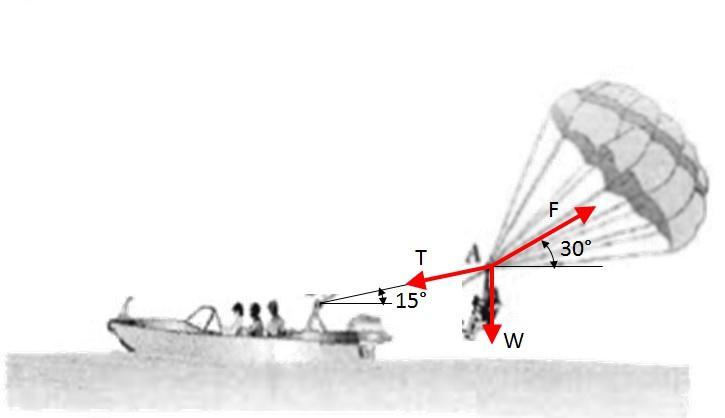
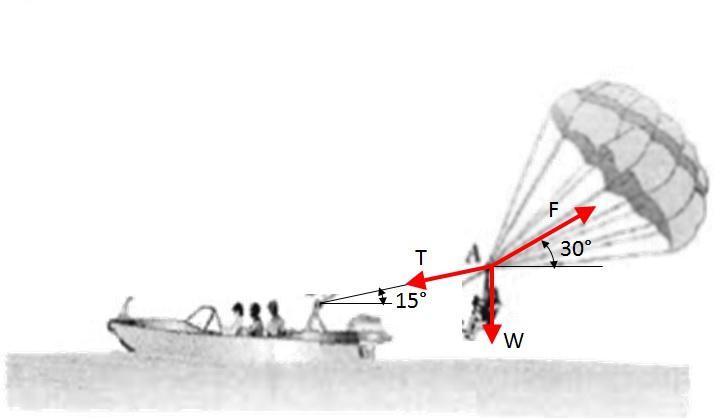
To analyze the forces acting on the rider, begin by sketching a free body diagram. Three forces can be identified: the tension force at 15° below horizontal, the drag force at 30° above horizontal, and the weight directed downward.
As the rider maintains a constant speed, the acceleration remains at 0.
Considering forces in the x-direction:
∑F = ma
F cos 30° - T cos 15° = 0
Thus, F = T cos 15° / cos 30°
Considering forces in the y-direction:
∑F = ma
F sin 30° - W - T sin 15° = 0
From which, W = F sin 30° - T sin 15°
Substituting gives:
W = (T cos 15° / cos 30°) sin 30° - T sin 15°
W = T cos 15° tan 30° - T sin 15°
W = T (cos 15° tan 30° - sin 15°)
Given T = 1900 N:
W = 1900 (cos 15° tan 30° - sin 15°)
W = 570 N
The rider's weight is 570 N, which is roughly equivalent to 130 lb.