Answer: Dalton’s model
Explanation:
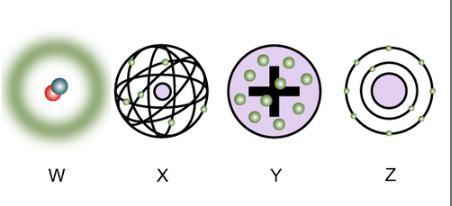
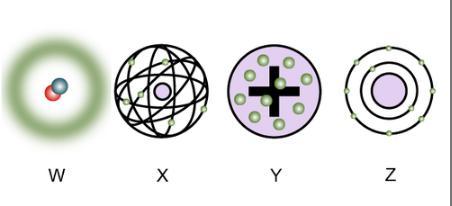
The image provided depicts four atomic models, each marked with a letter:
W corresponds to the current widely accepted atomic model: a nucleus surrounded by an electron cloud, where the positions and orbits of electrons around the nucleus are defined by regions (linked to specific energy levels) where the probability of finding an electron is highest. It's key to note that this model was refined through the contributions of quantum physics by Louis de Broglie and Erwin Schrodinger.
X refers to Rutherford's model (developed after Thomson's model). Ernest Rutherford conducted experiments that confirmed Thomas's atomic theory. Yet, the results led him to discover that there was a core of charge in the atom (later termed the nucleus) surrounded by electrons. Thus, a new atomic model was introduced, showcasing a positively charged nucleus enveloped by negatively charged electrons, resembling the solar system.
Y denotes Thomson's model, often called the plum pudding model. This scientist identified that atoms include smaller charged particles, defined as electrons. At that point, without knowledge of the atomic nucleus, Thomson theorized that electrons floated in a positively charged substance that balanced the negative charge of the electrons, similar to raisins in pudding or bread.
Z symbolizes Bohr's model. Proposed by Danish physicist Niels Bohr after Rutherford's findings, this model incorporates Rutherford’s concept but adds that electrons travel in specific orbits around the nucleus at varying energy levels.
Hence, the absent model is Dalton's model, recognized as the first atomic model: the atom visualized as an indivisible, solid sphere. This was a generally accepted notion at the time, dating back to ancient Greek philosophy.