answer.
Ask question
Login Signup
Ask question
All categories
  • English
  • Mathematics
  • Social Studies
  • Business
  • History
  • Health
  • Geography
  • Biology
  • Physics
  • Chemistry
  • Computers and Technology
  • Arts
  • World Languages
  • Spanish
  • French
  • German
  • Advanced Placement (AP)
  • SAT
  • Medicine
  • Law
  • Engineering
vlabodo
3 days ago
6

In which case is the speed of laser light the slowest relative to the observer? a person walking in the street and who sees lase

r light emitted from a low‑speed car that moves in the same direction as the person a student sitting in the classroom and who see laser light from the pointer used by the instructor laser light emitted from a high‑speed aircraft and detected by another high‑speed aircraft traveling in the opposite direction a person who sees laser light passing through a bucket full of water it is the same for all of the above
Physics
You might be interested in
Use the terms "force", "weight", "mass", and "inertia" to explain why it is easier to tackle a 220 lb football player than a 288
ValentinkaMS [3465]
<span>Answer
A person who weighs 220 lb has less mass than someone who weighs 288 lb, so accelerating the 220 lb player requires less force. The heavier player therefore carries greater momentum. Because 288 lb corresponds to more weight (and mass), that player has higher inertia and is harder to stop. For these reasons it is easier to tackle a 220 lb player than a 288 lb player. 
</span>
7 0
4 months ago
Read 2 more answers
Physics students study a piano being pulled across a room on a rug. They know that when it is at rest, it experiences a gravitat
inna [3103]
The static frictional force exceeds the kinetic frictional force, indicating that the static frictional force is over 1200 N. Explanation: The frictional force opposes the motion of any object on a surface, caused by interactions between the surface molecules and the object. It is known that static friction is typically stronger than kinetic friction (this is the reason initiating motion requires more force than keeping it moving along a surface). Hence, option 3 correctly describes the situation.
3 0
3 months ago
A small cork with an excess charge of +6.0µC is placed 0.12 m from another cork, which carries a charge of -4.3µC.
serg [3582]

A) 16.1 N

The force of electricity acting between the corks can be calculated using Coulomb's law:

F=k\frac{q_1 q_2}{r^2}

where

k represents Coulomb's constant

q_1 = 6.0 \mu C=6.0 \cdot 10^{-6} C denotes the charge magnitude on the first cork

q_2 = 4.3 \mu C = 4.3 \cdot 10^{-6}C indicates the charge magnitude on the second cork

r = 0.12 m is the distance separating the corks

By inserting the values into the formula, we arrive at

F=(9\cdot 10^9 N m^2 C^{-2} )\frac{(6.0\cdot 10^{-6}C)(4.3\cdot 10^{-6} C)}{(0.12 m)^2}=16.1 N

B) Attractive

<pas per="" coulomb="" law="" the="" orientation="" of="" electric="" force="" between="" two="" charged="" entities="" relies="" on="" their="" charge="" signs.=""><pmore specifically="">

- when both are similarly charged (e.g. positive-positive or negative-negative), the force is repulsive

- when charges are of opposite signs (e.g. positive-negative), the resulting force is attractive

<pin this="" case="" we="" have="">

Cork 1 holds a positive charge

Cork 2 possesses a negative charge

<pthus the="" force="" acting="" between="" them="" is="" attractive.="">

C) 2.69\cdot 10^{13}

The total charge of the negative cork is

q_2 = -4.3 \cdot 10^{-6}C

<pwe understand="" that="" a="" single="" electron="" has="" charge="" of="">

e=-1.6\cdot 10^{-19}C

<pthe total="" charge="" of="" the="" negative="" cork="" arises="" from="" having="" n="" extra="" electrons="" so="" we="" can="" express="" it="" as="">

q_2 = Ne

<pafter solving="" for="" n="" we="" can="" determine="" the="" count="" of="" excess="" electrons:="">

N=\frac{q_2}{e}=\frac{-4.3\cdot 10^{-6} C}{-1.6\cdot 10^{-19} C}=2.69\cdot 10^{13}

D) 3.75\cdot 10^{13}

The overall charge on the positive cork is

q_1 = +6.0\cdot 10^{-6}C

<pthe charge="" of="" a="" single="" electron="" is="" known="" to="" be="">

e=-1.6\cdot 10^{-19}C

<pthe total="" charge="" of="" the="" positive="" cork="" results="" from="" n="" excess="" electrons="" which="" can="" be="" depicted="" as="">

q_1 = -Ne

<pby calculating="" for="" n="" we="" derive="" the="" number="" of="" electrons="" cork="" has="" lost:="">

N=-\frac{q_1}{e}=-\frac{+6.0\cdot 10^{-6} C}{-1.6\cdot 10^{-19} C}=3.75\cdot 10^{13}

</pby></pthe></pthe></pafter></pthe></pwe></pthus></pin></pmore></pas>
6 0
3 months ago
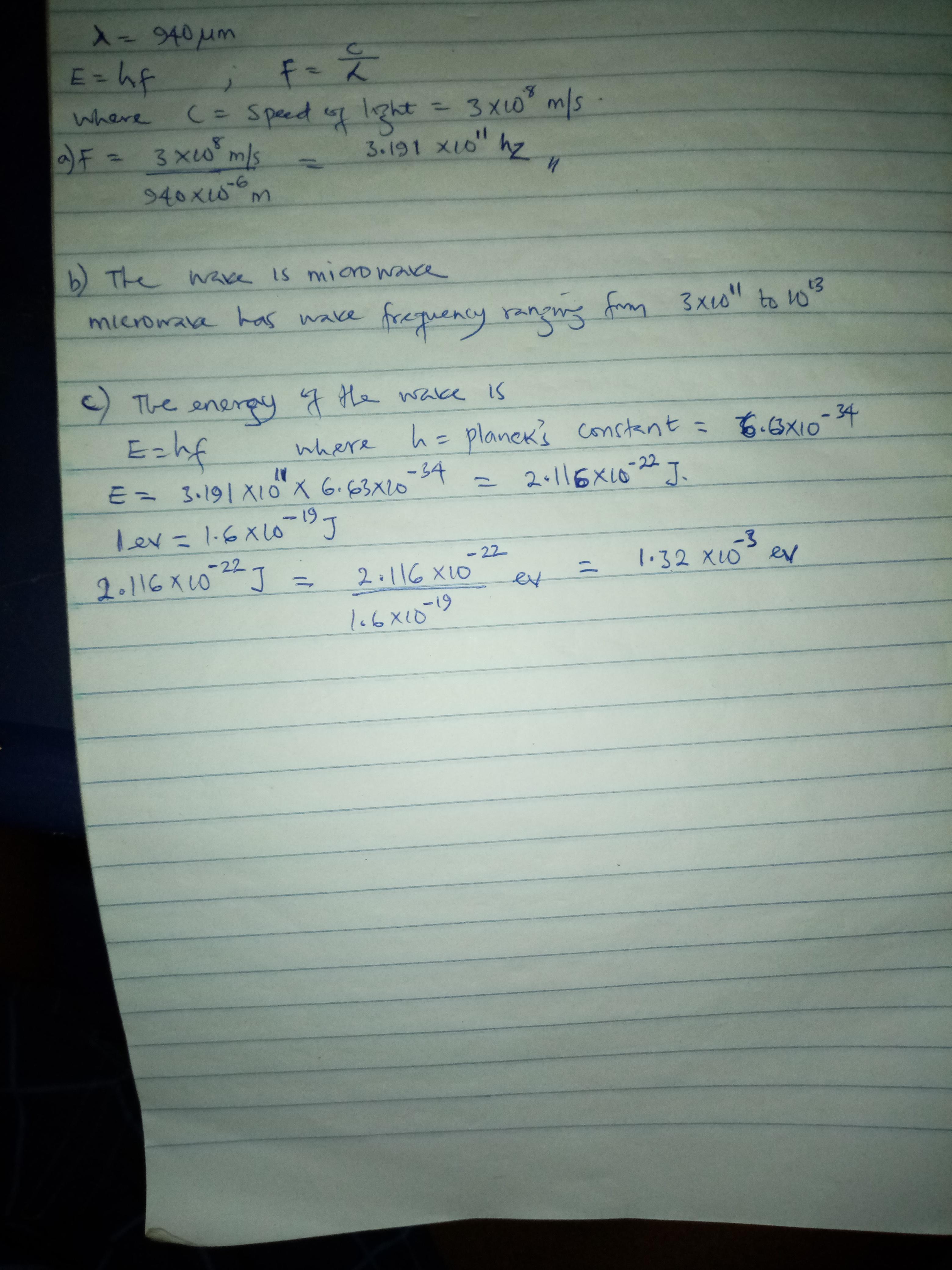
Radiation emitted from human skin reaches its peak at λ = 940 µm. (a) What is the frequency of this radiation? (b) What type of
inna [3103]

Answer:

a) The frequency is 3.191x10^11.

b) The type of radiation is microwave radiation.

c) The energy of one quantum of this radiation amounts to 1.32x10^-3ev.

Explanation:

For further details and calculations, please refer to the image below.

8 0
3 months ago
Other questions:
  • Throughout the reflection, make sure you have a copy of the Student Guide, PDF or Word, and your data tables. Use the drop-down
    12·2 answers
  • Solenoid 2 has twice the diameter, twice the length, and twice as many turns as solenoid 1. How does the field B2 at the center
    14·1 answer
  • A 40-kg uniform semicircular sign 1.6 m in diameter is supported by two wires as shown. What
    10·1 answer
  • A solar-powered car has a kinetic energy of 110250 J. Its mass is 180 kg. Work out how fast the car is travelling.
    9·2 answers
  • A 4kg block is sliding on a horizontal frictionless floor at a speed of 2.5ms and runs into a horizontal spring. The spring has
    7·2 answers
  • What is the rate of heat transfer by radiation, with an unclothed person standing in a dark room whose ambient temperature is 22
    15·1 answer
  • A small glider is coasting horizontally when suddenly a very heavy piece of cargo falls out of the bottom of the plane.
    11·1 answer
  • In rural areas, water is often extracted from underground by pumps. Consider an underground water source whose free surface is 6
    7·1 answer
  • Two friends are carrying a crate of mass 200 kg up a flight of stairs. The crate has length 1.25 m and height 0.500 m, and its c
    14·1 answer
  • A ball drops some distance and loses 30 j of gravitational potential energy. do not ignore air resistance. how much kinetic ener
    10·1 answer
Add answer
Login
Not registered? Fast signup
Signup
Login Signup
Ask question!