answer.
Ask question
Login Signup
Ask question
All categories
  • English
  • Mathematics
  • Social Studies
  • Business
  • History
  • Health
  • Geography
  • Biology
  • Physics
  • Chemistry
  • Computers and Technology
  • Arts
  • World Languages
  • Spanish
  • French
  • German
  • Advanced Placement (AP)
  • SAT
  • Medicine
  • Law
  • Engineering
Ierofanga
3 days ago
10

Which of the following do we need to know in order to calculate pH during an acid-base titration of a strong monoprotic acid wit

h a strong monoprotic base? Select all that apply
a. the concentration of the acid
b. the concentration of the base titrant
c. the initial volume of the acid solution
d. the volume of the titrant used
Chemistry
You might be interested in
A person loses 2.70 lbs in two weeks how many grams did he lose?
VMariaS [2998]
He lost 1224.7 grams.
6 0
4 months ago
Read 2 more answers
A student reported to her instructor that her unknown contained salt, salicylic acid, and sand. In reality the unknown contained
lorasvet [2795]
From the provided data, the unknown mixture was composed of salt, salicylic acid, and sand. It is understandable that the student suspected the presence of sand, yet scientific experimentation must verify such assumptions. The test involving salt and salicylic acid reveals that salt dissolves in water, while salicylic acid is only slightly soluble, and sand does not dissolve at all. By introducing the unknown into water, the salt would dissolve first, followed by the partial dissolution of salicylic acid. Heating the mixture could allow for the evaporation of salicylic acid, resulting in the remaining salt. If traces of sand were observed in the dissolved sample, it could suggest contamination.
8 0
2 months ago
You want to prepare a solution with a concentration of 200.0μM from a stock solution with a concentration of 500.0mM. At your di
lorasvet [2795]

Answer:

1) This dilution plan will yield a 200μM solution.

2) This dilution plan will not yield a 200μM solution.

3) This dilution plan will not yield a 200μM solution.

4) This dilution plan will yield a 200μM solution.

5) This dilution plan will yield a 200μM solution.

Explanation:

Convert the initial molarity into molar form as shown.

500mM = 500mM \times (\frac{1M}{1000M})= 0.5M

Let's examine the following serial dilution processes.

1)

Dilute 5.00 mL of the stock solution to 500 mL. Then take 10.00 mL of this new solution and dilute it further to 250 mL.

Concentration of 500 mL solution:

M_{2}= \frac{M_{1}V_{1}}{V_{2}}= \frac{(0.5M)(5.00mL)}{500 mL}= 5 \times 10^{-3}M

10 mL of this solution is further diluted to 250 mL

M_{final}= \frac{M_{2}V_{2}}{V_{final}}= \frac{(5 \times 10^{-3}M)(10.0mL)}{250 mL}= 2 \times 10^{-4}M

Convert μM:

2 \times 10^{-4}M = (2 \times 10^{-4}M)(\frac{1 \mu M}{10^{-6}M})= 200 \mu M

Thus, this dilution scheme will yield a 200μM solution.

2)

Dilute 5.00 mL of the stock solution to 100 mL. Then take 10.00 mL of this new solution and dilute to 1000 mL.

Concentration of 100 mL solution:

M_{2}= \frac{M_{1}V_{1}}{V_{2}}= \frac{(0.5M)(5.00mL)}{100 mL}= 2.5 \times 10^{-2}M

10 mL of this solution is further diluted to 1000 mL

M_{final}= \frac{M_{2}V_{2}}{V_{final}}= \frac{(2.5 \times 10^{-2}M)(10.0mL)}{1000 mL}= 2.5 \times 10^{-4}M

Convert μM:

2.5 \times 10^{-4}M = (2.5 \times 10^{-4}M)(\frac{1 \mu M}{10^{-6}M})= 250 \mu M

Thus, this dilution scheme will not yield a 200μM solution.

3)

Dilute 10.00 mL of the stock solution to 100 mL, followed by diluting 5 mL of that new solution to 100 mL.

Concentration of 100 mL solution:

M_{2}= \frac{M_{1}V_{1}}{V_{2}}= \frac{(0.5M)(10mL)}{100 mL}= 0.05M

5 mL of this solution is diluted to 1000 mL

M_{final}= \frac{M_{2}V_{2}}{V_{final}}= \frac{(0.05M)(5mL)}{1000 mL}= 0.25 \times 10^{-4}M

Convert μM:

0.25 \times 10^{-4}M = (0.25 \times 10^{-4}M)(\frac{1 \mu M}{10^{-6}M})= 25 \mu M

Thus, this dilution scheme will not yield a 200μM solution.

4)

Dilute 5 mL of the stock solution to 250 mL. Then take 10 mL of this new solution and further dilute it to 500 mL.

Concentration of 250 mL solution:

M_{2}= \frac{M_{1}V_{1}}{V_{2}}= \frac{(0.5M)(5mL)}{250 mL}= 0.01M

10 mL of this solution is further diluted to 500 mL

M_{final}= \frac{M_{2}V_{2}}{V_{final}}= \frac{(0.01M)(10mL)}{500 mL}= 2 \times 10^{-4}M

Convert μM:

2 \times 10^{-4}M = (2 \times 10^{-4}M)(\frac{1 \mu M}{10^{-6}M})= 200 \mu M

Thus, this dilution scheme will yield a 200μM solution.

5)

Dilute 10 mL of the stock solution to 250 mL. Then take another 10 mL of this new solution and dilute it to 1000 mL.

Concentration of 250 mL solution:

M_{2}= \frac{M_{1}V_{1}}{V_{2}}= \frac{(0.5M)(10mL)}{250 mL}= 0.02M

10 mL of this solution is further diluted to 1000 mL

M_{final}= \frac{M_{2}V_{2}}{V_{final}}= \frac{(0.02M)(10mL)}{1000 mL}= 2 \times 10^{-4}M

Convert μM:

2 \times 10^{-4}M = (2 \times 10^{-4}M)(\frac{1 \mu M}{10^{-6}M})= 200 \mu M

Thus, this dilution scheme will yield a 200μM solution.

7 0
3 months ago
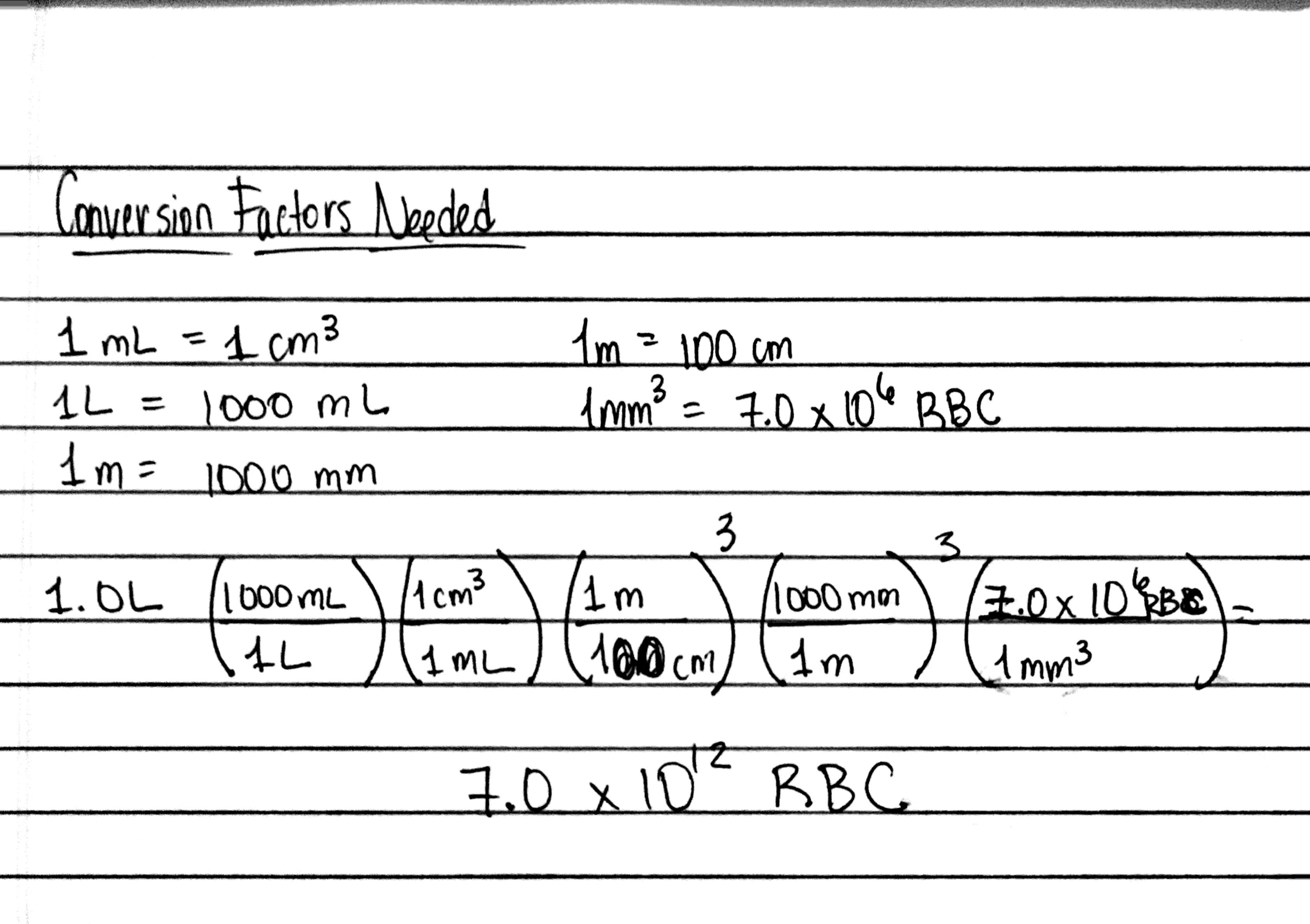
One cubic millimeter (mm3) of blood contains 7.0 x 10⁶ red blood cells. How many red blood cells are in 1.0 L of blood?
Anarel [2989]
The problem provides a conversion factor---> 1 mm3= 7.0 x 10^6 RBC. Therefore, to determine the quantity of red blood cells in your sample, we must first convert Liters to cm3 using the conversion factor--> 1 mL= 1 cm3

I have shared how to resolve this issue.


7 0
2 months ago
Other questions:
  • If 20.0g of MgSO4⋅7H2O is thoroughly heated, what mass of anhydrous magnesium sulfate will remain?
    9·2 answers
  • A flexible container has 5.00 L of nitrogen gas at 298 K. If the temperature is increased to 333K, what will the new volume of t
    6·1 answer
  • The properties of two elements are listed below. Element Atomic radius (pm) Ionic radius (pm) First ionization energy (kJ/mol) E
    7·2 answers
  • A generic element, Z, has two isotopes, 45Z and 47Z, and an average atomic mass of 45.36 amu. The natural abundances of the two
    8·1 answer
  • 2.00 g of an unknown volatile liquid was placed in a flask with a total volume of 265.0 mL. The cover of the flask has only a pi
    11·1 answer
  • A piston containing 0.120moles of methane gas, CH4, has a volume of 2.12liters. If methane is added until the volume is increase
    6·1 answer
  • A gas has an initial volume of 168 cm3 at a temperature of 255 K and a pressure of 1.6 atm. The pressure of the gas decreases to
    11·2 answers
  • When the reaction begins, the researcher records that the rate of reaction is such that 1 mole of A is consumed per minute. Afte
    7·1 answer
  • Which phrase best describes a chemical reaction? A. mixing two substances B. the combustion of a substance C. forming or breakin
    9·2 answers
  • Which of the following rock formations likely existed before the development of a stack?
    12·1 answer
Add answer
Login
Not registered? Fast signup
Signup
Login Signup
Ask question!