answer.
Ask question
Login Signup
Ask question
All categories
  • English
  • Mathematics
  • Social Studies
  • Business
  • History
  • Health
  • Geography
  • Biology
  • Physics
  • Chemistry
  • Computers and Technology
  • Arts
  • World Languages
  • Spanish
  • French
  • German
  • Advanced Placement (AP)
  • SAT
  • Medicine
  • Law
  • Engineering
Scrat
6 days ago
7

It's a snowy day and you're pulling a friend along a level road on a sled. You've both been taking physics, so she asks what you

think the coefficient of friction between the sled and the snow is. You've been walking at a steady 1.5\;{\rm m}/{\rm s}, and the rope pulls up on the sled at a 42.0^\circ angle. You estimate that the mass of the sled, with your friend on it, is 73.0 kg and that you're pulling with a force of 87.0 N.?

Physics
1 answer:
Maru [1K]6 days ago
5 0

Answer:

0.0984

Explanation:

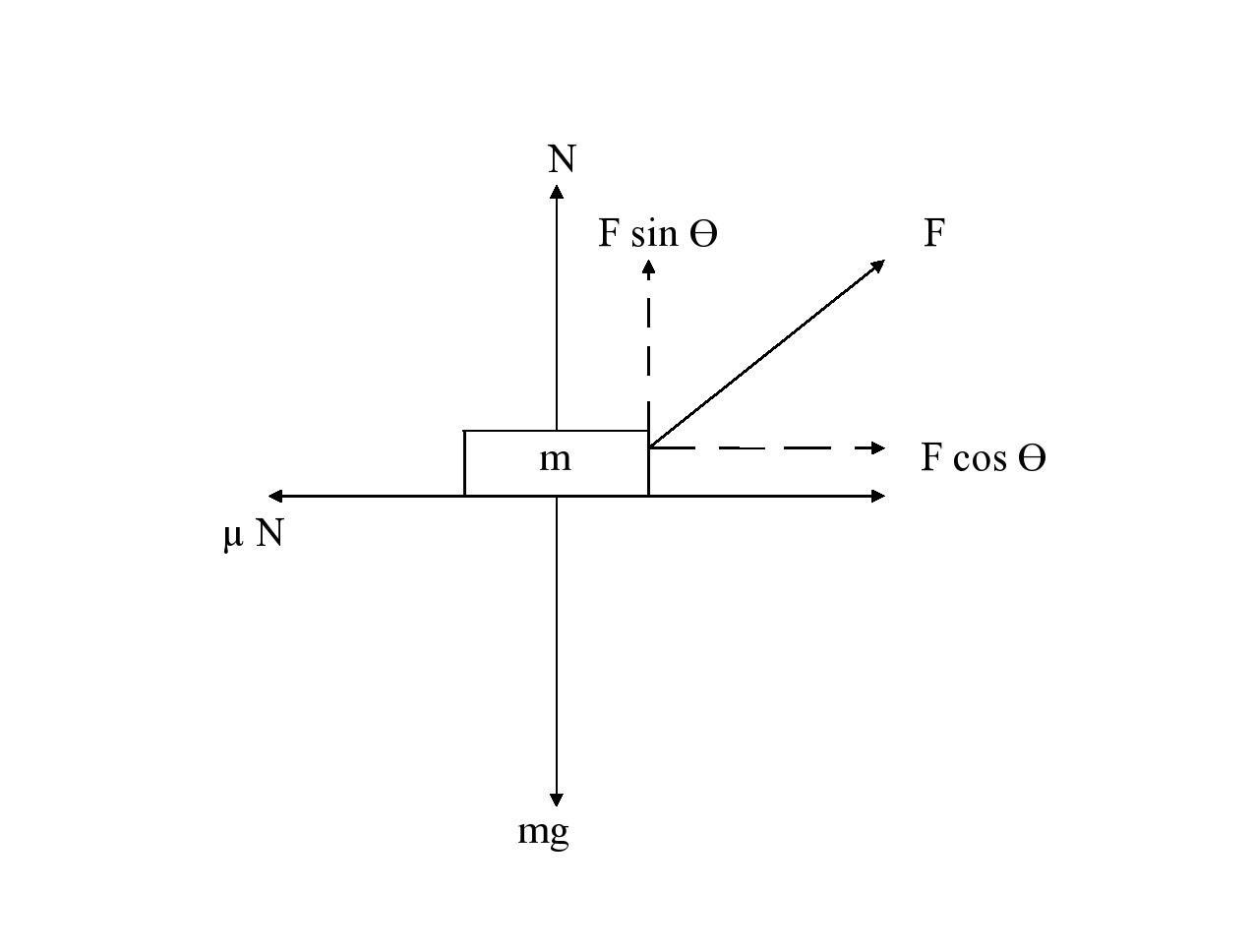
The first diagram below illustrates a free body diagram that will aid in resolving this problem.

According to the diagram, the force's horizontal component can be expressed as:

F_X = F_{cos \ \theta}

Substituting 42° for θ and 87.0° for F

F_X =87.0 \ N \ *cos \ 42 ^\circ

F_X =64.65 \ N

Meanwhile, the vertical component is:

F_Y = Fsin \ \theta

Again substituting 42° for θ and 87.0° for F

F_Y =87.0 \ N \ *sin \ 42 ^\circ

F_Y =58.21 \ N

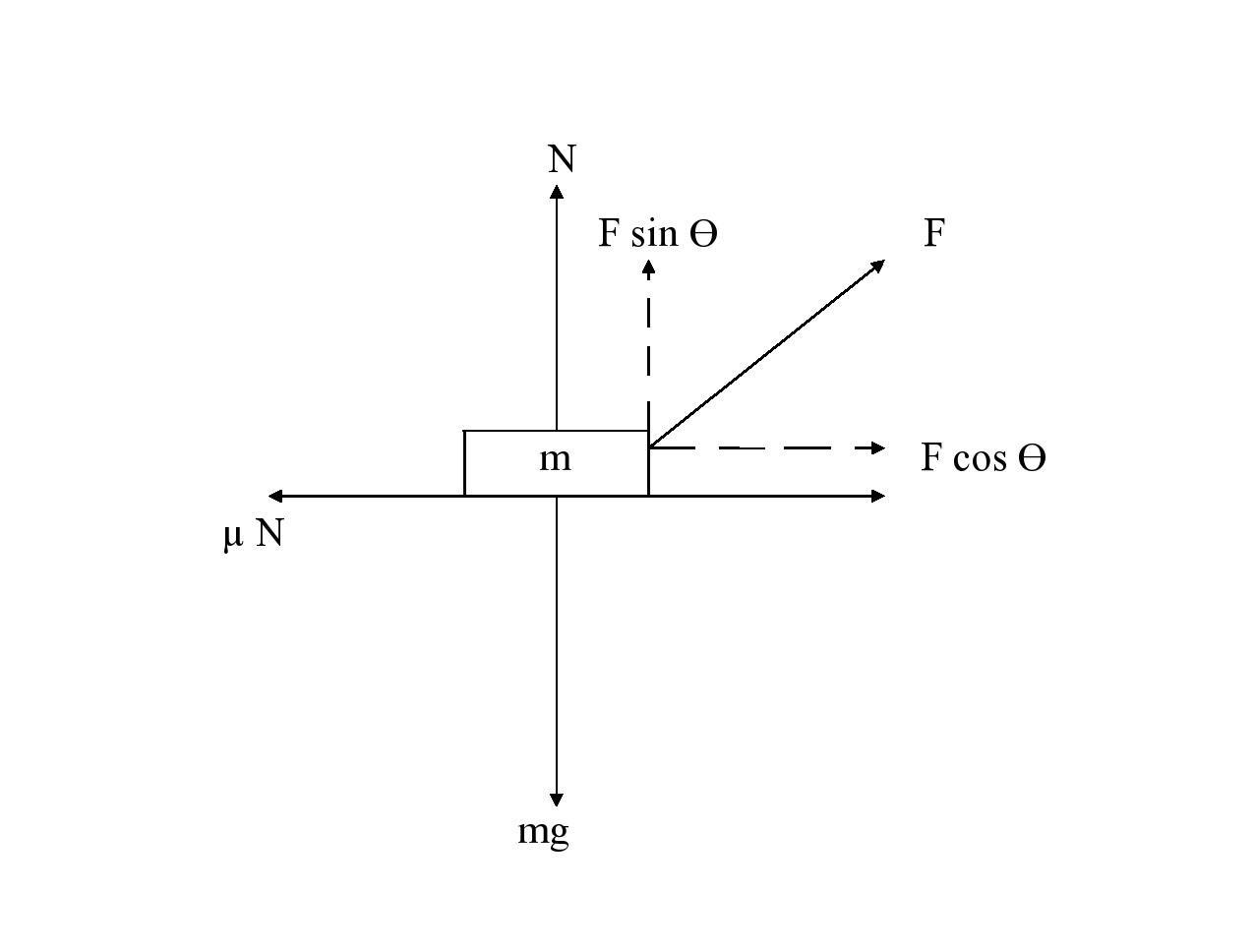
In resolving the vector, let A denote the components in mutually perpendicular directions.

The magnitudes of both components are illustrated in the second diagram provided and can be represented as A cos θ and A sin θ

The frictional force can be expressed as:

f = \mu \ N

Where;

\mu is the coefficient of friction

N = the normal force

Also, the normal reaction (N) is calculated as mg - F sin θ

Substituting F_Y \ for \ F_{sin \ \theta}. Normal reaction becomes:

N = mg \ - \ F_Y

By balancing the forces, the horizontal component of the force equals the frictional force.

The horizontal component is described as follows:

F_X = \mu \ ( mg - \ F_Y)

Rearranging the equation above to isolate \mu leads to:

\mu \ = \ \frac{F_X}{mg - F_Y}

Substituting in the following values:

F_X \ = \ 64.65 \ N

m = 73 kg

g = 9.8 m/s²

F_Y = \ 58.21 N

Thus:

\mu \ = \ \frac{64.65 N}{(73.0 kg)(9.8m/s^2) - (58.21 \ N)}

\mu = 0.0984

Therefore, the coefficient of friction is = 0.0984
You might be interested in
Rosa studies the position-time graph of two race cars. A graph titled Position versus Time shows time in hours on the x axis, nu
Sav [1105]

Answer:

B. Truck X was ahead, not truck Y.

Explanation:

Let's analyze the information provided.

Truck X moved from the point (0,20) to (2.8,50). This indicates that it began at the 20th kilometer and reached 50 km in 2.8 hours. Thus, its speed is v1 = (s2 - s1) / t

v1 = (50 - 20) / 2.8

v1 = 10.7 km/h

Given that it started from the 20th km, it indeed had a head start. Since the line on the graph is linear, this shows its speed was constant without any change in direction.

On the other hand, Truck Y's movement went from the origin (0,0) to (5,20), meaning it took 5 hours to travel 20 km, resulting in a speed of v2 = 20 / 5

v2 = 4 km/h

Again, the straightness of its graph line signifies it maintained a constant speed in a single direction.

Thus, it is evident that Rosa erred in her assumption that Truck Y had a head start.

5 0
7 days ago
Read 2 more answers
State two advantages of a lead-acid accumulator over a leclanche cell​
kicyunya [1025]

Respuesta:

Se pueden recargar.

Poseen una vida útil mayor.

Son reutilizables.

Explicación:

Las baterías de plomo-ácido y las pilas Leclanché son tipos de células electroquímicas.

Las pilas Leclanché son células primarias. Estas células producen reacciones químicas que generan corriente eléctrica de manera irreversible.

Por su parte, las baterías de plomo-ácido son células secundarias que permiten la reversibilidad de la corriente eléctrica generada.

Esto hace que las baterías de plomo-ácido sean reutilizables, con mayor durabilidad y un tiempo de vida más prolongado.

5 0
16 days ago
The amount of electric energy consumed by a 60.0-watt lightbulb for 1.00 minute could lift a
Sav [1105]

Answer:

Explanation:

For a 60W light bulb used for 1 minute:

P = 60 W

t = 1 minute = 60 seconds

This energy is capable of lifting an object weighing 10N.

W = 10N

This indicates conversion of electrical energy into potential energy.

Let's calculate the electrical energy:

Power describes the rate of work done.

Power = Work / time

Thus, work = power × time

Work = 60 × 60

Work = 3600 J

Potential energy calculation:

P.E = mgh

Where the weight is given by:

W = mg

Therefore, P.E = W·h

P.E = 10·h

Thus, we equate:

Potential energy = Electrical energy

P.E = Work

10·h = 3600

Dividing both sides by 10 gives:

h = 3600 / 10

h = 360m

The object can be lifted to a height of 360m.

6 0
6 days ago
An aluminum "12 gauge" wire has a diameter d of 0.205 centimeters. The resistivity ρ of aluminum is 2.75×10⁻⁸ ohm-meters. The el
Sav [1105]

Complete Question

An aluminum "12 gauge" wire measures a diameter of 0.205 centimeters. The resistivity ρ of aluminum is 2.75×10⁻⁸ ohm-meters. The electric field E in the wire varies over time as E(t)=0.0004t2−0.0001t+0.0004 newtons per coulomb, where time is recorded in seconds.

At time 5 seconds, I = 1.2 A.

We need to find the charge Q traveling through a cross-section of the conductor from time 0 to time 5 seconds.

Answer:

The charge is  Q =2.094 C

Explanation:

The question indicates that

    The wire’s diameter is  d = 0.205cm = 0.00205 \ m

     The radius of the wire is  r = \frac{0.00205}{2} = 0.001025 \ m

     Aluminum's resistivity is 2.75*10^{-8} \ ohm-meters.

       The electric field variation is described as

         E (t) = 0.0004t^2 - 0.0001 +0.0004


The charge is effectively given by the equation

       Q = \int\limits^{t}_{0} {\frac{A}{\rho} E(t) } \, dt

Where A is the area expressed as

       A = \pi r^2 = (3.142 * (0.001025^2)) = 3.30*10^{-6} \ m^2

 Thus,

       \frac{A}{\rho} = \frac{3.3 *10^{-6}}{2.75 *10^{-8}} = 120.03 \ m / \Omega

Therefore

      Q = 120 \int\limits^{t}_{0} { E(t) } \, dt

By substituting values

      Q = 120 \int\limits^{t}_{0} { [ 0.0004t^2 - 0.0001t +0.0004] } \, dt

     Q = 120 [ \frac{0.0004t^3 }{3} - \frac{0.0001 t^2}{2} +0.0004t] } \left | t} \atop {0}} \right.

The question states that t =  5 seconds

           Q = 120 [ \frac{0.0004t^3 }{3} - \frac{0.0001 t^2}{2} +0.0004t] } \left | 5} \atop {0}} \right.

          Q = 120 [ \frac{0.0004(5)^3 }{3} - \frac{0.0001 (5)^2}{2} +0.0004(5)] }

         Q =2.094 C


5 0
10 days ago
Albert uses as his unit of length (for walking to visit his neighbors or plowing his fields) the albert (a), the distance albert
Yuliya22 [1153]

To tackle this question, we know the following:

1 Albert equals 88 meters.

1 A = 88 m.

Initially, we square both sides of the equation:

(1 A)^2 = (88 m)^2

1 A^2 = 7,744 m^2

<span>Since 1 acre equals 4,050 m^2, let’s divide both sides by 7,744 to find out how many acres match this value:</span>

1 A^2 / 7,744 = 7,744 m^2 / 7,744

(1 / 7,744) A^2 = 1 m^2

Then multiply both sides by 4,050.

(4050 / 7744) A^2 = 4050 m^2

0.523 A^2 = 4050 m^2

<span>Thus, one acre is approximately 0.52 square alberts.</span>

7 0
3 days ago
Other questions:
  • Which, if any, of the following statements concerning the work done by a conservative force is NOT true? All of these statements
    8·1 answer
  • Assume that you stay on the earth's surface. what is the ratio of the sun's gravitational force on you to the earth's gravitatio
    15·2 answers
  • If 300. mL of water are poured into the measuring cup, the volume reading is 10.1 oz . This indicates that 300. mL and 10.1 oz a
    15·2 answers
  • Hawks and gannets soar above the ground and, when they spot prey, they fold their wings and essentially drop like a stone. They
    5·1 answer
  • A clever inventor has created a device that can launch water balloons with an initial speed of 85.0 m/s. Her goal is to pass a b
    8·1 answer
  • A 620-g object traveling at 2.1 m/s collides head-on with a 320-g object traveling in the opposite direction at 3.8 m/s. If the
    8·2 answers
  • Consult Conceptual Example 9 in preparation for this problem. Interactive LearningWare 6.3 also provides useful background. The
    7·1 answer
  • It takes 56.5 kilojoules of energy to raise the temperature of 150 milliliters of water from 5°C to 95°C. If you
    6·1 answer
  • f a car is speeding down a road at 40 miles/hour (mph), how long is the stopping distance D40 compared to the stopping distance
    6·1 answer
  • 1. Si comprimes un globo hasta reducir su volumen a un tercio de su valor original, ¿cuánto aumenta la presión en su interior?
    7·1 answer
Add answer
Login
Not registered? Fast signup
Signup
Login Signup
Ask question!