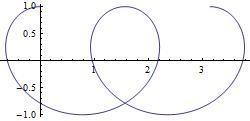
Answer:
.a vx = -3π
b.vy = 0
c.c. m = sin(4πt + π/2) / [πt + cos(4πt + π/2)]
d.m = sin(4π/6 + π/2) / [π/6 + cos(4π/6 + π/2)]
e. t = -1.0
f.f. t = -0.35
g.vx = π - 4πsin (4π(0.124) + π/2)
h.vmax=4π cos (4π(0.045) + π/2)
i.s(t) = [x(t)^2 + y(t)^2]^(1/2)
s'(t) = d [x(t)^2 + y(t)^2]^(1/2) / dt
Explanation:
x(t) = πt + cos(4πt + π/2)
Finding the horizontal distance's derivative with respect to time t yields the horizontal velocity
The change in position over a change in time represents velocity
vx = dx/dt = π - 4πsin (4πt + π/2)
vx = π - 4π sin (0 + π/2)
when t = 0, substituting the value of t into the previous equation
vx = π - 4π (1)
vx = -3π
b,
y(t) = sin(4πt + π/2)
finding the derivative with respect to t
dy/dt=4π cos (4πt + π/2)
π/2=90
when t=0
b. vy=dy/dt = 4π cos (4πt + π/2)
vy = 0
c. the slope of the tangent line
y(t)/x(t)
c. m = sin(4πt + π/2) / [πt + cos(4πt + π/2)]
d. at t=1/6, substitute into the result found in c
m = sin(4π/6 + π/2) / [π/6 + cos(4π/6 + π/2)]
e. t = -1.0
f. t = -0.35
g. Find t
vx = π - 4πsin (4πt + π/2) = 0
at the peak speed = 0
(4πt + π/2)=0.0043
t=-π/2+0.0043/(4π)
t=-0.124
vx = π - 4πsin (4π(0.124) + π/2)
h. Find t
vy = 4π cos (4πt + π/2) = 0
(4πt + π/2=1
t=0.57/4π
t=0.045
vmax=4π cos (4π(0.045) + π/2)
i. the resultant displacement
s(t) = [x(t)^2 + y(t)^2]^(1/2)
h. s'(t) = d [x(t)^2 + y(t)^2]^(1/2) / dt
s'(t)=
k and l. Solve for the time values
d [x(t)^2 + y(t)^2]^(1/2) / dt = 0
And substitute to find the maximum and minimum velocities.