answer.
Ask question
Login Signup
Ask question
All categories
  • English
  • Mathematics
  • Social Studies
  • Business
  • History
  • Health
  • Geography
  • Biology
  • Physics
  • Chemistry
  • Computers and Technology
  • Arts
  • World Languages
  • Spanish
  • French
  • German
  • Advanced Placement (AP)
  • SAT
  • Medicine
  • Law
  • Engineering
bazaltina
3 months ago
5

Six pendulums of mass m and length L as shown are released from rest at the same angle (theta) from vertical. Rank the pendulums

according to the number of complete cycles of motion each pendulum goes through per minute.
L = 4 m, M = 1 kg
L = 2 m, M = 4 kg
L = 4 m, M = 4 kg
L = 2 m, M = 2 kg
L = 1 m, M = 4 kg
L = 1 m, M = 2 kg
Physics
2 answers:
ValentinkaMS [3.4K]3 months ago
7 0

List the pendulums based on the frequency of complete cycles each performs per minute, arranged from highest to lowest frequency: L = 1, L = 2, L = 4

Additional details

Simple Harmonic Motion refers to the repetitive motion of an object through its equilibrium position, characterized by a consistent rate of vibrations or oscillations per second.

The swinging of a pendulum exemplifies simple harmonic motion.

Definitions:

  • Deviation (y): the distance of the object from its point of equilibrium.
  • Amplitude (A): the maximum distance from the equilibrium position.
  • Frequency (f): the count of oscillations within a given timeframe.
  • Period (T): the time taken for one complete cycle.

The following relationship exists between T and f:

\displaystyle T=\frac{1}{f}\\\\f=\frac{n}{t}

n = number of oscillations

t = time (s)

The problem inquires about the frequency of pendulum motion, which corresponds to the number of complete cycles executed each minute.

The swing period of a pendulum is influenced by the rope length and gravitational force. A longer rope results in a longer period and a lower frequency.

The formula applied is as follows:

\large{\boxed{\bold{T=2\pi \sqrt{\frac{L}{g} }}}\rightarrow \frac{1}{f}=2\pi \sqrt{\frac{L}{g} }

This formula indicates that frequency varies inversely with rope length—greater length yields fewer oscillations per minute.

Consequently, the pendulum's motion, arranged from highest to lowest frequency, is as follows:

L = 1, L = 2, L = 4

(the mass of the pendulum does not influence the swing period or frequency)

Discover more

The elevator's distance

net velocity

average velocity

Keywords: Simple Harmonic Motion, complete cycles, pendulum

Sav [3.1K]3 months ago
3 0

Answer:   1m, 1m, 2m, 2m, 4m, 4m.

It’s important to remember that the masses attached do not influence the number of oscillations.

Explanation:

To determine the number of oscillations (complete cycles), we can apply the formula n = t / T ……equation 1

The variables that impact the period of a simple pendulum are solely its length and gravitational acceleration. The period remains unaffected by factors such as mass.

period (T)= 2 x π x √(L/g) ….equation 2

where π = 3.142, L= rope length, and g = 9.8 m/s (gravitational acceleration)

According to the question, the time (t) is 60 seconds.

By merging equations 1 and 2, we obtain  

number of oscillations = time / (2 x π x √(L/g))

Case 1: for L = 4m

number of oscillations = 60 / ( 2 x 3.142 x √(4/9.8))

= 14.9 = 14 complete cycles (the problem specifies complete cycles)

Case 2: for L = 2m

number of oscillations = 60 / ( 2 x 3.142 x √(2/9.8))

= 21.4 = 21 complete cycles

Case 3: where L = 4m, results in the same as case 1, yielding 14 complete cycles

Case 4: where L = 2m, mirrors the outcome in case 2, producing 21 complete cycles

Case 5: in the instance of L = 1m

number of oscillations = 60 / ( 2 x 3.142 x √(1/9.8))

= 30.1 = 30 complete cycles

Case 6: when L = 1m, which repeats case 5, also gives 30 complete cycles

From these findings, the order of the pendulums from the highest to lowest number of complete cycles is as follows: 1m, 2m, 2m, 4m, 4m.

Remember, the number of oscillations is independent of their respective masses.

You might be interested in
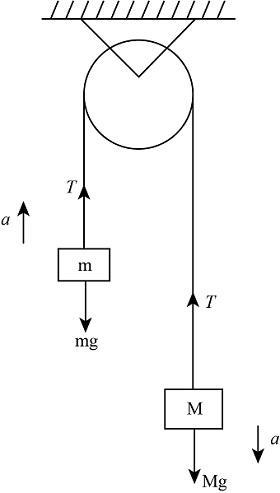
Two blocks are attached to opposite ends of a massless rope that goes over a massless, frictionless, stationary pulley. One of t
Softa [3030]

Answer:

1/7 kg

Explanation:

Refer to the attached diagram for enhanced clarity regarding the question.

One of the blocks weighs 1.0 kg and accelerates downward at 3/4g.

g denotes the acceleration due to gravity.

Let M represent the block with known mass, while 'm' signifies the mass of the other block and 'a' refers to the acceleration of body M.

Given M = 1.0 kg and a = 3/4g.

By applying Newton's second law; \sum fy = ma_y

For the body with mass m;

T - mg = ma... (1)

For the body with mass M;

Mg - T = Ma... (2)

Combining equations 1 and 2 gives;

+Mg -mg = ma + Ma

Ma-Mg = -mg-ma

M(a-g) = -m(a+g)

Substituting M = 1.0 kg and a = 3/4g into this equation leads to;

3/4 g-g = -m(3/4 g+g)

3/4 g-g = -m(7/4 g)

-g/4 = -m(7/4 g)

1/4 = 7m/4

Multiplying gives: 28m = 4

m = 1/7 kg

Hence, the mass of the other box is 1/7 kg

3 0
3 months ago
5. The speed of a transverse wave on a string is 170 m/s when the string tension is 120 ????. To what value must the tension be
Sav [3153]

Answer:

The tension in the string when the speed increased is 134.53 N

Explanation:

Given;

Tension in the string, T = 120 N

initial speed of the transverse wave, v₁ = 170 m/s

final speed of the transverse wave, v₂ = 180 m/s

The wave speed is expressed as;

v = \sqrt{\frac{T}{\mu} }

where;

μ represents mass per unit length

v^2 = \frac{T}{\mu} \\\\\mu = \frac{T}{v^2} \\\\\frac{T_1}{v_1^2} = \frac{T_2}{v_2^2}

The new tension T₂ will be computed as;

T_2 = \frac{T_1 v_2^2}{v_1^2} \\\\T_2 = \frac{120*180^2}{170^2} \\\\T_2 = 134.53 \ N

Consequently, the tension in the string when the speed was increased is 134.53 N

3 0
2 months ago
the minute hand on a clock is 9 cm long and travels through an arc of 252 degrees every 42 minutes. To the nearest tenth of a ce
Ostrovityanka [3204]

Answer:

The distance covered by the minutes hand is 39.60 cm.

Explanation:

Note: A clock has a circular shape, where the minutes hand acts as the radius, and its motion creates an arc.

Length of an arc is calculated as ∅/360(2πr)

L = ∅/360(2πr).................... Equation 1π

Here, L represents the arc’s length, ∅ is the angle made by the arc, and r is the arc’s radius.

Given: ∅ = 252°, r = 9 cm, π = 3.143.

Upon substituting these values into equation 1,

L = 252/360(2×3.143×9)

L = 0.7×2×3.143×9

L = 39.60 cm.

Thus, the distance traversed by the minutes hand is 39.60 cm.

4 0
3 months ago
A crate on a motorized cart starts from rest and moves with a constant eastward acceleration ofa= 2.60 m/s^2. A worker assists t
Keith_Richards [3271]

Response:

To find power, we must first determine the work done by the force.

1) We will use the following equation to calculate work:

\int\limits {F} \, dx

The force is provided by the problem; our goal is to express 'dx' in terms of 't'

2) It's known that:

\frac{dV}{dt} = a = 2.6

Thus, we have:

v = 2.6t

Then:

\frac{dx}{dt} = V = 2.6t\\ \\dx = 2.6t*dt

3) Finally, substituting all known values gives us:

\int\limits^{4.7}_{0} {5.4t*2.6t} \, dt

After some calculations, the resulting work is:

161.9638 J.

4) To find power, we will use the following equation:

P = \frac{W}{t}

Thus

P = 161.9638/4.7 = 34.46 W

8 0
2 months ago
Other questions:
  • A food item that is left out of the refrigerator turns brown and forms bubbles and gas. What are the signs that this is a chemic
    6·2 answers
  • A household refrigerator runs one-fourth of the time and removes heat from the food compartment at an average rate of 800 kJ/h.
    8·1 answer
  • A titanium bicycle frame displaces 0.314 l of water and has a mass of 1.41 kg.part what is the density of the titanium in g/cm3
    7·1 answer
  • Four students measured the acceleration of gravity. The accepted value for their location is 9.78m/s2. Which student’s measureme
    14·1 answer
  • The total conversion of 1.00 kilogram of the Sun's mass into energy yields​?
    15·1 answer
  • A trolley of mass 200kg is travelling north at 2m\s. It collides head on with a second trolley of mass 500kg which is travelling
    7·1 answer
  • A girl drops a pebble from a high cliff into a lake far below. She sees the splash of the pebble hitting the water 2.00s later.
    10·1 answer
  • The altitude of the International Space Station ttt minutes after its perigee (closest point), in kilometers, is given by \qquad
    8·1 answer
  • A 1-m-long monopole car radio antenna operates in the AM frequency of 1.5 MHz. How muchcurrent is required to transmit 4 W of po
    9·1 answer
  • You hold glider A of mass 0.125 kg and glider B of mass 0.375 kg at rest on an air track with a compressed spring of negligible
    11·1 answer
Add answer
Login
Not registered? Fast signup
Signup
Login Signup
Ask question!