answer.
Ask question
Login Signup
Ask question
All categories
  • English
  • Mathematics
  • Social Studies
  • Business
  • History
  • Health
  • Geography
  • Biology
  • Physics
  • Chemistry
  • Computers and Technology
  • Arts
  • World Languages
  • Spanish
  • French
  • German
  • Advanced Placement (AP)
  • SAT
  • Medicine
  • Law
  • Engineering
Mariana
1 day ago
12

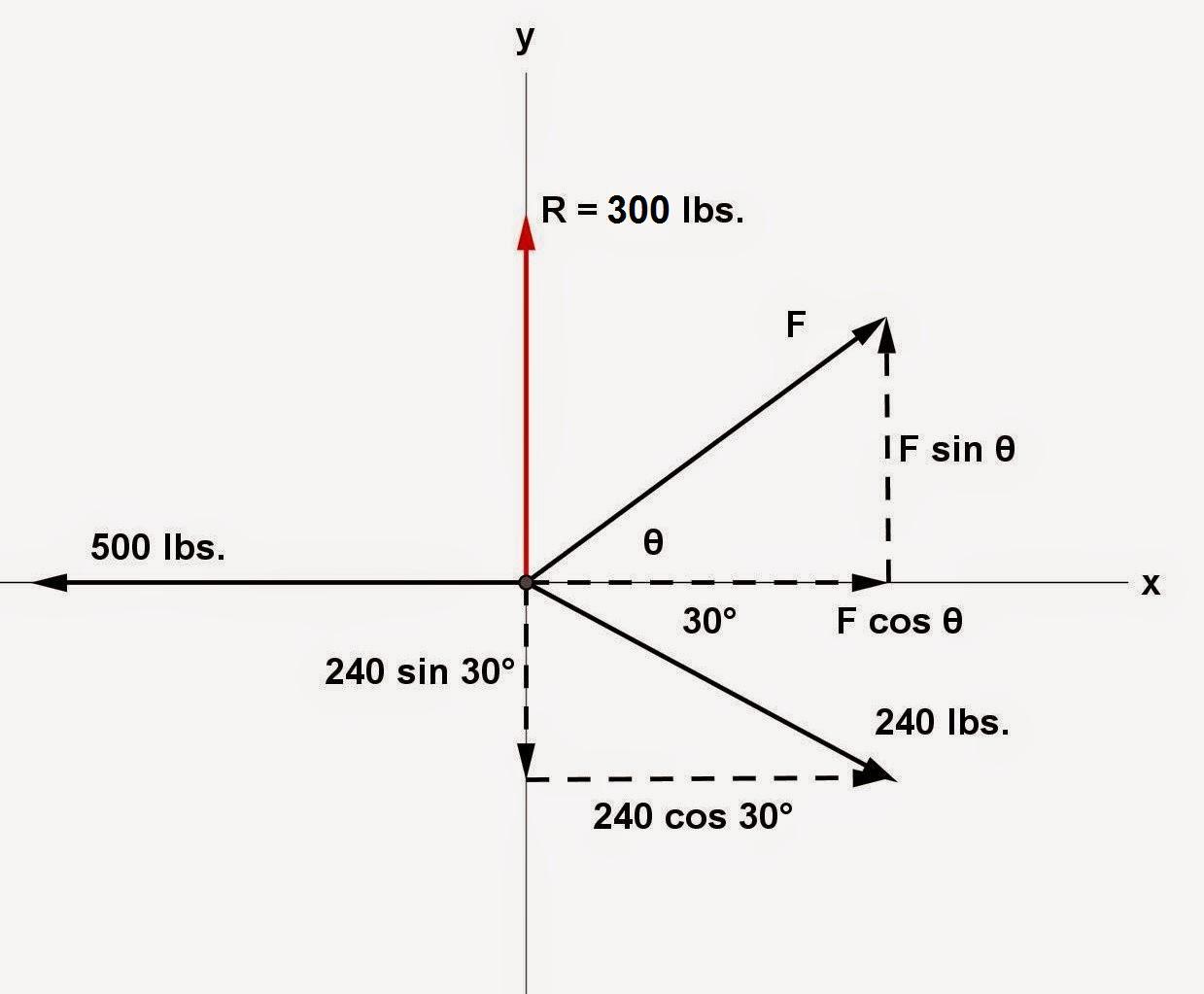
The resultant of the concurrent forces is 300 lb pointing up along the Y axis. Compute the values of F and the angle required to

give the resultant.

Physics
2 answers:
Yuliya22 [1.1K]1 day ago
5 0

The computed values of F and the angle that would yield the resultant are F = 823.529 lbs and theta = 30.667 degrees.

Further Clarification

The resultant force from the concurrent efforts is 300 lb directed upwards along the Y axis. We need to find F and the corresponding angle.

The initial step is to determine the x and y components of all forces and then focus on the isolated figure:

The total of y components is

\sum F_y = R_y\\F sin \theta - (240 lbs) (sin 30) = 300 lbs\\F sin \theta - (240 lbs) (0.5) = 300 lbs\\F sin \theta - (120 lbs) = 300 lbs\\F sin \theta = 420 lbs

The total of x components is

\sum F_x = R_x\\F cos \theta - (240 lbs) (cos 30) - 500 lbs = 0\\F cos \theta - (240 lbs) (0.866) - 500 lbs = 0\\F cos \theta - (207.846 lbs) - 500 lbs = 0\\F cos \theta = 707.846 lbs

By substituting the angle θ in either of the two working equations, we can obtain

\frac{F sin \theta}{F cos \theta} = \frac{420 lbs}{707.846 lbs} \\tan \theta = 0.593\\\theta = 30.667 \\ F sin \theta = 420 lbs\\F sin 30.667 = 420 lbs\\F = \frac{420 lbs}{sin 30.667} \\F = \frac{420 lbs}{0.510} \\F = 823.529 lbs

Learn More

  1. Find out more about the values of F
  2. Discover more about the resultant
  3. Learn more about the angle

Answer Details

Grade: 9

Subject: Physics

Chapter: Forces

Keywords: values of F, angle, resultant, concurrent forces, angle

Maru [1K]1 day ago
5 0
<span>500 cos(180) i + 500 sin(180)
240 cos(-30) i + 240 sin(-30)
F cos(theta) i + F sin(theta)
-----------------------------------
300 cos(90) i + 300 sin(90)</span>
You might be interested in
You apply the brakes of your car abruptly and your book starts sliding off the front seat. Three observers sitting in the car ex
Softa [913]

Answer:

All observers are accurate.

Explanation:

This situation reflects a matter of reference frames regarding the book's motion as perceived by different observers.

From their distinct frames of reference, each observer's perspective is valid.

Observer A is in an inertial reference frame.

Observers capable of explaining the book's behavior and its relationship to the car through the interplay of forces and changes in velocity are classified as being in inertial reference frames.

Observer A's observations illustrate this, for she pointed out the relative motion between the book and the car, indicating her position in an inertial reference frame.

Likewise, observers in these inertial reference frames can elucidate object velocity changes based on the forces affecting them from other objects.

This is exemplified by observer B, who notes the car's force impacting the book's velocity.

Observer C occupies a non-inertial reference frame, as Newton's laws of motion do not apply. This scenario arises within non-inertial frames.

7 0
4 days ago
To determine the height of a flagpole, Abby throws a ball straight up and times it. She sees that the ball goes by the top of th
Softa [913]

Answer:

H = 10.05 m

Explanation:

The stone reaches the top of the flagpole at both t = 0.5 s and t = 4.1 s

therefore, the total duration of the upwards motion above the peak of the pole is provided as

\Delta t = 4.1 - 0.5 = 3.6 s

now we have

\Delta t = \frac{2v}{g}

3.6 = \frac{2v}{9.8}

v = 17.64 m/s

this indicates the speed at the flagpole's top

at this point we have

v_f - v_i = at

17.64 - v_i = (-9.8)(0.5)

v_i = 22.5 m/s

the height of the flagpole is stated as

H = \frac{v_f + v_i}{2}t

H = \frac{22.5 + 17.64}{2} (0.5)

H = 10.05 m

5 0
12 days ago
A bus slows down uniformly from 75.0 km/h to 0 km/h in 21 s. How far does it travel before stopping?
Yuliya22 [1153]

1 hour = 3,600 seconds
1 km = 1,000 meters

75 km/hour = (75,000/3,600) m/s = 20-5/6 m/s

The mean speed during the deceleration is

                                   (1/2)(20-5/6 + 0) = 10-5/12 m/s.

Traveling at this average speed for 21 seconds,
the bus covers

                        (10-5/12) × (21) = 218.75 meters.

7 0
15 days ago
Read 2 more answers
A solid metal sphere of diameter D is spinning in a gravity-free region of space with an angular velocity of ωi. The sphere is s
ValentinkaMS [1144]

Answer:

0.6

Explanation:

The formula for the volume of a sphere is \frac{4}{3} \pi (\frac{D}{2})^3

Thus \pi * r^2 * (\frac{D}{2} ) = \frac{4}{3} \pi (\frac{D}{2})^3

The radius of the disk is 1.15(\frac{ D}{2} )

Applying angular momentum conservation;

The M_i of the sphere = \frac{2}{5} m \frac{D}{2}^2

M_i of the disk = m*\frac{ \frac{1.15*D}{2}^2 }{2}

\frac{wd}{ws} = \frac{\frac{2}{5}m * \frac{D}{2}^2}{ m * \frac{(\frac{`.`5*D}{2})^2 }{2} }

= 0.6

5 0
4 days ago
Can pockets of vacuum persist in an ideal gas? Assume that a room is filled with air at 20∘C and that somehow a small spherical
kicyunya [1011]

Answer:

The time required is 20 μs

Explanation:

Here is the data provided:

temperature = 20°C  = 293 K

radius = 1 cm

atomic mass of air = 29 u

To determine

the duration for air to refill the vacuum space

solution:

We calculate the root mean square velocity of air particles. This can be expressed as:

\frac{1}{2}mv^2 = \frac{3}{2}RT

where m indicates mass, t is temperature, v is speed, and R is the ideal gas constant, which is approximately 8.3145 (kg·m²/s²)/K·mol.

v = \sqrt{\frac{3RT}{M} }............................1

v = \sqrt{\frac{3(8.314)293}{29*10{-3}kg} }

Resulting in v = 501.99 m/s.

<pNow, to cover the distance of 1 cm,<pThe duration needed for air is calculated as:

time taken = \frac{r}{v}

which gives us:

time taken = \frac{1*10^{-2}m}{501.99}

so, time taken = 19.92 × 10^{6} seconds = 20μs.

Thus, the required time is 20 μs.

3 0
10 days ago
Other questions:
  • A displacement vector points in a direction of θ = 23° left of the positive y-axis. The magnitude of this vector is D = 155 m. R
    12·1 answer
  • How many electrons must be removed from a neutral, isolated conducting sphere to give it a positive charge of 8.0 x 10 8 C? [Q=n
    14·1 answer
  • Each plate of a parallel-plate capacator is a square with side length r, and the plates are separated by a distance d. The capac
    13·1 answer
  • You, Archimedes, suspect that the king’s crown is not solid gold but is instead gold-plated lead. To test your theory, you weigh
    9·1 answer
  • Imagine that the satellite described in the problem introduction is used to transmit television signals. You have a satellite TV
    11·1 answer
  • If low CVP precipitates a suction alarm, rapid infusion of volume can remedy the situation after dropping the P-level.
    15·1 answer
  • At one instant of time a rocket is traveling in outer space at 2500m/s and is exhausting fuel at a rate of 100 kg/s. If the spee
    6·1 answer
  • Suppose that 8 turns of a wire are wrapped around a pipe with a length of 60 inches and a circumference of 4​ inches, so that th
    7·2 answers
  • A kinesin that is transporting a secretory vesicle uses approximately 80 ATP molecules/s. Each ATP provides a kinesin molecule w
    7·1 answer
  • An Object moving at a velocity of 30 m/s slows to a stop in 7 seconds. What was its acceleration
    12·1 answer
Add answer
Login
Not registered? Fast signup
Signup
Login Signup
Ask question!