answer.
Ask question
Login Signup
Ask question
All categories
  • English
  • Mathematics
  • Social Studies
  • Business
  • History
  • Health
  • Geography
  • Biology
  • Physics
  • Chemistry
  • Computers and Technology
  • Arts
  • World Languages
  • Spanish
  • French
  • German
  • Advanced Placement (AP)
  • SAT
  • Medicine
  • Law
  • Engineering
Tcecarenko
1 month ago
7

Which of the following statements are true for electric field lines? Check all that apply. Check all that apply. Electric field

lines point away from positive charges and toward negative charges. Electric field lines are continuous; they do not have a beginning or an ending. Electric field lines can never intersect. Electric field lines are close together in regions of space where the magnitude the electric field is weak and are father apart where it is strong. At every point in space, the electric field vector at that point is tangent to the electric field line through that point.
Physics
1 answer:
Keith_Richards [3.2K]1 month ago
5 0

Answer:

Electric field lines radiate from positive charges and converge on negative charges. True

Electric field lines are continuous and do not have a start or end point. False

Electric field lines can never cross each other. True

In regions of space where the electric field is weak, the field lines are farther apart, and they are closer together in regions where it's strong. False

At any given point in space, the electric field vector aligns with the tangent to the electric field line at that location. True

Explanation:

Electric field lines emanate from positive charges and draw towards negative charges. They always move away from positive charges and head towards negative ones.

Electric field lines are continuous, without a definitive start or finish. False  

As the lines originate from positive charges and terminate at negative ones.

Electric field lines cannot cross one another. True

It’s not possible for them to intersect, as this would imply the field has multiple directions at one point. Moreover, the actual field value at that point would need to be determined by combining both field lines.

Electric field lines are spaced close together in areas where the electric field magnitude is potent and spaced apart in weak regions.False

This is incorrect as regions with higher field strength have lines that are closer together, while weaker regions have them farther apart.

At each location in space, the electric field vector coincides with the tangent to the corresponding field line at that point. True

This statement aligns with the definition of electric field lines.

You might be interested in
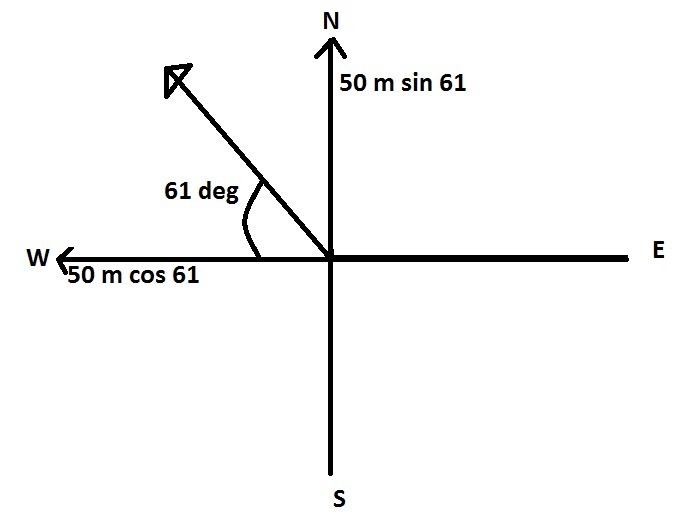
A player throws a football 50.0 m at 61.0° north of west. what is the westward component of the displacement of the football?
inna [3103]

Answer: 24.24 m

Explanation:

A player launches a football 50.0 m at an angle of 61° to the north of west. We will break this down into vertical and horizontal elements.

Horizontal component: 50 cos 61° = 24.24 m directed westward

Vertical component: 50 sin 61° = 43.73 m directed toward the north.

Refer to the diagram below.

Therefore, the westward displacement of the football corresponds to the horizontal component of the displacement, which is 24.24 m.

7 0
2 months ago
A Honda Civic travels in a straight line along a road. The car’s distance x from a stop sign is given as a function of time t by
serg [3582]

a) Average velocity: 2.8 m/s

b) Average velocity: 5.2 m/s

c) Average velocity: 7.6 m/s

Explanation:

a)

The car's position over time t can be described by

x(t)=\alpha t^2 - \beta t^3

where

\alpha = 1.50 m/s^2

\beta = 0.05 m/s^3

To find the average velocity, we divide the displacement by the elapsed time:

v=\frac{\Delta x}{\Delta t}

At time t = 0, the position is:

x(0)=\alpha \cdot 0^2 - \beta \cdot 0^3 = 0

At time t = 2.00 s, the position is:

x(2)=\alpha \cdot 2^2 - \beta \cdot 2^3=5.6 m

This leads us to the displacement of

\Delta x = x(2)-x(0)=5.6-0=5.6 m

The duration for this interval is

\Delta t = 2.0 s - 0 s = 2.0 s

Therefore, the average velocity during this period is

v=\frac{5.6 m}{2.0 s}=2.8 m/s

b)

At time t = 0, the position is:

x(0)=\alpha \cdot 0^2 - \beta \cdot 0^3 = 0

At time t = 4.00 s, the position is:

x(4)=\alpha \cdot 4^2 - \beta \cdot 4^3=20.8 m

Thus, the displacement is

\Delta x = x(4)-x(0)=20.8-0=20.8 m

The time interval is

\Delta t = 4.0 - 0 = 4.0 s

This yields an average velocity of

v=\frac{20.8}{4.0}=5.2 m/s

c)

The position at t = 2 s is:

x(2)=\alpha \cdot 2^2 - \beta \cdot 2^3=5.6 m

And at t = 4 s it is:

x(4)=\alpha \cdot 4^2 - \beta \cdot 4^3=20.8 m

This gives us a displacement of

\Delta x = 20.8 - 5.6 = 15.2 m

While the time interval is

\Delta t = 4.0 - 2.0 = 2.0 s

So the resulting average velocity is

v=\frac{15.2}{2.0}=7.6 m/s

Find out more about average velocity:

6 0
3 months ago
Which of the following are inertial reference frames? A. A car driving at steady speed on a straight and level road. B. A car dr
Softa [3030]
A. A car moving at a constant speed on a flat, straight road. B. A vehicle traveling at a steady speed on a 10-degree incline. An object operates within an inertial reference frame if there is no net force acting upon it. According to Newton's second law, this implies that the object's acceleration also equals zero. Assessing the scenarios yields: A. A car moving at a constant speed on a flat road qualifies as an inertial reference frame, since its velocity and direction remain unchanged; thus, acceleration is zero. B. A car moving steadily up a 10-degree incline still constitutes an inertial reference frame, for similar reasons. C. A car accelerating after departing a stop sign does not represent an inertial frame due to its change in speed. D. A car driving at a steady speed around a curve cannot be considered an inertial reference frame since its direction is changing, resulting in a change in velocity and thus acceleration. Therefore, options A and B are correct.
8 0
2 months ago
Read 2 more answers
Other questions:
  • The figure above represents a stick of uniform density that is attached to a pivot at the right end and has equally spaced marks
    13·1 answer
  • A displacement vector has a magnitude of 810 m and points at an angle of 18° above the positive x axis. what are the x and y sca
    14·1 answer
  • An electron is trapped in a square well of unknown width, L. It starts in unknown energy level, n. When it falls to level n-1 it
    15·1 answer
  • The acceleration of the car with two washers added to the string would be what?
    14·2 answers
  • The total energy of a 0.050 kg object travelling at 0.70 c is:
    8·2 answers
  • A displacement vector is 34.0 m in length and is directed 60.0° east of north. What are the components of this vector? Northward
    15·1 answer
  • A mover hoists a 50 kg box from the ground to a height of 2 m. What was the change in the box's energy
    11·1 answer
  • A 32-kg child decides to make a raft out of empty 1.0-L soda bottles and duct tape. Neglecting the mass of the duct tape and pla
    15·1 answer
  • 8) A flat circular loop having one turn and radius 5.0 cm is positioned with its plane perpendicular to a uniform 0.60-T magneti
    12·1 answer
  • Six baseball throws are shown below. In each case the baseball is thrown at the same initial speed and from the same height h ab
    5·2 answers
Add answer
Login
Not registered? Fast signup
Signup
Login Signup
Ask question!