answer.
Ask question
Login Signup
Ask question
All categories
  • English
  • Mathematics
  • Social Studies
  • Business
  • History
  • Health
  • Geography
  • Biology
  • Physics
  • Chemistry
  • Computers and Technology
  • Arts
  • World Languages
  • Spanish
  • French
  • German
  • Advanced Placement (AP)
  • SAT
  • Medicine
  • Law
  • Engineering
Aleksandr
1 day ago
5

A block slides from rest with negligible friction down the track above, descending a vertical height of 5.0 m to point P at the

bottom. It then slides on the horizontal surface. The coefficient of friction between the block and the horizontal surface is 0.20. How far does the block slide on the horizontal surface before it comes to rest?
Physics
1 answer:
Softa [913]1 day ago
7 0

Answer:

The block travels 25 m on the horizontal surface before stopping.

Explanation:

Hello!

To solve this problem, we apply the principle of energy conservation. Initially, the block has gravitational potential energy (PE), which can be calculated as follows:

PE = m · g · h

Where:

m = block's mass.

g = gravitational acceleration.

h = height at which the block is situated.

As the block descends the track, its height reduces and, consequently, its potential energy diminishes. Due to the conservation of energy, the potential energy lost translates into increased kinetic energy (KE). In simpler terms, as the block slides, potential energy changes into kinetic energy. The kinetic energy formula is given as:

KE = 1/2 · m · v²

Where:

m = block's mass.

v = block's velocity.

Thus, at the bottom of the ramp, the block's kinetic energy corresponds to what it had as potential energy at the top.

Initial PE = KE at the base

Once the block slides on a level surface, friction acts to halt its motion. According to the energy-work theorem, the kinetic energy change of an object equals the total work performed on it. Therefore, to bring the block to rest, the work associated with friction equals the kinetic energy it possesses at the base, which is also the potential energy from the top:

initial PE = KE at the base = work exerted by friction

The work done by friction can be calculated like this:

W = Fr · Δx

Where:

W = work

Fr = frictional force.

Δx = distance covered.

Furthermore, the frictional force can be found as follows:

Fr = μ · N

Where:

μ = friction coefficient.

N = normal force.

Since the block is not moving vertically, the normal force is identical to the block's weight:

Sum of vertical forces = ∑Fy = N - w = 0 ⇒N = w

And the block's weight can be determined by:

w = m · g

Where m is the mass and g denotes the gravitational acceleration.

So, the work performed by friction can be expressed as:

W = μ · m · g · Δx

Utilizing the equation:

initial PE = work done by friction

m · g · h = μ · m · g · Δx

Solving for Δx, we have:

h/μ = Δx

5.0 m / 0.20 = Δx

Δx = 25 m

Thus, the block slides a total of 25 m on the level surface before it comes to a halt.

You might be interested in
Phyllis had always been the one to take care of Douglas, now he feels as if it is his duty and privilege to take care of her, ev
ValentinkaMS [1149]
1. Certainty in Reasoning: Douglas is confident in his ability to reason well to make sound judgments.

2. Analytical: <span>Douglas remains constantly aware of potential issues and is proactive in predicting both short-term and long-term consequences while taking care of his wife.</span>
7 0
2 days ago
Read 2 more answers
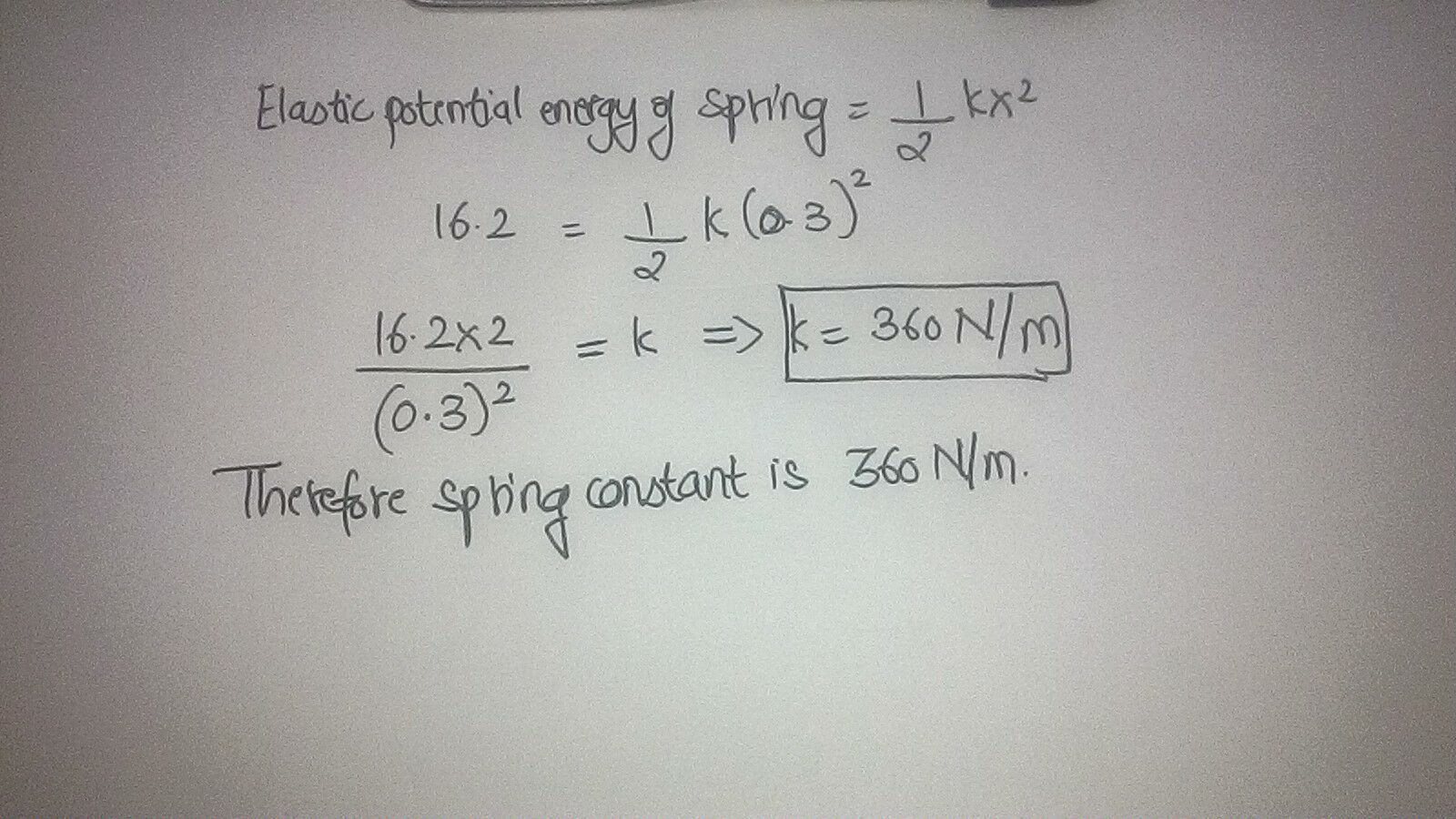
A compressed spring has 16.2J of elastic potential energy when it is compressed 0.30m . What is the spring constant of the sprin
ValentinkaMS [1149]
I hope this provides the assistance you need.

3 0
10 days ago
Three moles of an ideal gas with a molar heat capacity at constant volume of 4.9 cal/(mol∙K) and a molar heat capacity at consta
ValentinkaMS [1149]

Answer:

The amount of heat that enters the gas throughout this two-step process totals 120 cal.

Explanation:

Given that,

Moles present = 3

Heat capacity at volume held constant = 4.9 cal/mol.K

Heat capacity at pressure held constant = 6.9 cal/mol.K

Starting temperature = 300 K

Ending temperature = 320 K

We are tasked with determining the heat absorbed by the gas at constant pressure

Employing the heat formula

\Delta H_{1}=nC_{p}\times\Delta T

Substituting the values into the equation

\Delta H_{1}=3\times6.9\times(320-300)

\Delta H_{1}=414\ cal

Next, we calculate the heat absorbed by the gas at constant volume

Using the corresponding heat formula

\Delta H_{1}=nC_{v}\times\Delta T

Insert the values into the formula

\Delta H_{1}=3\times4.9\times(300-320)

\Delta H_{1}=-294\ cal

Now, it's necessary to evaluate the total heat flow into the gas during both steps

Using the total heat formula

\Delta H_{T}=\Delta H_{1}+\Delta H_{2}

\Delta H_{T}=414-294

\Delta H_{T}=120\ cal

Thus, the heat that transfers into the gas throughout this two-step process amounts to 120 cal.

7 0
1 day ago
A 7.5 kg cannon ball leaves a canon with a speed of 185 m/s. Find the average net force applied to the ball if the cannon muzzle
Keith_Richards [1034]

To determine the average net force, we can calculate acceleration using:

x = 0.5*a*t^2

v = a*t

where x=3.6m and v=185 m/s.

Thus,

t=v/a and therefore x = 0.5*a*(v/a)^2 = 0.5 * (v^2)/a

which gives us a= (0.5*v^2)/x

Since we have the known values of v and x, we can compute a by substituting these numbers.

The average net force is then given as:

F = m*a,

with m=7.5kg.


5 0
1 day ago
A uniform magnetic field makes an angle of 30o with the z axis. If the magnetic flux through a 1.0 m2 portion of the xy plane is
Yuliya22 [1153]

Response:

(b) 10 Wb

Clarification:

Given;

angle of the magnetic field, θ = 30°

initial area of the plane, A₁ = 1 m²

initial magnetic flux through the plane, Φ₁ = 5.0 Wb

The equation for magnetic flux is;

Φ = BACosθ

where;

B denotes the magnetic field strength

A represents the area of the plane

θ is the inclination angle

Φ₁ = BA₁Cosθ

5 = B(1 x cos30)

B = 5/(cos30)

B = 5.7735 T

Next, calculate the magnetic flux through a 2.0 m² section of the same plane:

Φ₂ = BA₂Cosθ

Φ₂ = 5.7735 x 2 x cos30

Φ₂ = 10 Wb

<pHence, the magnetic flux through a 2.0 m² area of the same plane is 10 Wb.

Option "b"

3 0
5 days ago
Other questions:
  • An archer tests various arrowheads by shooting arrows at a pumpkin that is suspended from a tree branch by a rope, as shown to t
    14·1 answer
  • The figure above represents a stick of uniform density that is attached to a pivot at the right end and has equally spaced marks
    13·1 answer
  • 4 A wheel starts from rest and has an angular acceleration of 4.0 rad/s2. When it has made 10 rev determine its angular velocity
    13·1 answer
  • 3. A 3.0 × 10⁻³ kg copper penny drops a distance of 50.0 m to the ground. If 65 percent of the initial potential energy goes int
    6·1 answer
  • Timmy drove 2/5 of a journey at an average speed of 20 mph.
    8·2 answers
  • At one instant of time a rocket is traveling in outer space at 2500m/s and is exhausting fuel at a rate of 100 kg/s. If the spee
    6·1 answer
  • A ball is dropped from the top of a cliff. By the time it reaches the ground, all the energy in its gravitational potential ener
    14·1 answer
  • Smoking increases ____ levels in the blood, thus increasing the possibility of unwanted clotting.
    14·1 answer
  • An Object moving at a velocity of 30 m/s slows to a stop in 7 seconds. What was its acceleration
    12·1 answer
  • A dipole of moment 0.5 e·nm is placed in a uniform electric field with a magnitude of 8 times 104 N/C. What is the magnitude of
    11·1 answer
Add answer
Login
Not registered? Fast signup
Signup
Login Signup
Ask question!