answer.
Ask question
Login Signup
Ask question
All categories
  • English
  • Mathematics
  • Social Studies
  • Business
  • History
  • Health
  • Geography
  • Biology
  • Physics
  • Chemistry
  • Computers and Technology
  • Arts
  • World Languages
  • Spanish
  • French
  • German
  • Advanced Placement (AP)
  • SAT
  • Medicine
  • Law
  • Engineering
Kay
1 month ago
13

t-Butyl alcohol (TBA) is an important octane enhancer that is used to replace lead additives in gasoline [Ind. Eng. Chem. Res.,

27, 2224 (1988)]. TBA was produced by the liquid-phase hydration (W) of isobutene (I) over an Amberlyst-15 catalyst. The system is normally a multiphase mixture of hydrocarbon, water, and solid catalysts. However, the use of cosolvents or excess TBA can achieve reasonable miscibility. The reaction mechanism is believed to be

Chemistry
1 answer:
alisha [2.9K]1 month ago
5 0

The production mechanism for t-butyl alcohol proceeds as follows:

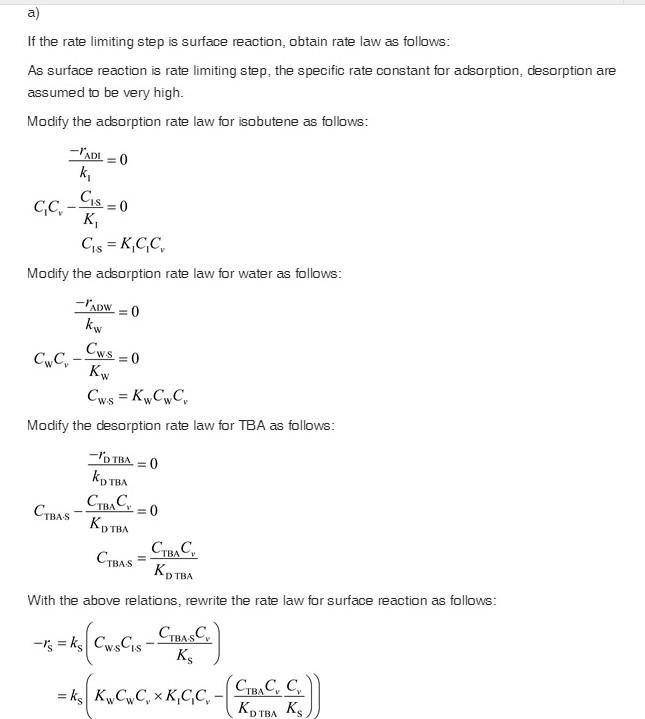
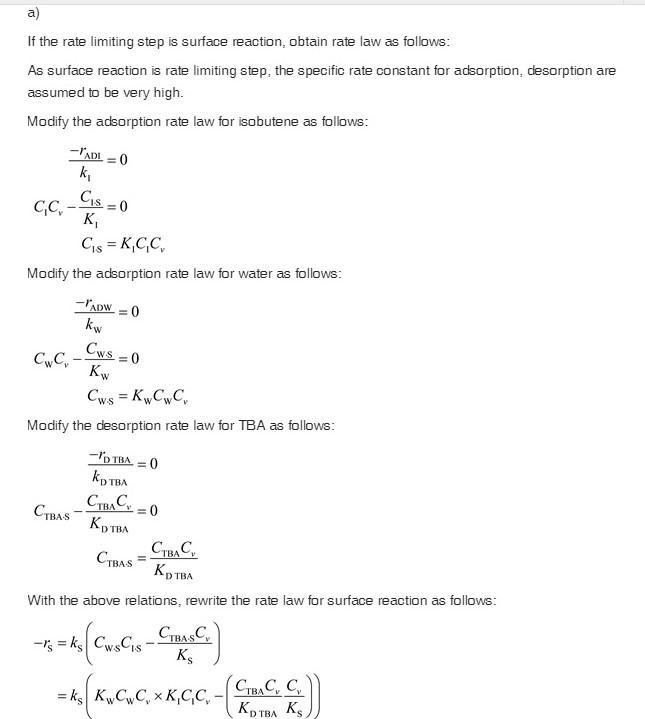
The reaction and corresponding rate law for isobutene adsorption on the Amberlyst-15 catalyst can be described by:

I + S ⇄ I * S -r_{ADI} = k_I(C_1C_v-\frac{C_{I.S}}{K_I} )

where C_V represents the concentration of unoccupied sites

K_I denotes the adsorption equilibrium constant

k_I indicates the forward rate constant

C_I,C_{I.S} are the concentrations of isobutene and the site occupied by isobutene

The equation for the adsorption of water (W) onto the Amberlyst-15 catalyst is outlined as:

W + S ⇄ W.S -r_{ADW} = k_W(C_WC_V-\frac{C_{W.S}}{K_W} )

The surface reaction's rate law can be described as:

W.S + I.S ⇄ TBA. S + Sn -r_s = k_s(C_{W.S}C_{I.S}-\frac{C_{TBA.S}C_V}{K_s} )

The desorption rate law for TBA from the catalyst is as follows:

TBA. S ⇄ TBA + S -r_{D TBA} = k_{DTBA}(C_{TBA.S}-\frac{C_{TBA}C_V}{K_{DTBA}} )

The image included below illustrates the rest of the steps.

You might be interested in
Write the balanced molecular and net ionic equation for the reaction that occurs when the contents of the two beakers are added
alisha [2963]

1) reacting hydrochloric acid with nickel:

Balanced molecular equation: Ni(s) + 2HCl(aq) → NiCl₂(aq) + H₂(g).

Ionic equation: Ni(s) + 2H⁺(aq) + 2Cl⁻(aq) → Ni²⁺(aq) + 2Cl⁻(aq) + H₂(g).

Net ionic equation: Ni(s) + 2H⁺(aq) → Ni²⁺(aq) + H₂(g).

In this reaction, nickel undergoes oxidation, changing from an oxidation state of 0 to +2, while hydrogen is reduced from +1 to 0 (H₂).

2) reacting sulfuric acid with iron:

Balanced molecular equation: Fe(s) + H₂SO₄(aq) → FeSO₄(aq) + H₂(g).

Ionic equation: Fe(s) + 2H⁺(aq) + SO₄²⁻(aq) → Fe²⁺(aq) + SO₄²⁻(aq) + H₂(g).

Net ionic equation: Fe(s) + 2H⁺(aq) → Fe²⁺(aq) + H₂(g).

In this scenario, iron is oxidized from an oxidation state of 0 to +2, while hydrogen experiences reduction from +1 to 0 (H₂).

3) hydrobromic acid reacting with magnesium:

Balanced molecular equation: Mg(s) + 2HBr(aq) → MgBr₂(aq) + H₂(g).

Ionic equation: Mg(s) + 2H⁺(aq) + 2Br⁻(aq) → Mg²⁺(aq) + 2Br⁻(aq) + H₂(g).

Net ionic equation: Mg(s) + 2H⁺(aq) → Mg²⁺(aq) + H₂(g).

This reaction sees magnesium oxidized from 0 to +2, and hydrogen reduced from +1 to 0 (H₂).

4) acetic acid reacting with zinc:

Balanced molecular equation: Zn(s) + 2CH₃COOH(aq) → (CH₃COO)₂Zn(aq) + H₂(g).

Ionic equation: Zn(s) + 2H⁺(aq) + 2CH₃COO⁻(aq) → Zn²⁺(aq) + 2CH₃COO⁻(aq) + H₂(g).

Net ionic equation: Zn(s) + 2H⁺(aq) → Zn²⁺(aq) + H₂(g).

Here, zinc gets oxidized from 0 to +2 (Zn²⁺), while hydrogen is reduced from +1 to 0 (H₂).

7 0
1 month ago
Examine the sets of bonds given in the choices. which one arranges the bonds in order of increasing (shortest to longest) bond l
Tems11 [2777]
The stronger the attraction between elements, the shorter the bond length becomes; conversely, a weaker attraction results in a longer bond length. This attraction arises from differences in their electronegativities, which is the capacity of an element to draw electrons toward itself. According to periodic trends, electronegativity rises as you move left to right and bottom to top on the periodic table. Therefore, the order from the most electronegative to the least is: Cl > Br > I. As a result, the sequence by bond length from shortest to longest is: C-Cl > C-Br > C-I.
8 0
1 month ago
A 25.0-g sample of ice at -6.5oC is removed from the freezer and allowed to warm until it melts. Given the data below, select al
KiRa [2933]

Answer:

B, D

Explanation:

We need to recognize that the ice will rise in temperature from -6.5 ºC to 0 ºC for it to change into water.

Let's define q₁ as the heat needed to warm the ice to 0ºC, and q₂ as the heat for the transition from solid to liquid.

The calculation for q₁ is as follows:

q₁ = s x m x ΔT, where s represents the specific heat of ice (2.09 J/gºC), m is the mass, and ΔT is the temperature difference.

For q₂, the enthalpy of fusion is computed as:

q₂ = C x ΔT

with C indicating the specific heat for the phase transition, denoted as AH in kJ/mol.

All necessary data for computing q₁, q₂, and the total heat change (q₁ + q₂) is provided.

q₁ = 25.0 g x (2.09 J/gºC) x (0 - (-6.5 ºC))

q₁ = 339.6 J = 0.339 kJ

q₂ = (25 g/18 g/mol) x 6.02 kJ/mol = 1.39 x 6.02 kJ = 8.36 kJ

Combining these values gives us qtotal = 0.339 kJ + 8.36 kJ = 8.70 kJ.

Now we can answer the question:

(a) False, AH refers to the heat capacity during melting.

(b) True, as we concluded earlier.

(c) False, there’s only one phase transition from solid (ice) to liquid.

(d) True based on our calculations above.

(e) False, according to our findings.

7 0
1 month ago
The recommended daily intake of potassium (K) is 4.725 grams. Assuming that every raisin contains 3.677 milligrams of K, how man
alisha [2963]
3.677 mg =0,003677g \ \ \ \ \ \ \ \ \Rightarrow \ \ \ \ \ \ \ 1 \ raisin\\ 4,725g \ \ \ \ \ \ \ \ \ \ \ \ \Rightarrow \ \ \ \ \ \ \ \ x\\\\ x=\frac{4,725g*1}{ 0,003677g}\approx 1285 \ raisins
3 0
29 days ago
In the unit 2 lab, what combination produced a brown bubbly liquid that looks like root-beer? (Select the two parts of the combi
Alekssandra [3086]
Baking soda and chalk
6 0
1 month ago
Other questions:
  • The standard curve was made by spectrophotographic analysis of equilibrated iron(III) thiocyanate solutions of known concentrati
    15·1 answer
  • A decorative "ice" sculpture is carved from dry ice (solid CO2) and held at its sublimation point of –78.5°C. Consider the proce
    10·1 answer
  • Determine the number of 3s electrons in na.
    12·1 answer
  • For the chemical equation SO 2 ( g ) + NO 2 ( g ) − ⇀ ↽ − SO 3 ( g ) + NO ( g ) SO2(g)+NO2(g)↽−−⇀SO3(g)+NO(g) the equilibrium co
    12·1 answer
  • The Museum of West Namibia wants to know if the Mesosaurus fossils were separated in one or a series of quick, huge movements, o
    13·1 answer
  • A student did not read the direction to the experiment properly and mixed up where to place the NaOH solution and the vinegar. H
    8·1 answer
  • Classify each of these soluble solutes as a strong electrolyte, a weak electrolyte, or a nonelectrolyte. Solutes Formula Hydroch
    5·2 answers
  • what is the net ionic equation with its physical states? (NH4)2CO3(aq)+Ca(ClO4)2(aq)⟶CaCO3(s)+2NH4ClO4(aq)
    11·1 answer
  • Which species has the smaller bond angle, h3o+ or h2o?
    15·1 answer
  • What volume of co2 gas at 645 torr and 800. k could be produced by the decomposition of 45.0 g of caco3? caco3(s) → cao(s) + co2
    8·1 answer
Add answer
Login
Not registered? Fast signup
Signup
Login Signup
Ask question!