answer.
Ask question
Login Signup
Ask question
All categories
  • English
  • Mathematics
  • Social Studies
  • Business
  • History
  • Health
  • Geography
  • Biology
  • Physics
  • Chemistry
  • Computers and Technology
  • Arts
  • World Languages
  • Spanish
  • French
  • German
  • Advanced Placement (AP)
  • SAT
  • Medicine
  • Law
  • Engineering
ziro4ka
2 months ago
11

Part B

Mathematics
1 answer:
AnnZ [12.3K]2 months ago
7 0

Answer:

Part A) The straight-line distance between the school and the Fire Station is 4.6\ miles

Part B) The straight-line distance between the school and the hospital is 2.1\ miles

Step-by-step explanation:

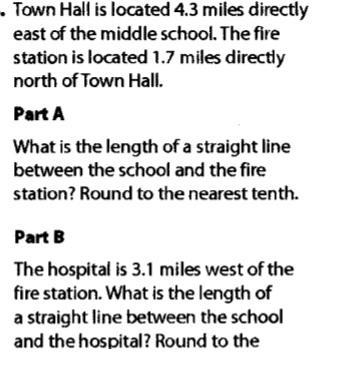
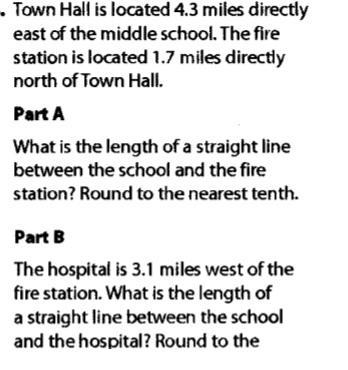
The full question can be found in the attached image.

Let

The positive x-coordinates represent the East

The positive y-coordinates represent the North

The negative x-coordinates indicate the West

The negative y-coordinates indicate the South

Treat point A (0,0) as the Middle School (reference point).

Part A) The Town Hall is situated 4.3 miles directly east of the Middle School,

thus the coordinates for Town Hall are B(4.3,0).

The Fire Station is positioned 1.7 miles directly north of Town Hall, therefore

the coordinates for the Fire Station are C(4.3,1.7).

What is the straight-line distance between the school and the Fire Station?

Keep in mind that

the distance formula between two points is indicated as

d=\sqrt{(y2-y1)^{2}+(x2-x1)^{2}}

We have

A(0,0) and C(4.3,1.7).

Now substitute

d=\sqrt{(1.7-0)^{2}+(4.3-0)^{2}}

d=\sqrt{(1.7)^{2}+(4.3)^{2}}

d=4.6\ miles

Part B) Now considering

The hospital is 3.1 miles west of the fire station.

The coordinates for the hospital are D(4.3-3.1,1.7).

D(1.2,1.7)

What is the straight-line distance between the school and the hospital?

Remember that

the distance formula applies here as well,

d=\sqrt{(y2-y1)^{2}+(x2-x1)^{2}}

with points A(0,0) and D(1.2,1.7).

Substituting the values gives us

d=\sqrt{(1.7-0)^{2}+(1.2-0)^{2}}

d=\sqrt{(1.7)^{2}+(1.2)^{2}}

d=2.1\ miles

You might be interested in
max invests $6000 in a savings account for 3 years. the account pays compound interest at a rate of 1.5% per year for the first
AnnZ [12381]

Answer:

2.1%

Step-by-step explanation:

The compound interest formula can be expressed as:

A=P(1+I)^n\\\\P-Principal \\A-amount\\i-compound \ interest \ rate

Starting with a Principal amount of $6000 and applying an interest rate of 1.5% for the first two years:

A=P(1+i)^n\\\\A_2=6000(1+0.015)^2\\\\A_2=6181.35

We calculate compound interest A_2 for one year at rate i, resulting in $6311.16:

A=P(1+i)^n, n=1, i=i, P=6181.35, A=6311.16\\\\6311.16=6181.35(1+i)^1\\\\\frac{6311.16}{6181.35}=(1+i)\\\\i=\frac{6311.16}{6181.35}-1\\\\i=0.02100

Thus, the interest rate for the third year is 2.1%

7 0
2 months ago
Read 2 more answers
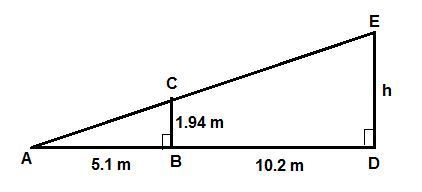
George is 1.94 meters tall and wants to find the height of a tree in his yard. He started at the base of the tree and walked 10.
Leona [12618]
Create a visual representation to depict the situation outlined below.

Let h signify the height of the tree.

Since ΔABC is similar to ΔADE, it follows that
DE/BC = AD/AB

This means that
h/1.94 = (5.1 + 10.2)/5.1 = 3
Consequently, h = 1.94*3 = 5.82 m

Final result: 5.82 m

7 0
2 months ago
There were 2.605 people at the basketball game. A reporter rounded this number to the nearest hundred from a newspaper article.
Svet_ta [12734]
Rounded to the nearest hundred, 2605 becomes 2600. If it had been 2650 or more, it would have rounded to 2700.
7 0
1 month ago
A certain pen has been designed so that true average writing lifetime under controlled conditions (involving the use of awriting
tester [12383]

Answer:

a) Null hypothesis:\mu \geq 10

Alternative hypothesis:\mu < 10

b) p_v =P(t_{17}

Given that the p-value is lower than the significance threshold in this situation, we have sufficient grounds to reject the null hypothesis.

c) p_v =P(t_{17}

In this case, since the p-value exceeds the significance threshold, we have adequate evidence to FAIL to reject the null hypothesis.

d) p_v =P(t_{17}

Here again, with the p-value being less than the significance level, we can reject the null hypothesis.

Step-by-step explanation:

1) Provided data and references

\bar X represents the average of the samples

s denotes the standard deviation of the samples

n=18 indicates the number of samples

\mu_o =10 is the value we are examining

\alpha defines the significance level for the test.

t represents the specific statistic of interest

p_v indicates the p-value relevant to the test (the variable of concern)

Define the null and alternative hypotheses.

To assess if the true mean is at least 10 hours, we must set up a hypothesis:

Part a

Null hypothesis:\mu \geq 10

Alternative hypothesis:\mu < 10

If we consider the sample size being less than 30 and the population deviation unknown, it’s more appropriate to use a t-test to compare the actual mean with the reference value, calculated as:

t=\frac{\bar X-\mu_o}{\frac{s}{\sqrt{n}}} (1)

Part b

In this scenario t=-2.3, \alpha=0.05

Initially, we need to calculate the degrees of freedom df=n-1=18-1=17

Since this is a left-tailed test, the p-value is determined by:

p_v =P(t_{17}

In this instance, with the p-value being less than the significance level, we have sufficient evidence to reject the null hypothesis.

Part c

For this situation t=-1.8, \alpha=0.01

We need to find the degrees of freedom df=n-1=18-1=17

For the left-tailed test, the p-value is given by:

p_v =P(t_{17}

In this case, since the p-value is above the significance level, we have enough grounds to FAIL to reject the null hypothesis.

Part d

For this case t=-3.6, \alpha=0.05

Firstly, we find the degrees of freedom df=n-1=18-1=17

Since we are conducting a left-tailed test, the p-value is calculated as:

p_v =P(t_{17}

Here, with the p-value being lower than the significance threshold, we can reject the null hypothesis.
5 0
2 months ago
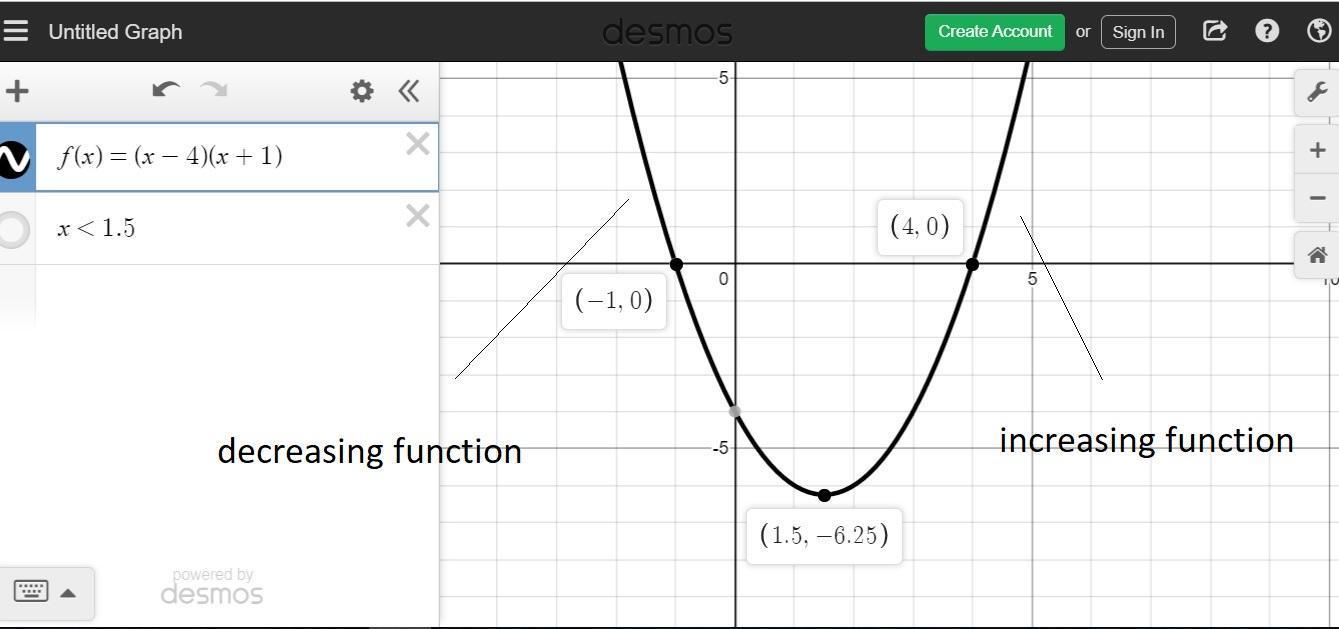
The graph of the function f(x) = (x – 4)(x + 1) is shown below. On a coordinate plane, a parabola opens up. It goes through (neg
tester [12383]

Answer:

The function decreases across all real numbers x where x < 1.5.

Step-by-step explanation:

We have

f(x)=(x-4)(x+1)

f(x)=x^2+x-4x-4

f(x)=x^2-3x-4

This represents an upward-opening vertical parabola

The vertex denotes a minimum point

The vertex is located at (1.5,-6.25)

We know that

The function is decreasing within the interval ----> (-∞, 1.5) x < 1.5

This means----> the function is continuously decreasing for all real x values under 1.5

Conversely, the function is increasing within the interval ----> (1.5, ∞) x> 1.5

Thus, for all real x values greater than 1.5, the function is increasing

Check the attached figure for further clarification

Therefore

The true statement is

The function decreases across all real numbers x where x < 1.5.

5 0
2 months ago
Read 2 more answers
Other questions:
  • The table below shows the linear relationship between the number of people at a picnic and the total cost of the picnic. Which s
    13·2 answers
  • A regular polygon has 15 sides. Which is a possible angle of rotational symmetry for the figure? 12° 45° 72° 90°
    13·2 answers
  • The Weibull distribution is widely used in statistical problems relating to aging of solid insulating materials subjected to agi
    8·1 answer
  • Suppose a research paper states that the distribution of the daily sea-ice advance/retreat from each sensor is similar and is ap
    12·1 answer
  • Follow this link to view Jamie’s work. Critique Jamie’s work by explaining the reasonableness of the scenario and the accuracy o
    11·1 answer
  • If there were 49 cars in a line that stretched 528 feet, what is the average car length? assume that the cars are lined up bumpe
    8·1 answer
  • Sabine records the daily heights of a random sample of bamboo stalks, in inches. They are:
    13·2 answers
  • Suppose we are playing draw poker. we are dealt (from a well-shuffled deck) five cards, which contain four spades and another ca
    12·1 answer
  • How much will Kasey pay in Medicare if she makes $42,300 next year? $613.35 $2,678.40 $3,291.75 $4,320.00
    8·1 answer
  • The following observations are on stopping distance (ft) of a particular truck at 20 mph under specified experi- mental conditio
    15·1 answer
Add answer
Login
Not registered? Fast signup
Signup
Login Signup
Ask question!