answer.
Ask question
Login Signup
Ask question
All categories
  • English
  • Mathematics
  • Social Studies
  • Business
  • History
  • Health
  • Geography
  • Biology
  • Physics
  • Chemistry
  • Computers and Technology
  • Arts
  • World Languages
  • Spanish
  • French
  • German
  • Advanced Placement (AP)
  • SAT
  • Medicine
  • Law
  • Engineering
Sergeeva-Olga
17 days ago
15

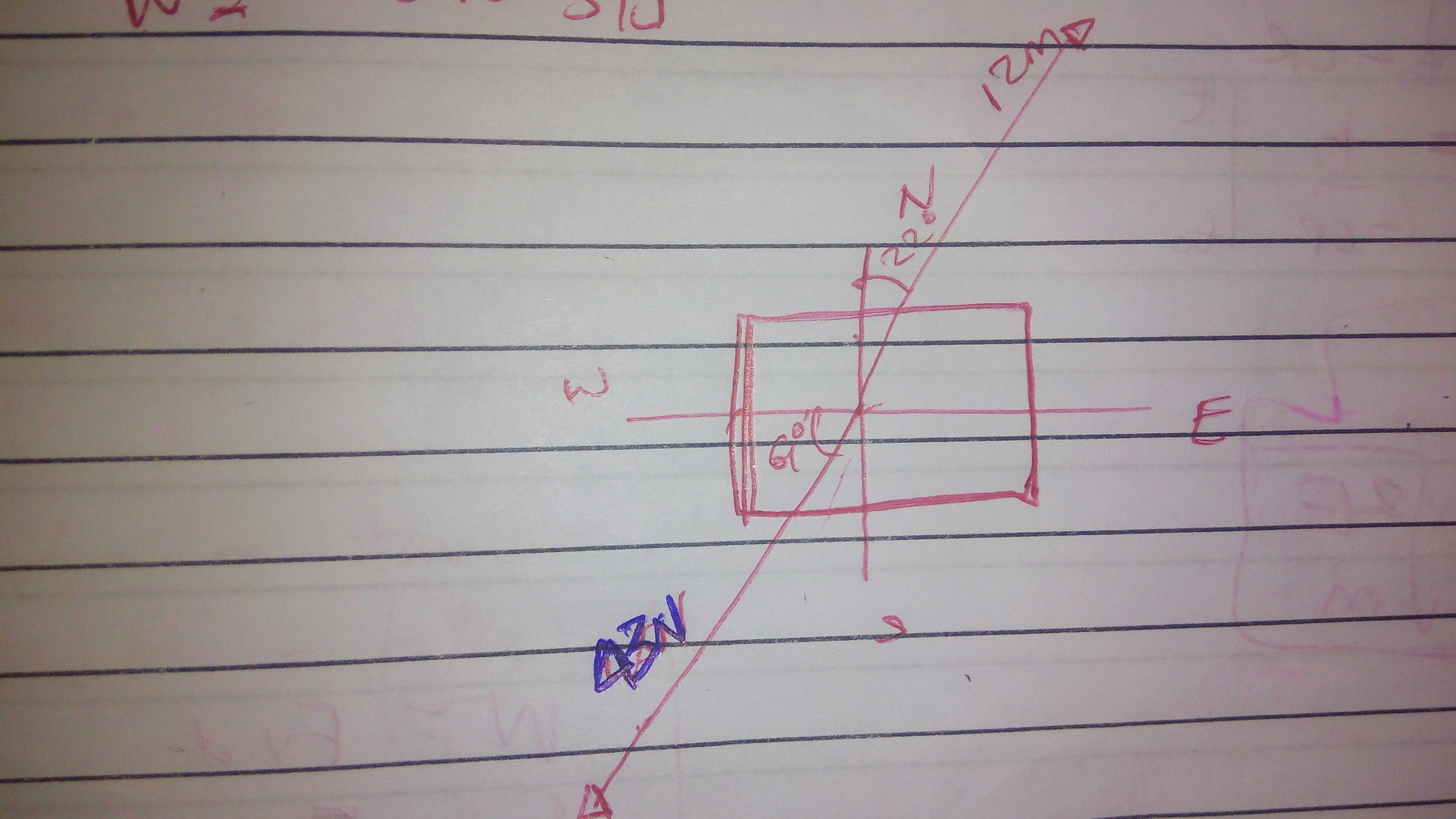
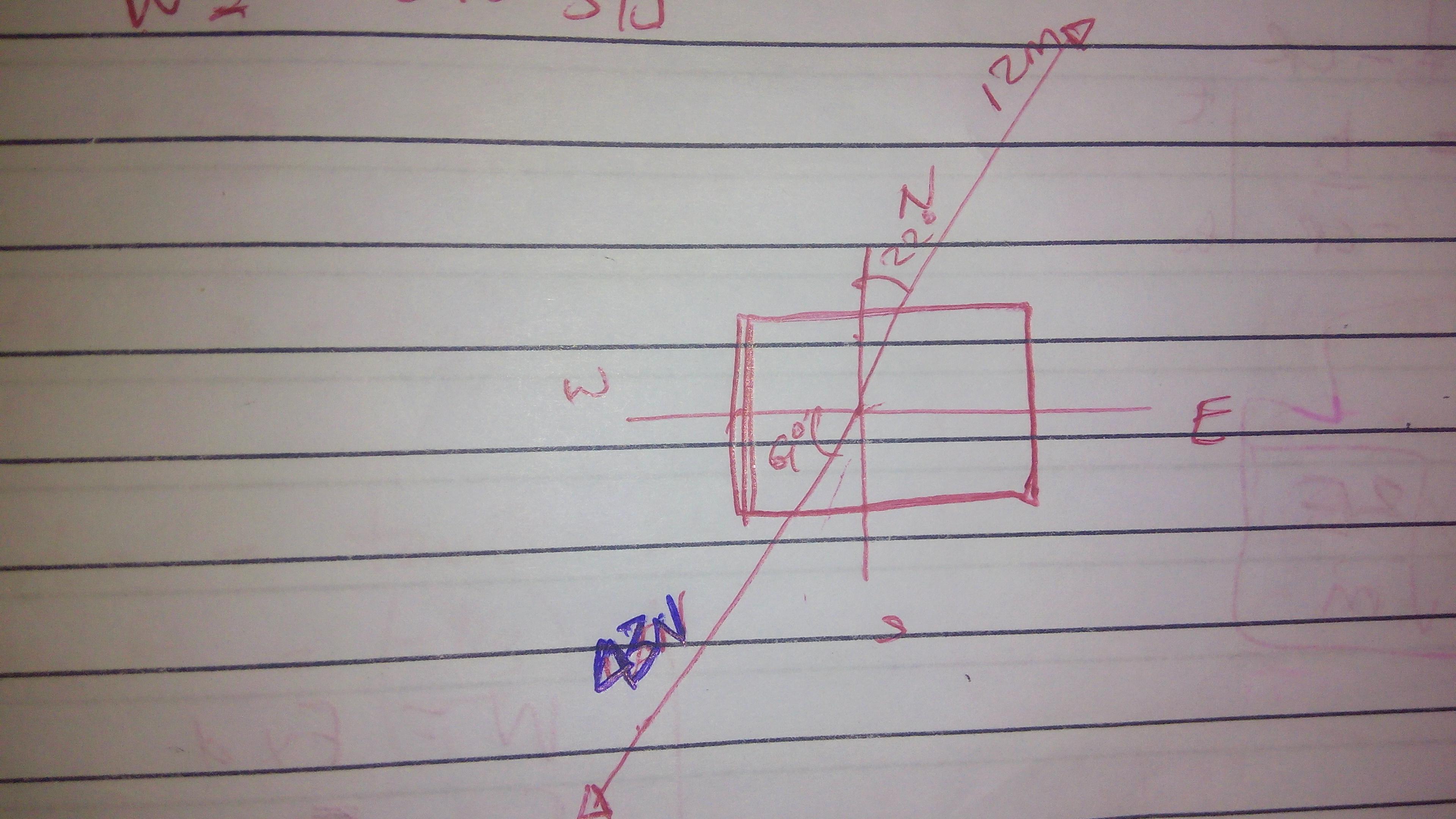
A large crate sits on the floor of a warehouse. Paul and Bob apply constant horizontal forces to the crate. The force applied by

Paul has magnitude 43.0 N and direction 61.0∘ south of west.
How much work does Paul's force do during a displacement of the crate that is 12.0 m in the direction 22.0∘ east of north?

Physics
1 answer:
kicyunya [2.2K]17 days ago
6 0

Answer:

W = -510.98 J

Explanation:

Force = 43 N, 61° SW

Displacement = 12 m, 22° NE

The work done is calculated using:

W = F*d*cos(A)

where A is the angle between the applied force and displacement.

The angle A between the force and displacement is determined as A = 61 + 90 + 22 = 172°

Hence, W = 43 * 12 * cos(172)

This results in W = -510.98 J

The negative result indicates that the work is done contrary to the direction of the force applied.

You might be interested in
Charge is placed on two conducting spheres that are very far apart and connected by a long thin wire. The radius of the smaller
Softa [2029]

Answer:

σ₁ = 3.167 * 10^{-6} C/m²

σ₂ = 7.6 * 10 ^{-6}  C/m²

Explanation:

Provided Information:

i) Smaller sphere's radius ( r ) = 5 cm.

ii) Larger sphere's radius ( R ) = 12 cm.

iii) Electric field at the larger sphere's surface  ( E₁ ) = 358 kV/m, which is equivalent to 358 * 1000 v/m

E_{1} = (\frac{1}{4\pi\epsilon }) (\frac{Q_{1} }{R^{2} } )

358000 = 9 * 10^{9 } *\frac{Q_{1} }{0.12^{2} }

Charge (Q₁) = 572.8 * 10^{-9} C

Since the electric field inside a conductor is zero, the electric potential ( V ) remains constant.

V = constant

∴\frac{Q_{1} }{R} = \frac{Q_{2} }{r}

Q_{2} = \frac{r}{R} *Q_{1}

Q_{2} = \frac{5}{12} *572.8*10^{-9}   = 238.666 *10^{-9} C

Surface charge density ( σ₁ ) for the larger sphere.

Calculated Area ( A₁ )  = 4 * π * R²  = 4 * 3.14 * 0.12 = 0.180864 m².

σ₁  = \frac{Q_{1} }{A_{1} } = \frac{572.8 *10^{-9} }{0.180864} = 3.167 * 10^{-6}  C/m².

Surface charge density ( σ₂ ) for the smaller sphere.

Calculated Area ( A₂ )  = 4 * π * r²  = 4 * 3.14 * 0.05²  = 0.0314 m².

σ₂ =\frac{Q_{2} }{A_{2} } = \frac{238.66 *10^{-9} }{0.0314} = 7.6 * 10 ^{-6} C/m²

8 0
25 days ago
What is the least possible initial kinetic energy in the oxygen atom could have and still excite the cesium atom?
inna [2205]
K=E[(m+M)/M] Kmin=4.4
8 0
7 days ago
Albert uses as his unit of length (for walking to visit his neighbors or plowing his fields) the albert (a), the distance albert
Yuliya22 [2420]

To tackle this question, we know the following:

1 Albert equals 88 meters.

1 A = 88 m.

Initially, we square both sides of the equation:

(1 A)^2 = (88 m)^2

1 A^2 = 7,744 m^2

<span>Since 1 acre equals 4,050 m^2, let’s divide both sides by 7,744 to find out how many acres match this value:</span>

1 A^2 / 7,744 = 7,744 m^2 / 7,744

(1 / 7,744) A^2 = 1 m^2

Then multiply both sides by 4,050.

(4050 / 7744) A^2 = 4050 m^2

0.523 A^2 = 4050 m^2

<span>Thus, one acre is approximately 0.52 square alberts.</span>

7 0
24 days ago
When you apply the torque equation ∑τ = 0 to an object in equilibrium, the axis about which torques are calculated:
Softa [2029]

Answer:

option D.

Explanation:

The correct choice is option D.

For an object in equilibrium, the torque measured at any point will be zero.

An object is deemed to be in equilibrium when the net moment acting on it equals zero.

If the object experiences a net moment not equal to zero, it will rotate and will not remain stable.

3 0
1 month ago
A 55-kg pilot flies a jet trainer in a half vertical loop of 1200-m radius so that the speed of the trainer decreases at a const
Keith_Richards [2256]

a) -1.54 m/s^2

b) 803.4 N

Explanation:

a) At point C (top of the loop), the pilot experiences weightlessness, leading to the normal force from the seat being zero:

N = 0

Consequently, the force balance equation at position C becomes:

mg=m\frac{v^2}{r}where the left term signifies the pilot's weight and the right term represents the centripetal force, with:

= acceleration due to gravity

= jet's velocity at the top g=9.8 m/s^2

= loop radius

vBy solving for v,

r=1200 m

Thus, this is the jet's speed at C.

The speed at position A (bottom) can be derived fromv_C=\sqrt{gr}=\sqrt{(9.8)(1200)}=108.4 m/s

The distance traveled by the jet corresponds to half the circumference of the circle with radius r, therefore

v_A=550 km/h =152.8 m/s

Given the plane's deceleration is consistent, we can obtain it using the following equation:

s=\pi r=\pi(1200)=3770 m

b) The pilot experiences a force equal to the normal force from the seat. At point B (half-way through the loop), we find:

v_C^2-v_A^2=2as\\a=\frac{v_C^2-v_A^2}{2s}=\frac{108.4^2-152.8^2}{2(3770)}=-1.54 m/s^2- The normal force from the seat, N, directed towards the center of the loop

- As there are no further forces acting toward the central axis, N must equal the centripetal force:

(1)

where

represents the speed at position B.

To deduce the velocity at B, we note that the distance covered by the jet between positions A and B is a quarter of a circle:

With knowledge of the deceleration, we can implement the equation of motion to find the velocity at the midway point B:N=m\frac{v_B^2}{r}

v_B

Thus, we then apply eq.(1) to determine the normal force acting on the pilot at B:

s=\frac{\pi r}{2}=\frac{\pi(1200)}{2}=1885 m

6 0
6 days ago
Other questions:
  • Bonnie and clyde are sliding a 300 kg bank safe across the floor to their getaway car. the safe slides with a constant speed if
    14·1 answer
  • A bowling pin is thrown vertically upward such that it rotates as it moves through the air, as shown in the figure. Initially, t
    5·1 answer
  • The nucleus of an atom has all of the following characteristics except that it
    5·1 answer
  • A clever inventor has created a device that can launch water balloons with an initial speed of 85.0 m/s. Her goal is to pass a b
    8·1 answer
  • Read each scenario below. Then select the answer that best completes each sentence.
    6·2 answers
  • Two balls of unequal mass are hung from two springs that are not identical. The springs stretch the same distance as the two sys
    12·1 answer
  • A quantum system has three energy levels, so three wavelengths appear in its emission spectrum. the shortest observed wavelength
    7·1 answer
  • A charged particle (q = −8.0 mC), which moves in a region where the only force acting on the particle is an electric force, is r
    8·1 answer
  • You should have observed that there are some frequencies where the output is stronger than the input. Discuss how that is even p
    15·1 answer
  • A portable television using a 12 volt, 3 Ah rechargeable battery can operate for a period of about 6 hours. What is the average
    7·1 answer
Add answer
Login
Not registered? Fast signup
Signup
Login Signup
Ask question!