answer.
Ask question
Login Signup
Ask question
All categories
  • English
  • Mathematics
  • Social Studies
  • Business
  • History
  • Health
  • Geography
  • Biology
  • Physics
  • Chemistry
  • Computers and Technology
  • Arts
  • World Languages
  • Spanish
  • French
  • German
  • Advanced Placement (AP)
  • SAT
  • Medicine
  • Law
  • Engineering
umka2103
17 days ago
7

Two tiny particles having charges of +5.00 μC and +7.00 μC are placed along the x-axis. The +5.00-µC particle is at x = 0.00 cm,

and the other particle is at x = 100.00 cm. Where on the x-axis must a third charged particle be placed so that it does not experience any net electrostatic force due to the other two particles? Two tiny particles having charges of +5.00 μC and +7.00 μC are placed along the x-axis. The +5.00-µC particle is at x = 0.00 cm, and the other particle is at x = 100.00 cm. Where on the x-axis must a third charged particle be placed so that it does not experience any net electrostatic force due to the other two particles? 4.58 cm 50 cm 9.12 cm 91.2 cm 45.8 cm

Physics
1 answer:
Sav [2.2K]17 days ago
8 0

Answer:

The third charged particle needs to be positioned at x = 0.458 m = 45.8 cm

Explanation:

To address this inquiry, we refer to Coulomb's law:

Two point charges (q₁, q₂) spaced apart by a distance (d) impart a mutual force (F) with a magnitude defined by the equation:

F = \frac{k*q_1*q_2}{d^2} Formula (1)

F: Electric force in Newtons (N)

K: Coulomb's constant in N*m²/C²

q₁, q₂: Charges quantified in Coulombs (C)

d: distance in meters (m)

Equivalence

1μC= 10⁻⁶C

1m = 100 cm

Information

K = 8.99 * 10⁹ N*m²/C²

q₁ = +5.00 μC = +5.00 * 10⁻⁶ C

q₂= +7.00 μC = +7.00 * 10⁻⁶ C

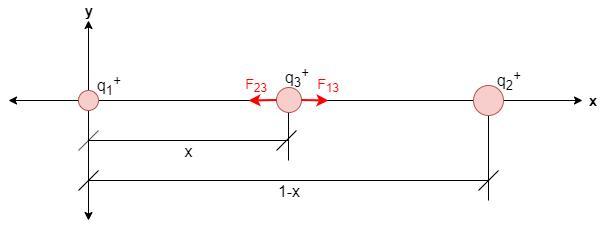
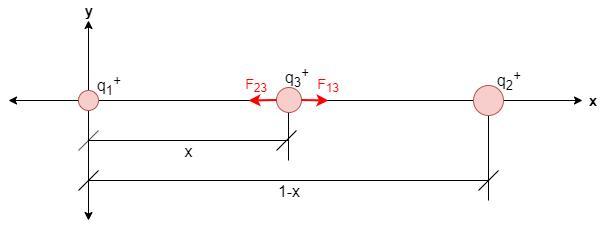
d₁ = x (m)

d₂ = 1-x (m)

Problem analysis

Refer to the accompanying graphic.

We assume a positive charge q₃, thus F₁₃ and F₂₃ exhibit repulsive forces that need to be equivalent so the resultant force is zero:

Utilizing equation (1), we will determine the forces F₁₃ and F₂₃

F_{13} = \frac{k*q_1*q_3}{d_1^2}

F_{23} = \frac{k*q_2*q_3}{d_2^2}

F₁₃ = F₂₃

\frac{k*q_1*q_3}{d_1^2} = \frac{k*q_2*q_3}{d_2^2} We eliminate k and q₃ from both sides

\frac{q_1}{d_1^2}= \frac{q_2}{d_2^2}

\frac{q_1}{x^2}=\frac{q_2}{(1-x)^2}

\frac{5*10^{-6}}{x^2}=\frac{7*10^{-6}}{(1-x)^2} We discard 10⁻⁶ from both sides

(1-x)^2 = \frac{7}{5} x^2

1-2x+x^2=\frac{7}{5} x^2

5-10x+5x^2=7 x^2

2x^2+10x-5=0

We solve for the quadratic equation:

x_1 = \frac{-b+\sqrt{b^2-4ac} }{2a} = \frac{-10+\sqrt{10^2-4*2*(-5)} }{2*2} = 0.458m

x_2 = \frac{-b-\sqrt{b^2-4ac} }{2a} = \frac{-10-\sqrt{10^2-4*2*(-5)} }{2*2} = -5.458m

Choosing x₂ results in F₁₃ and F₂₃ acting in the same direction and unable to cancel each other, therefore we select x₁ as the accurate choice since at this stage the forces counteract each other.

x = 0.458m = 45.8cm

You might be interested in
For a group class project, students are building model roller coasters. Each roller coaster needs to begin at the top of the fir
Keith_Richards [2263]

Case A:

A.75 kg 65 N/m 1.2 m

m = weight of the car = 0.75 kg

k = spring's stiffness = 65 N/m

h = elevation of the hill = 1.2 m

x = spring's compression = 0.25 m

Applying the principle of energy conservation from the Top of the hill to the Bottom of the hill

Energy at the Top of the hill equals Energy at the Bottom of the hill

spring energy + gravitational potential energy = kinetic energy

(0.5) k x² + mgh = (0.5) m v²

(0.5) (65) (0.25)² + (0.75 x 9.8 x 1.2) = (0.5) (0.75) v²

v = 5.4 m/s


Case B:

B.60 kg 35 N/m.9 m

m = weight of the car = 0.60 kg

k = spring's stiffness = 35 N/m

h = height of the hill = 0.9 m

x = spring's compression = 0.25 m

Using energy conservation from the Top of the hill to the Bottom of the hill

Top hill energy = Bottom hill energy

spring energy + gravitational potential energy = kinetic energy

(0.5) k x² + mgh = (0.5) m v²

(0.5) (35) (0.25)² + (0.60 x 9.8 x 0.9) = (0.5) (0.60) v²

v = 4.6 m/s


Case C:

C.55 kg 40 N/m 1.1 m

m = weight of the car = 0.55 kg

k = spring's stiffness = 40 N/m

h = height of the hill = 1.1 m

x = spring's compression = 0.25 m

Using conservation of energy from the Top of the hill to the Bottom of the hill

Energy at the Top of the hill = Energy at the Bottom of the hill

spring energy + gravitational potential energy = kinetic energy

(0.5) k x² + mgh = (0.5) m v²

(0.5) (40) (0.25)² + (0.55 x 9.8 x 1.1) = (0.5) (0.55) v²

v = 5.1 m/s


Case D:

D.84 kg 32 N/m.95 m

m = weight of the car = 0.84 kg

k = spring's stiffness = 32 N/m

h = height of the hill = 0.95 m

x = spring's compression = 0.25 m

Using energy conservation from the Top of the hill to the Bottom of the hill

Total energy at Top of hill = Total energy at Bottom of hill

spring energy + gravitational potential energy = kinetic energy

(0.5) k x² + mgh = (0.5) m v²

(0.5) (32) (0.25)² + (0.84 x 9.8 x 0.95) = (0.5) (0.84) v²

v = 4.6 m/s


thus, the closest result is from case C at 5.1 m/s


7 0
26 days ago
Read 2 more answers
When jumping, a flea accelerates at an astounding 1000 m/s2 but over the very short distance of 0.50 mm. If a flea jumps straigh
Yuliya22 [2438]

Answer:

A flea can attain a maximum elevation of 51 mm.

Explanation:

Hello!

The following equations describe the height and velocity of the flea:

During the jump:

h = h0 + v0 · t + 1/2 · a · t²

v = v0 + a · t

In free fall:

h = h0 + v0 · t + 1/2 · g · t²

v = v0 + g · t

Where:

h = flea's height at time t.

h0 = initial height.

v0 = starting velocity.

t = time interval.

a = flea's acceleration while jumping.

v = flea's velocity at that specific time.

g = gravitational acceleration.

Initially, we need to determine the time taken for the flea to attain a height of 0.0005 m. This will help us calculate the flea's velocity during the jump:

h = h0 + v0 · t + 1/2 · a · t²

If we assume the ground as the origin, thus h0 = 0. Since the flea starts stationary, v0 = 0. Therefore:

h = 1/2 · a · t²

We need to find the value of t when h = 0.0005 m:

0.0005 m = 1/2 · 1000 m/s² · t²

0.0005 m / 500 m/s² = t²

t = 0.001 s

Next, we calculate the velocity achieved during that time:

v = v0 + a · t (v0 = 0)

v = a · t

v = 1000 m/s² · 0.001 s

v = 1.00 m/s

At a height of 0.50 mm, the flea's velocity stands at 1.00 m/s. This initial speed will reduce due to gravity's downward pull. When the speed reaches zero, the flea will have reached its peak height. Using the velocity equation, let's determine the time taken to reach maximum height (v = 0):

v = v0 + g · t

At peak height, v = 0:

0 m/s = 1.00 m/s - 9.81 m/s² · t

-1.00 m/s / -9.81 m/s² = t

t = 0.102 s

Now, we can compute the height attained by the flea during this time:

h = h0 + v0 · t + 1/2 · g · t²

h = 0.0005 m + 1.00 m/s · 0.102 s - 1/2 · 9.81 m/s² · (0.102 s)²

h = 0.051 m

A flea reaches a maximum height of 51 mm.

5 0
1 month ago
What is the torque τa about axis a due to the force f⃗ ? express the torque about axis a at cartesian coordinates (0,0)?
Yuliya22 [2438]

Response:

\tau_a = F a sin \theta

Explanation:

Torque is defined as:

\tau = F d sin \theta

where

F is the force's magnitude,

d represents the distance from where the force is applied to the center of rotation,

\theta and is the angle between the force's direction and d.

In this question, we have:

F, the force

a, the distance of applying the force from the center (0,0)

\theta, and the angle between the force's direction and a.

Thus, the torque is

\tau_a = F a sin \theta

5 0
12 days ago
A bag is dropped from a hovering helicopter. The bag has fallen for 2.0 s. What is the bag’s velocity? How far has the bag falle
Maru [2360]
The term "dropped" indicates that the bag is falling freely, starting from rest. For a free-falling object, the final velocity can be calculated using the equation,
                                            Vf = gt
where g represents the gravitational acceleration at 9.8 m/s².
Substituting the values,
                                            Vf = (9.8 m/s²)(2 s) = 19.6 m/s
Thus, the velocity of the bag is 19.6 m/s.
 
3 0
15 days ago
The cantilever beam AB has a rectangular cross section of 150 × 200 mm. Knowing that the tension in the cable BD is 10.8 kN and
serg [2593]

Response:

Explanation:

The solution can be found in the attached file.

6 0
18 days ago
Other questions:
  • A group of physics students hypothesize that for an experiment they are performing, the speed of an object sliding down an incli
    13·2 answers
  • An object is released from rest near and above Earth’s surface from a distance of 10m. After applying the appropriate kinematic
    8·1 answer
  • The nucleus of an atom has all of the following characteristics except that it
    5·1 answer
  • A scientist is creating a new synthetic material. The material’s density is 6.1 g/cm3. Which sentences describe how the scientis
    7·2 answers
  • A soft drink (mostly water) flows in a pipe at a beverage plant with a mass flow rate that would fill 220 cans, 0.355 - l each,
    6·2 answers
  • Astronomers determine that a certain square region in interstellar space has an area of approximately 2.4 \times 10^72.4×10 ​7 ​
    7·1 answer
  • A test car carrying a crash test dummy accelerates from 0 to 30 m/s and then crashes into a brick wall. Describe the direction o
    6·1 answer
  • A 55 kg gymnast wedges himself between two closely spaced vertical walls by pressing his hands and feet against the walls. Part
    10·1 answer
  • An object is moving back and forth on the x-axis according to the equation x(t) = 3sin(20πt), t> 0, where x(t) is measured in
    5·1 answer
  • An archer fires an arrow, which produces a muffled "thwok" as it hits a target. If the archer hears the "thwok" exactly 1 s afte
    10·1 answer
Add answer
Login
Not registered? Fast signup
Signup
Login Signup
Ask question!