answer.
Ask question
Login Signup
Ask question
All categories
  • English
  • Mathematics
  • Social Studies
  • Business
  • History
  • Health
  • Geography
  • Biology
  • Physics
  • Chemistry
  • Computers and Technology
  • Arts
  • World Languages
  • Spanish
  • French
  • German
  • Advanced Placement (AP)
  • SAT
  • Medicine
  • Law
  • Engineering
iris
2 months ago
7

An element is a main constituent of paper, diamond and clothes etc. It forms covalent bonds with itself and other elements:- (1)

identify the element (2) write the electron dot structure of its oxide. (3) draw the electron dot structure of methane and ethene.

Chemistry
2 answers:
alisha [2.9K]2 months ago
7 0

Explanation:

1) The primary element in paper, diamond, and clothing is carbon. Carbon possesses the unique ability to form robust covalent bonds with other carbon atoms, resulting in intricate organic structures.

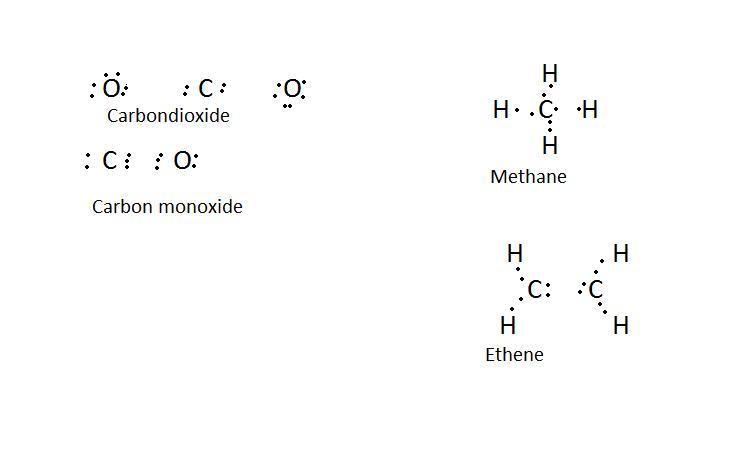
2) Carbon forms two oxides: carbon dioxide CO_2 and carbon monoxide CO.

Structures are displayed in an image.

3) A methane molecule contains one carbon atom.

Methane = CH_4

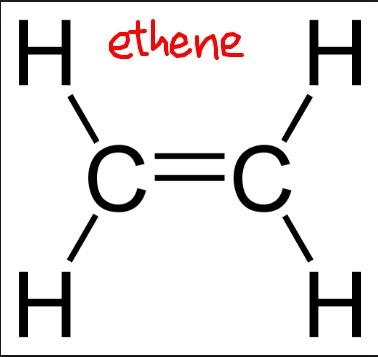
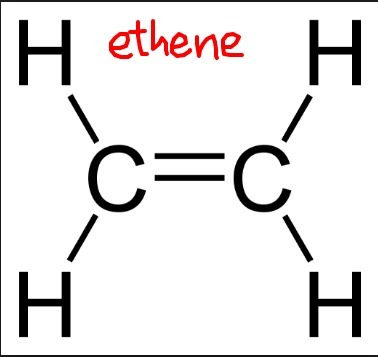
In ethene, two carbon atoms are connected by a double bond.

Ethene = C_2H_4

The electron dot structures for methane and ethene are illustrated in an image

lorasvet [2.7K]2 months ago
6 0

Answer 1) Carbon - This element is a key component of paper in the form of cellulose, diamond consists entirely of carbon, and most fabric fibers are carbon-based. It has four valence electrons in its outer shell, enabling it to form covalent bonds with other elements or with itself by donating or accepting electrons to achieve a stable octet.


Answer 2) There are two types of carbon oxides:

i) CO and ii) CO_{2}


Images for the electron dot structures are provided.


Answer 3) The structure of methane and ethene can be found in the accompanying image.

You might be interested in
Draw a structure for the product of nucleophilic substitution obtained on solvolysis of tert−butyl bromide in methanol, and arra
Alekssandra [3086]
The mechanism will include a) A slow step, which is the rate-determining step In this phase, the leaving group (chloride ion) departs from the substrate, forming carbocation b) A fast step: The nucleophile will interact with the cation, resulting in the substituted product. This mechanism is depicted as follows:
5 0
1 month ago
Read 2 more answers
What evidence is there from your results that the characteristic color observed for each compound is due to the metal ion in eac
lorasvet [2795]

An element of evidence indicating that the color of the flame is attributed to the metal ion rather than the chemical is that none of the flames produced by different metals shared the same color (each metal produced its unique flame color). Although most tested metals had chloride, the flame colors were all distinct. The two flames that contained copper (one from copper (II) chloride and the other from copper (II) sulfate) showed similar colors; one was green-blue and the other was bright green. This suggests a close resemblance, and any slight variation could be attributed to error.

4 0
3 months ago
A compound that is composed of carbon, hydrogen, and oxygen contains 70.6% C, 5.9% H, and 23.5% O by mass. The molecular weight
Tems11 [2777]

Answer: The molecular formula will be C_8H_8O_2

Explanation:

When percentages are provided, we assume the total mass to be 100 grams.

Thus, the mass of each element corresponds to the specified percentage.

Mass of C= 70.6 g

Mass of H = 5.9 g

Mass of O = 23.5 g

Step 1: convert given masses to moles.

Moles of C =\frac{\text{ given mass of C}}{\text{ molar mass of C}}= \frac{70.6g}{12g/mole}=5.9moles

Moles of H =\frac{\text{ given mass of H}}{\text{ molar mass of H}}= \frac{5.9g}{1g/mole}=5.9moles

Moles of O =\frac{\text{ given mass of O}}{\text{ molar mass of O}}= \frac{23.5g}{16g/mole}=1.5moles

Step 2: For determining the mole ratio, divide each molar amount by the smallest number of moles calculated.

For C = \frac{5.9}{1.5}=4

For H = \frac{5.9}{1.5}=4

For O =\frac{1.5}{1.5}=1

The resulting ratio of C: H: O= 4: 4: 1

Hence, the empirical formula obtained is C_4H_4O

The empirical weight is calculated as C_4H_4O = 4(12)+4(1)+1(16)= 68g.

The molecular weight = 136 g/mole

Now the molecular formula needs to be obtained.

n=\frac{\text{Molecular weight }}{\text{Equivalent weight}}=\frac{136}{68}=2

The molecular formula can be derived as=2\times C_4H_4O=C_8H_8O_2

4 0
2 months ago
How many atoms of Mg are present in 97.22 grams of Mg?
VMariaS [2998]

Answer: The correct choice is (b).

Explanation:

We have the mass of Magnesium at 97.22 g, and the molar mass of Magnesium is 24.305 g/mol.

Therefore, the calculation for the number of moles is as follows.

          Number of moles = \frac{mass given in grams}{Molar mass}

                                 = \frac{97.22 g}{24.305 g/mol}  

                                 = 4 mol

Additionally, it is known that one mole contains 6.023 \times 10^{23} atoms/mol. Thus, we calculate the total number of atoms in 4 moles as follows.

               4 mol \times 6.023 \times 10^{23} atoms/mol

               = 24.08 \times 10^{23} atoms

or,            = 2.408 \times 10^{23} atoms

Hence, we conclude that in 97.22 grams of Magnesium, there are 2.408 \times 10^{23} atoms.

7 0
2 months ago
Other questions:
  • Which of the following statements is true about one formula unit of RuF2?<br>​
    12·1 answer
  • In the same condition, what happens to the net force acting on the rope?
    7·1 answer
  • Two mixtures were prepared from three very narrow molar mass distribution polystyrene samples with molar masses of 10,000, 30,00
    5·1 answer
  • A certain element has a melting point over 700 ∘C and a density less than 2.00 g/cm3. What is one possible identity for this ele
    12·2 answers
  • A 50.0 mL Volumetric flask filled with aqueous solution of hydrogen peroxide has a total mass of 88.5 g. The mass of the volumet
    12·1 answer
  • What is the mass of a solution that has a density of 0.775 g/ml and a volume of 50.0ml?
    8·1 answer
  • A 10.1 g sample of NaOH is dissolved in 250.0 g of water in a coffee-cup calorimeter. The temperature increases from 23.0 °C to
    14·2 answers
  • A driver with a nearly empty fuel tank may say she is "running on fumes."
    5·1 answer
  • Be sure to answer all parts. Enter your answers in scientific notation. The following reactions have the indicated equilibrium c
    14·1 answer
  • ANALYZE A ball of clay is manipulated into different shapes in each of the images
    9·1 answer
Add answer
Login
Not registered? Fast signup
Signup
Login Signup
Ask question!