answer.
Ask question
Login Signup
Ask question
All categories
  • English
  • Mathematics
  • Social Studies
  • Business
  • History
  • Health
  • Geography
  • Biology
  • Physics
  • Chemistry
  • Computers and Technology
  • Arts
  • World Languages
  • Spanish
  • French
  • German
  • Advanced Placement (AP)
  • SAT
  • Medicine
  • Law
  • Engineering
lubasha
1 month ago
11

If the patient has to be administered a dosage of 2 tablets every 8 hours for 7 days, what is the number of tablets required for

the prescribed dosage?
Chemistry
1 answer:
eduard [2.7K]1 month ago
6 0
If a patient needs to take 2 tablets every 8 hours over a span of 7 days.
 24/8=3     3*2=6
This indicates that the patient is required to take 6 tablets per day. 
6*7=42   Hence, the total amount of tablets needed for the 7-day period is 42
I hope this clarifies things!:)
You might be interested in
The recommended daily allowance (rda of calcium is 1.2 g. calcium carbonate contains 12.0% calcium by mass. how many grams of ca
eduard [2782]
1) Calcium carbonate comprises 40.0% calcium by weight.
M(CaCO₃)=100.1 g/mol
M(Ca)=40.1 g/mol
w(Ca)=40.1/100.1=0.400 (which is 40.0%)!

2) The mass fraction mentioned is superfluous information.

3) The resulting solution is:

m(Ca)=1.2 g

m(CaCO₃)=M(CaCO₃)*m(Ca)/M(Ca)

m(CaCO₃)=100.1g/mol*1.2g/40.1g/mol=3.0 g
4 0
1 month ago
Read 2 more answers
Sea water's density can be calculated as a function of the compressibility, B, where p = po exp[(p - Patm)/B]. Calculate the pre
lions [2927]

Answer:

A pressure of 137.14 MPa exists 10,000 m beneath the ocean surface.

At this same depth, the density measures 2039 kg/m3.

Explanation:

P0 and ρ0 symbolize the pressure and density at sea level (indicative of atmospheric conditions). With an increase in ocean depth, both pressure and density likewise rise.

The relationship between pressure and density can be expressed as:

\frac{dP}{dy}=\rho*g=\rho_0*g*e^{(P-P_0)/\beta\\\\

By rearranging

\frac{dP}{e^{(P-P_0)/\beta}}= \rho_0*g*dy\\\\\int\limits^{P}_{P_0} {e^{-(P-P_0)/\beta}}dP =\int\limits^y_0 {\rho_0*g*dy}\\\\(-\beta*e^{-(P-P_0)/\beta})-(\beta*e^0)=\rho_0*g*(y-0)\\\\-\beta*(e^{-(P-P_0)/\beta}-1)=\rho_0*g*y\\\\e^{-(P-P_0)/\beta}=1-\frac{\rho_0*g*y}{\beta}\\\\-\frac{P-P_0}{\beta} =ln(1-\frac{\rho_0*g*y}{\beta})\\\\P-P_0=-\beta*ln(1-\frac{\rho_0*g*y}{\beta})\\

This equation allows for computation of P at 10,000 m beneath the ocean's surface:

P-P_0=-\beta*ln(1-\frac{\rho_0*g*y}{\beta})\\\\P-P_0=-200MPa*ln(1-\frac{1027kg/m^3*9.81m/s^2*10,000m}{200MPa})\\\\P-P_0=-200MPa*ln(1-\frac{1027*9.81*10,000Pa}{200*10^6Pa})\\\\P-P_0=-200MPa*ln(1-0.5037)\\\\P-P_0=-200MPa*(-0.6857)=137.14MPa

The density found at a depth of 10,000 m in the ocean is

\rho=\rho_0*e^{(P-P_0)/\beta}\\\rho=1027kg/m^3*e^{(137.14/200)}=1027*e^{0.686}kg/m^3\\\rho=1027*1.985 kg/m^3\\\rho=2039\,kg/m^3

4 0
1 month ago
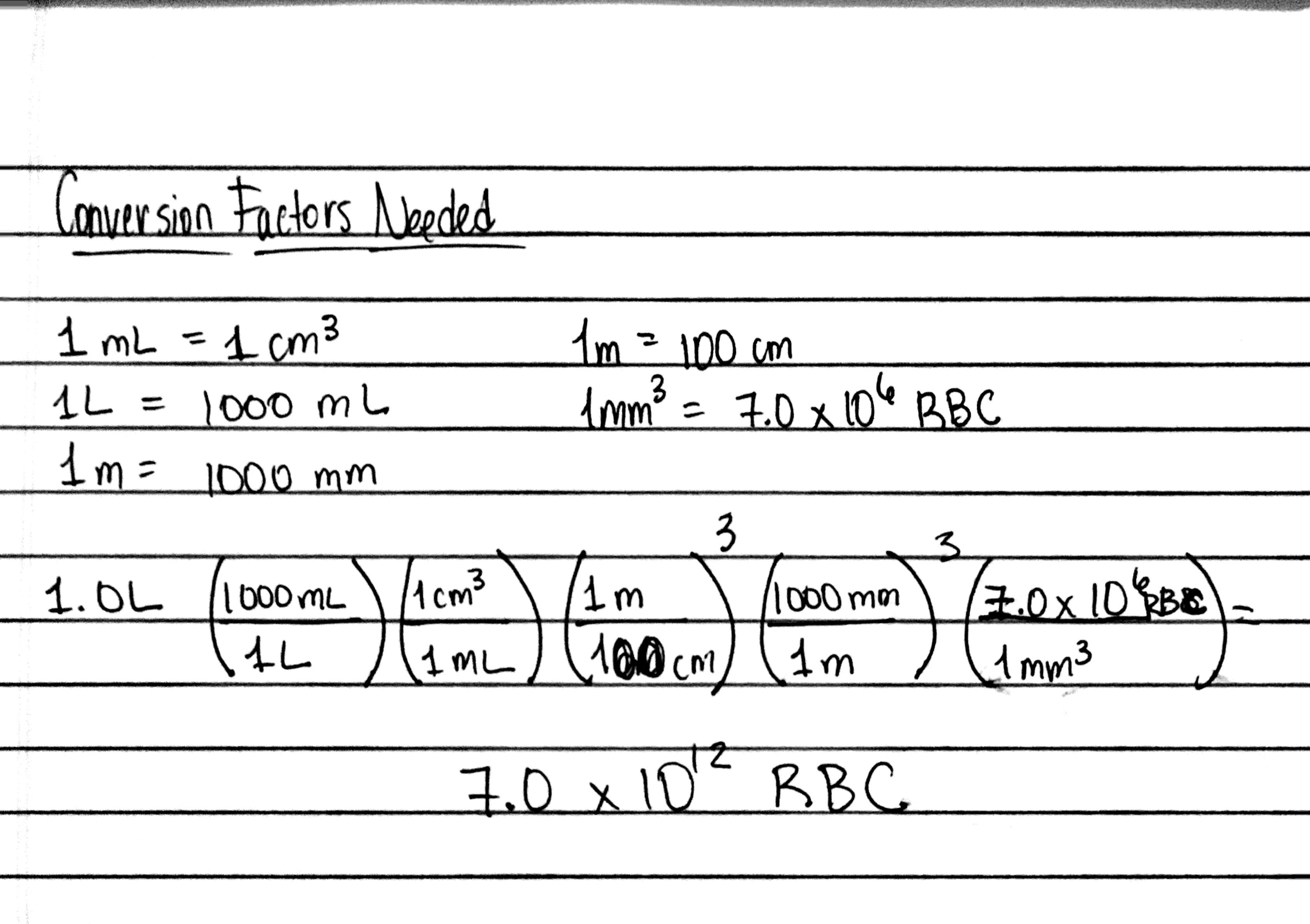
One cubic millimeter (mm3) of blood contains 7.0 x 10⁶ red blood cells. How many red blood cells are in 1.0 L of blood?
Anarel [2989]
The problem provides a conversion factor---> 1 mm3= 7.0 x 10^6 RBC. Therefore, to determine the quantity of red blood cells in your sample, we must first convert Liters to cm3 using the conversion factor--> 1 mL= 1 cm3

I have shared how to resolve this issue.


7 0
17 days ago
Claire is investigating potential and kinetic energy using a large ball. For her investigation, Claire will stand at the top of
alisha [2963]
As the ball descends down the hill, its potential energy diminishes while its kinetic energy rises.

The ball's potential energy will decrease as it moves down the slope, and its kinetic energy will experience an increase.

Kinetic energy refers to the energy possessed by an object in motion.

K. E = \frac{1}{2} m v²

where m is the mass of the ball

and v represents the ball's velocity.

Potential energy is the energy associated with an object's position as it traverses down a slope, expressed as:

P.E = mgh

with m as the mass of the ball,

g as gravitational acceleration, and h as the height.

It is clear that as the object descends, its height decreases, while its velocity increases.

learn more:

Potential energy

3 0
24 days ago
A 20.0–milliliter sample of 0.200–molar K2CO3 so­lution is added to 30.0 milliliters of 0.400–mo­lar Ba(NO3)2 solution. Barium c
KiRa [2933]

Respuesta:

0.16 M

Explicación:

Teniendo en cuenta:

Molarity=\frac{Moles\ of\ solute}{Volume\ of\ the\ solution}

O sea,

Moles =Molarity \times {Volume\ of\ the\ solution}

Dado que:

Para K_2CO_3 :

Molaridad = 0.200 M

Volumen = 20.0 mL

Convierte mL a L:

1 mL = 10⁻³ L

Entonces, volumen = 20.0×10⁻³ L

Los moles de K_2CO_3 son:

Moles=0.200 \times {20.0\times 10^{-3}}\ moles

Moles de K_2CO_3 = 0.004 moles

Para Ba(NO_3)_2 :

Molaridad = 0.400 M

Volumen = 30.0 mL

Convertimos mL a L:

1 mL = 10⁻³ L

Volumen = 30.0×10⁻³ L

Entonces, los moles de Ba(NO_3)_2 son:

Moles=0.400 \times {30.0\times 10^{-3}}\ moles

Moles de Ba(NO_3)_2 = 0.012 moles

Según la reacción:

Ba(NO_3)_2 + K_2CO_3\rightarrow BaCO_3 + 2KNO_3

1 mol de Ba(NO_3)_2 reacciona con 1 mol de K_2CO_3

Por lo tanto,

0.012 mol de Ba(NO_3)_2 reacciona con 0.012 mol de K_2CO_3

Moles disponibles de K_2CO_3 = 0.004 mol

El reactivo limitante es el que está en menor cantidad, entonces K_2CO_3 es el limitante (0.004 < 0.012).

La formación del producto depende del reactivo limitante, así que,

1 mol de K_2CO_3 reacciona con 1 mol de Ba(NO_3)_2 y produce 1 mol de BaCO_3

0.004 mol de K_2CO_3 reacciona con 0.004 mol de Ba(NO_3)_2 y genera 0.004 mol de BaCO_3

Los moles restantes de Ba(NO_3)_2 son: 0.012 - 0.004 = 0.008 mol

El volumen total es 20 + 30 mL = 50 mL = 0.050 L

Por lo que la concentración del ion bario, Ba^{2+}, después de la reacción es:

Molarity=\frac{0.008}{0.050}\ M = 0.16\ M

3 0
2 months ago
Other questions:
  • A 30.5 gram sample of glucose (c6h12o6) contains ________ mol of glucose.
    13·1 answer
  • Arbon dioxide is dissolved in blood (ph 7.5) to form a mixture of carbonic acid and bicarbonate. Part a neglecting free co2, wha
    9·2 answers
  • What is the kinetic energy acquired by the electron in hydrogen atom, if it absorbs a light radiation of energy 1.08x101 J. (A)
    14·1 answer
  • A substance with a density of 2.70 g/mL occupies a volume of 21.3 mL. What is the mass of the sample? Report your answer in unit
    11·1 answer
  • What two-step process separated the cans into aluminum, steel, and tin?
    7·1 answer
  • An ideal gas contained in a piston which is compressed. The gas is insulated so that no heat flows into or out of it. 1) What ha
    7·1 answer
  • The phosphorylation of glucose to glucose 6-phosphate Group of answer choices is so strongly exergonic that it does not require
    6·1 answer
  • A scientist was asked to test the effect of a new vitamin for rats. His hypothesis was that young rats that had vitamins added t
    9·2 answers
  • Breathing air that contains 4.0% by volume CO2 over time causes rapid breathing, throbbing headache, and nausea, among other sym
    11·2 answers
  • Commercial grade fuming nitric acid contains about 90.0% HNO3 by mass with a density of 1.50 g/mL, calculate the molarity of the
    8·2 answers
Add answer
Login
Not registered? Fast signup
Signup
Login Signup
Ask question!