answer.
Ask question
Login Signup
Ask question
All categories
  • English
  • Mathematics
  • Social Studies
  • Business
  • History
  • Health
  • Geography
  • Biology
  • Physics
  • Chemistry
  • Computers and Technology
  • Arts
  • World Languages
  • Spanish
  • French
  • German
  • Advanced Placement (AP)
  • SAT
  • Medicine
  • Law
  • Engineering
kramer
5 days ago
9

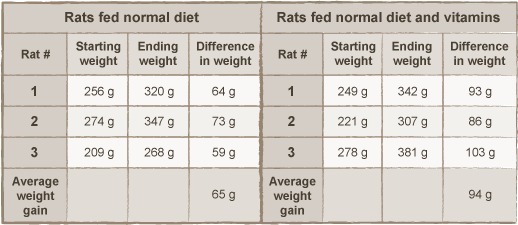
A scientist was asked to test the effect of a new vitamin for rats. His hypothesis was that young rats that had vitamins added t

o their food would gain weight faster than young rats fed a normal diet. He predicted that if young rats were fed vitamins, then they would gain more weight by the end of the experiment. He tested the effect of adding vitamins to some of the rats' diet by measuring the amount of weight each rat gained after three months. He then determined the average weight gained in each group. To analyze his results, he put the data he collected into the table shown below.
Which of the following could have added bias to the data?

 A.Keeping the rats in the same room, but in separate cages during the experiment B.Not using all male or all female rats, since they are different sizes when grown C.Recording the data in a table instead of on a graph D.Not having the experimental results peer reviewed

Chemistry
2 answers:
Anarel [2.6K]5 days ago
8 0

A: incorrect as isolating the rats in distinct cages within the same room during the experiment would have no impact.

C: incorrect since it depends on whether the scientist opts to record observations in a graph or a table, hence no influence will affect the results.

D: incorrect since peer review occurs only after the experiment has been finalized.

Consequently, statement B is accurate due to the distinct growth patterns of male and female rats in any species; typically, males exhibit more growth than females. Hence, it is critical for the study that all rats used are of the same sex, either male or female.

Thus, option (B) is the right answer.

Anarel [2.6K]5 days ago
3 0
The control group consisted of the rats who were given the normal diet without added vitamins (apex)
You might be interested in
A compound that is composed of carbon, hydrogen, and oxygen contains 70.6% C, 5.9% H, and 23.5% O by mass. The molecular weight
Tems11 [2400]

Answer: The molecular formula will be C_8H_8O_2

Explanation:

When percentages are provided, we assume the total mass to be 100 grams.

Thus, the mass of each element corresponds to the specified percentage.

Mass of C= 70.6 g

Mass of H = 5.9 g

Mass of O = 23.5 g

Step 1: convert given masses to moles.

Moles of C =\frac{\text{ given mass of C}}{\text{ molar mass of C}}= \frac{70.6g}{12g/mole}=5.9moles

Moles of H =\frac{\text{ given mass of H}}{\text{ molar mass of H}}= \frac{5.9g}{1g/mole}=5.9moles

Moles of O =\frac{\text{ given mass of O}}{\text{ molar mass of O}}= \frac{23.5g}{16g/mole}=1.5moles

Step 2: For determining the mole ratio, divide each molar amount by the smallest number of moles calculated.

For C = \frac{5.9}{1.5}=4

For H = \frac{5.9}{1.5}=4

For O =\frac{1.5}{1.5}=1

The resulting ratio of C: H: O= 4: 4: 1

Hence, the empirical formula obtained is C_4H_4O

The empirical weight is calculated as C_4H_4O = 4(12)+4(1)+1(16)= 68g.

The molecular weight = 136 g/mole

Now the molecular formula needs to be obtained.

n=\frac{\text{Molecular weight }}{\text{Equivalent weight}}=\frac{136}{68}=2

The molecular formula can be derived as=2\times C_4H_4O=C_8H_8O_2

4 0
16 days ago
A 250 ml flask contains 3.4 g of neon gas at 45°c. Calculate the pressure of the neon gas inside the flask.
eduard [2509]
The solution to your inquiry yields P = 17.73 atm. Explanation: The volume V is 250 ml, equivalent to 0.25 liters (L), with a mass of 3.4 g and a temperature of 45°C, which converts to 318°K. We utilize the ideal gas law PV = nRT for the calculations.
7 0
8 days ago
A sample of neon gas at STP is allowed to expand into an evacuated vessel. What is the sign of work for this process?
Alekssandra [2711]

Answer:

The work done in this process will be considered Negative.

Explanation:

The energy transferred by the system to the environment is negative

Therefore, if work is done on the system, it is labeled as positive. Conversely, when work is done by the system, it is regarded as negative.

In this scenario, the argon gas is expanding, and the work is exerted by the system into the surroundings (container), making the sign Negative.

Thus, the result for the work pertaining to this process will carry a Negative sign.

3 0
1 month ago
Consider the following system at equilibrium:
VMariaS [2690]

Answer:

A - Increase (R), Decrease (P), Decrease(q), Triple both (Q) and (R)

B - Increase(P), Increase(q), Decrease (R)

C - Triple (P) and cut (q) down to a third

Explanation:

According to the principle of Le Chatelier, when a system reaches equilibrium and a change is introduced, the system will respond to counteract that change.

Since P and Q are reactants, raising the amount of either one or both without a proportional rise in R (which is a product) will cause the equilibrium to move towards the right. Similarly, if R decreases while P and Q remain constant, this too will push the equilibrium to the right. Thus, Increase(P), Increase(q), and Decrease(R) will lead to a rightward shift in the equilibrium.

Conversely, raising R without increasing P and Q will draw the equilibrium to the left. Likewise, cutting down P and/or Q without a similar reduction in R will shift the equilibrium leftward. Therefore, Increase(R), Decrease(P), Decrease(q), and triple both (Q) and (R) will shift the equilibrium to the left.

If there are equivalent changes in P and Q, with R remaining unchanged, then the equilibrium remains stationary. So, tripling (P) while reducing (q) to one third will not alter the equilibrium.

6 0
1 month ago
A 19.3-g mixture of oxygen and argon is found to occupy a volume of 16.2 l when measured at 675.9 mmhg and 43.4oc. what is the p
KiRa [2711]
<span>The partial pressure of oxygen is 438.0 mmHg. The ideal gas equation is expressed as PV = nRT where P represents pressure, V denotes volume, n is the number of moles, R is the ideal gas constant (8.3144598 (L*kPa)/(K*mol)), and T signifies absolute temperature. To convert from Celsius to Kelvin, we have 43.4 + 273.15 = 316.55 K. For the pressure conversion from mmHg to kPa: 675.9 mmHg * 0.133322387415 = 90.11260165 kPa. When solving for n using the ideal gas equation, we derive n = PV / (RT) which provides n = 90.11260165 kPa * 16.2 L / (8.3144598 (L*kPa)/(K*mol) * 316.55 K)= 1459.824147 L*kPa / 2631.94225 (L*kPa)/(mol), resulting in n = 0.554656603 mol. Thus, we have 0.554656603 moles of gas particles. Next, we determine the contribution from oxygen. The atomic weight of oxygen is 15.999 g/mol, while argon is 39.948 g/mol, and the molar mass of O2 is 31.998 g/mol. We establish the relationships where M is the number of moles of O2, and 0.554656603 - M gives the number of moles of Ar. Setting up the equation: M * 31.998 + (0.554656603 - M) * 39.948 = 19.3, we solve for M resulting in 0.359424148 moles of oxygen out of 0.554656603 total moles. This leads to oxygen providing 0.359424148 / 0.554656603 = 0.648012024 or 64.8012024% of the total pressure of 675.9 mmHg. The partial pressure therefore calculates to 675.9 * 0.648012024 = 437.9913271 mmHg, rounded to 438.0 mmHg</span>
7 0
19 days ago
Other questions:
  • How many carbon atoms are there in a 1.3-carat diamond? diamonds are a form of pure carbon. (1 carat?
    13·2 answers
  • A galvanic (voltaic) cell contains a copper cathode immersed in a copper(ii) chloride solution and a nickel anode immersed in a
    13·1 answer
  • Leonard adds 5 grams of sugar to 1 liter of water to make one sugar solution. Then he adds 10 grams of sugar to 1 liter of water
    9·1 answer
  • Determine the freezing point of a solution which contains 0.31 mol of sucrose in 175 g of water. kf = 1.86ï°c/m
    15·1 answer
  • When the temperature of an ideal gas is increased from 27C to 927C then kinetic energy increases by
    9·1 answer
  • A decorative "ice" sculpture is carved from dry ice (solid CO2) and held at its sublimation point of –78.5°C. Consider the proce
    10·1 answer
  • If 7.50 g of the unknown compound contained 0.250 mol of c and 0.500 mol of h, how many moles of oxygen, o, were in the sample?
    14·1 answer
  • If 6 g of element k combine with 17 g of element l, how many grams of element k combine with 85 g of element l?
    13·1 answer
  • Lysine is an amino acid that is an essential part of nutrition but which is not synthesized by the human body. What is the molar
    7·2 answers
  • How much heat is required, in calories, to raise the temperature of 57.8g of silver from 17.0oC to 43.5oC, if the specific heat
    6·1 answer
Add answer
Login
Not registered? Fast signup
Signup
Login Signup
Ask question!