answer.
Ask question
Login Signup
Ask question
All categories
  • English
  • Mathematics
  • Social Studies
  • Business
  • History
  • Health
  • Geography
  • Biology
  • Physics
  • Chemistry
  • Computers and Technology
  • Arts
  • World Languages
  • Spanish
  • French
  • German
  • Advanced Placement (AP)
  • SAT
  • Medicine
  • Law
  • Engineering
gtnhenbr
6 days ago
13

A projectile is fired from ground level with a speed of 150 m/s at an angle 30.° above the horizontal on an airless planet where

g = 10.0 m/s2. What is the horizontal component of its velocity after 4.0 s? Express your answer to two significant figures Group of answer choices

Physics
2 answers:
Ostrovityanka [2.2K]6 days ago
6 0

Answer:

129.9 m/s.

Explanation:

Vo = 150 m/s

θ = 30°

g = 10 m/s²

To find the horizontal component, Vx = Vo cos θ

= 150 × cos 30

= 150 × 0.866

= 129.9 m/s.

Yuliya22 [2.4K]6 days ago
6 0

Answer:

130 m/s (to two significant figures)

Explanation:

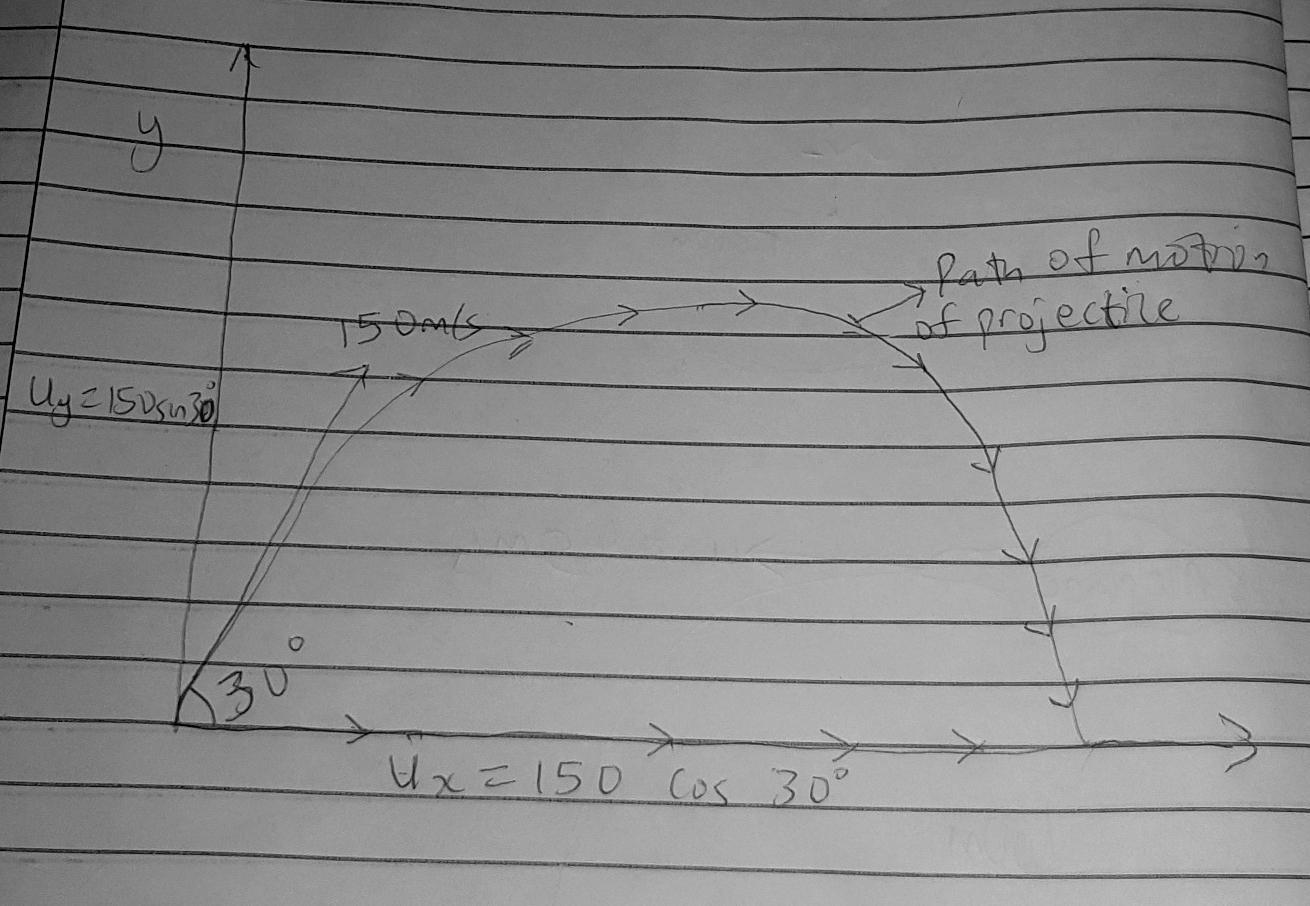
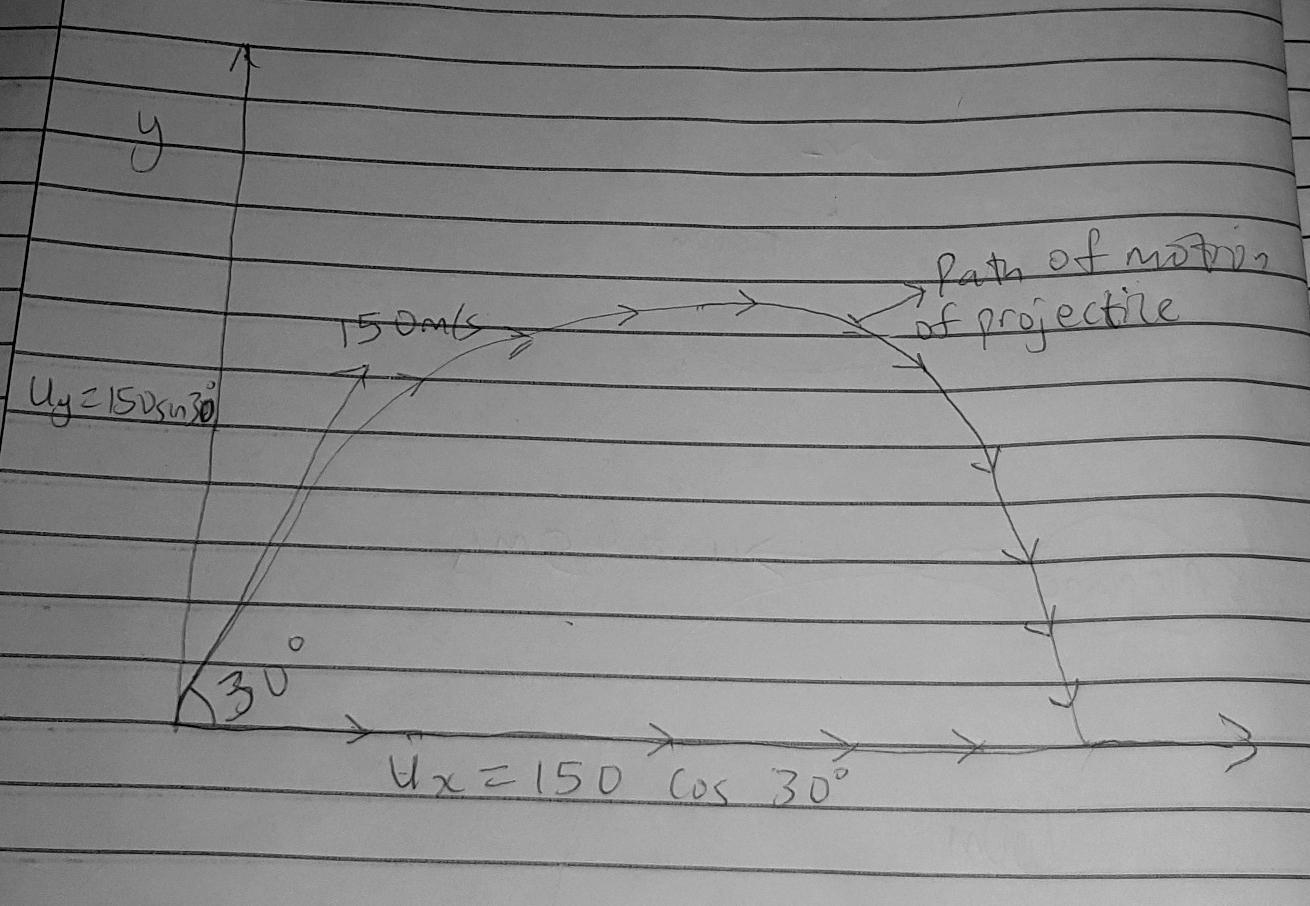
In projectile motion, the launching velocity and launch angle help to determine both the horizontal and vertical velocity components.

u represents the initial projectile velocity = 150 m/s

uₓ = u cos θ = 150 cos 30° = 129.9 m/s

uᵧ = u sin θ = 150 sin 30° = 75.0 m/s

A projectile's motion can be viewed as made up of independent vertical and horizontal elements.

The vertical motion is affected by gravitational acceleration (which pulls down on the projectile), altering the vertical velocity component due to this acting force.

Conversely, there is no acting force in the horizontal direction, which means the horizontal component maintains a steady velocity throughout the projectile's flight.

Thus, at t = 4 s, the horizontal component of the projectile's speed remains equal to the initial horizontal velocity component.

At t = 4 s, the horizontal component of velocity is uₓ = u cos θ = 150 cos 30° = 129.9 m/s ≈ 130 m/s
You might be interested in
A displacement vector points in a direction of θ = 23° left of the positive y-axis. The magnitude of this vector is D = 155 m. R
Keith_Richards [2256]

Answer:

Dₓ = -155 sin 23° i + 0 j

Explanation:

The accompanying diagram illustrates the vector.

According to the diagram,

The vector D has an x-component (or horizontal component) expressed as -D sinθ i. Specifically,

Dₓ = -D sin θ i   [The negative sign indicates that D is directed along the negative x-axis]

Where;

D = magnitude of D = 155m

θ = angle of D = 23°

Consequently;

Dₓ = -155 sin 23° i

Since Dₓ signifies the x component, its unit vector, j component holds a value of 0.

<pthus d="" can="" be="" formulated="" in="" terms="" of="" and="" the="" unit="" vectors="" i="" j="" as="" follows="">

Dₓ = -155 sin 23° i + 0 j

</pthus>
3 0
1 month ago
The wavelength of light is 5000 angstrom. Express it in nm and m.
serg [2593]

Answer:

1 angstrom equals 0.1 nm.

To convert 5000 angstroms: 5000 angstrom = 5000 / 1 × 0.1 nm.

= 500 nm

1 \:  angstrom = 1 \times  {10}^{ - 10} m

To express 5000 angstroms in meters: 5000 angstrom = 5000 × 1 × 10^-10.

= 5 × 10^-7 m

Hope this explanation is useful for you.

7 0
1 month ago
At a location where the acceleration due to gravity is 9.807 m/s2, the atmospheric pressure is 9.891 × 10⁴ Pa. A barometer at th
serg [2593]

Answer:

8616.7468 \ kg/m^3

Explanation:

The measurement of pressure is indicated as p=\rho gh where p denotes the pressure, \rho signifies density, and h represents height

Given values include pressure p=9.891\times 10^4\ Pa, gravity's acceleration g=9.9870\ m/sec^2, and height =1.163 m

\rho =\frac{p}{gh}=\frac{9.891\times 10^4}{9.870\times 1.163}=8616.7468 \ kg/m^3

5 0
8 days ago
Read 2 more answers
Simone is walking her dog on a leash. The dog is pulling with a force of 32 N to the right and Simone is pulling backward with a
ValentinkaMS [2425]

Conclusion:

The total net force acting on the objects is 16 N, directed towards the right.

Clarification:

It is stated that,

The force exerted by the dog, F_1 = 32\ N (to the right)

The force exerted by Simone, F_2 = -16\ N (backward)

Here, assume the backward direction is negative and the right direction is positive.

The net force will move in the direction where the larger force is present. The net force can be calculated as:

F=F_1+F_2

F=32+(-16)

F = 16 N

Thus, the net force amounts to 16 N, acting towards the right.

6 0
24 days ago
Read 2 more answers
James Cameron piloted a submersible craft to the bottom of the Challenger Deep, the deepest point on the ocean's floor, 11,000 m
serg [2593]

Answer:

4.1\cdot 10^8 N

Explanation:

To begin with, we must determine the pressure acting on the sphere, which is calculated using:

p=p_0 + \rho g h

where

p_0 =1.01\cdot 10^5 Pa denotes the atmospheric pressure

\rho = 1000 kg/m^3 represents the density of the water

g=9.8 m/s^2 signifies the acceleration due to gravity

h=11,000 m indicates the depth

By substituting these values,

p=1.01\cdot 10^5 Pa + (1000 kg/m^3)(9.8 m/s^2)(11,000 m)=1.08\cdot 10^8 Pa

The sphere's radius is calculated as r = d/2 = 1.1 m/2 = 0.55 m

Thus, the sphere's total surface area can be expressed as

A=4 \pi r^2 = 4 \pi (0.55 m)^2=3.8 m^2

Consequently, the inward force acting on the sphere equals

F=pA=(1.08\cdot 10^8 Pa)(3.8 m^2)=4.1\cdot 10^8 N

8 0
1 day ago
Read 2 more answers
Other questions:
  • An object is released from rest near and above Earth’s surface from a distance of 10m. After applying the appropriate kinematic
    8·1 answer
  • A proton starts from rest and gains 8.35 x 10^-14 joule of kinetic energy as it accelerates between points A and B in an electri
    14·2 answers
  • The air is less dense at higher elevations, so skydivers reach a high terminal speed. The highest recorded speed for a skydiver
    14·1 answer
  • There is a distinction between average speed and the magnitude of average velocity. Give an example that illustrates the differe
    6·1 answer
  • A thin electrical heating element provides a uniform heat flux qo" to the outer surface of a duct through which air flows. The d
    7·1 answer
  • a 1250 kg car accelerates from rest to 6.13m/s over a distance of 8.58m calculate the average force of traction
    6·1 answer
  • In the demolition of an old building, a 1,300 kg wrecking ball hits the building at 1.07 m/s2. Calculate the amount of force at
    15·2 answers
  • Write a conclusion to this lab in which you discuss when a person on a roller coaster ride would have sensations of weightlessne
    9·1 answer
  • A 5.0-g marble is released from rest in the deep end of a swimming pool. An underwater video reveals that its terminal speed in
    11·1 answer
  • Two objects are placed in thermal contact and are allowed to come to equilibrium in isolation. The heat capacity of Object A is
    7·1 answer
Add answer
Login
Not registered? Fast signup
Signup
Login Signup
Ask question!
