answer.
Ask question
Login Signup
Ask question
All categories
  • English
  • Mathematics
  • Social Studies
  • Business
  • History
  • Health
  • Geography
  • Biology
  • Physics
  • Chemistry
  • Computers and Technology
  • Arts
  • World Languages
  • Spanish
  • French
  • German
  • Advanced Placement (AP)
  • SAT
  • Medicine
  • Law
  • Engineering
VladimirAG
17 days ago
5

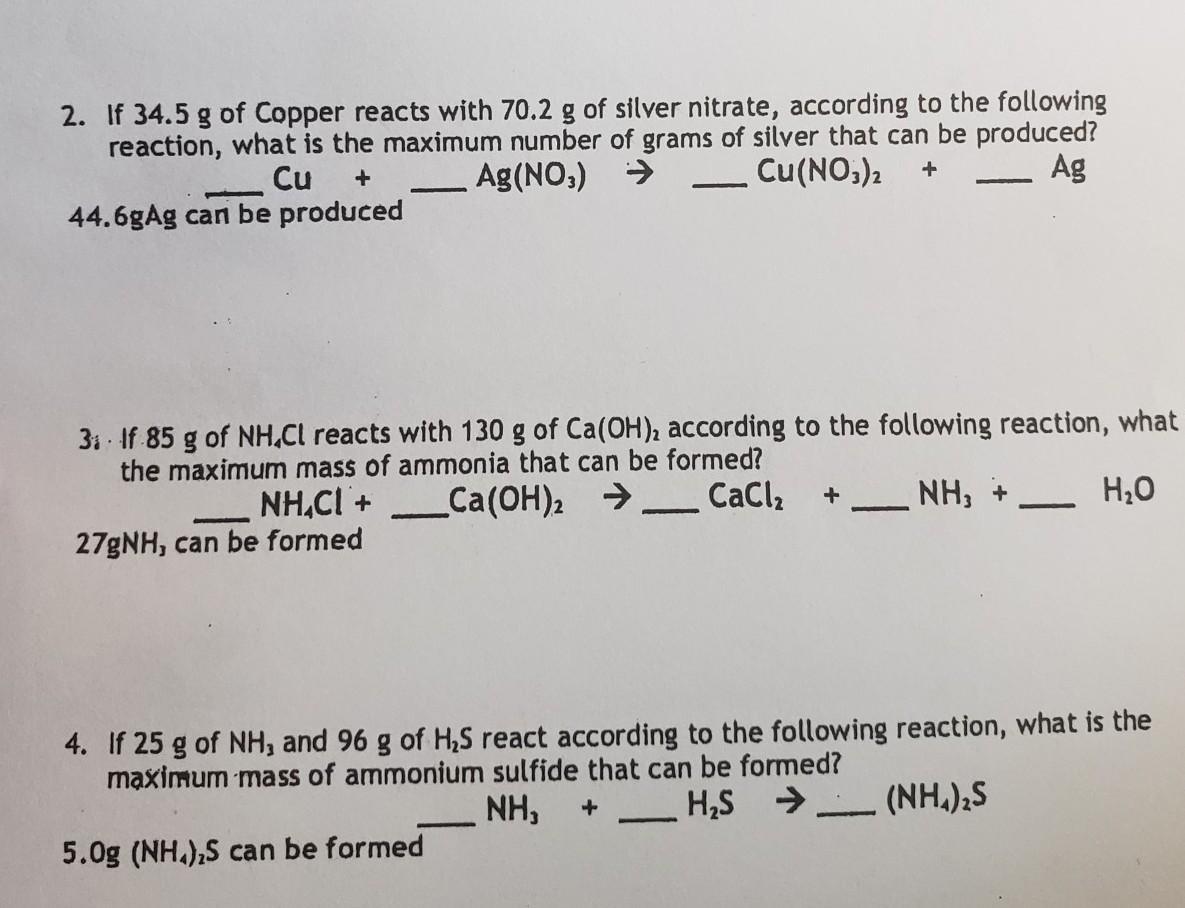
If 34.5 g of Copper reacts with 70.2 g of silver nitrate, according to the following

Chemistry
2 answers:
lorasvet [2.6K]17 days ago
6 0
Initially, one needs to balance the chemical equation. Then, by calculating the moles of copper available against the moles that can react with 70.2 g of silver nitrate, it's concluded that copper is in excess while silver nitrate acts as the limiting reagent. Thus, the maximum achievable mass of silver can be inferred.
eduard [2.6K]17 days ago
4 0
The production yield is expected to be 44.55.
You might be interested in
he population of the Earth is roughly eight billion people. If all free electrons contained in this extension cord are evenly sp
eduard [2645]

1) Drift velocity: 3.32\cdot 10^{-4}m/s

2. 5.6\cdot 10^{13} electrons per individual

Explanation:

1)

In a conducting material with an electric current, the drift velocity of electrons can be calculated using this equation:

v_d=\frac{I}{neA}

where

I stands for current

n represents the density of free electrons

e=1.6\cdot 10^{-19}C indicates the charge of an electron

A signifies the wire's cross-sectional area

The wire's cross-sectional area can be determined as

A=\pi r^2

where r denotes the wire's radius. Thus, the equation transforms to

v_d=\frac{I}{ne\pi r^2}

In this scenario, we have:

I = 8.0 A as the current

8.5\cdot 10^{28} m^{-3} indicates the free electron concentration

d = 1.5 mm is the diameter, making the radius

r = 1.5/2 = 0.75 mm = 0.75\cdot 10^{-3}m

So, the resulting drift velocity is:

v_d=\frac{8.0}{(8.5\cdot 10^{28})(1.6\cdot 10^{-19})\pi(0.75\cdot 10^{-3})^2}=3.32\cdot 10^{-4}m/s

2)

The entire length of the cord is

L = 3.00 m

And the cross-sectional area is

A=\pi r^2=\pi (0.75\cdot 10^{-3})^2=1.77\cdot 10^{-6} m^2

Consequently, the volume of the cord is

V=AL (1)

The number of electrons per unit volume is n, thus the total electrons in this cord would be

N=nV=nAL=(8.5\cdot 10^{28})(1.77\cdot 10^{-6})(3.0)=4.5\cdot 10^{23}

Overall, the Earth's population rounds to 8 billion individuals, equating to

N'=8\cdot 10^9

Hence, the number of electrons distributed to each person is:

N_e = \frac{N}{N'}=\frac{4.5\cdot 10^{23}}{8\cdot 10^9}=5.6\cdot 10^{13}

7 0
1 month ago
Identify the number of moles in 369 grams of calcium hydroxide. Use the periodic table and the polyatomic ion resource.
Alekssandra [2891]

Response: The moles in 369 grams of calcium hydroxide are 4.98 moles

Reasoning: Given,

Mass of calcium hydroxide = 369 g

Molar mass of calcium hydroxide = 74.093 g/mole

Formula used:

\text{Moles of calcium hydroxide}=\frac{\text{Mass of calcium hydroxide}}{\text{Molar mass of calcium hydroxide}}

Now substituting the provided values into this formula, you will find the moles of calcium hydroxide.

\text{Moles of calcium hydroxide}=\frac{369g}{74.093g/mole}=4.98mole

Thus, the number of moles in 369 grams of calcium hydroxide is, 4.98 moles

7 0
11 days ago
How does vegetation slow and prevent sediment loss?
Alekssandra [2891]
Vegetation cover serves as the most efficient and effective method to curb sediment loss. The roots of plants like grass interlink soil particles, aiding in erosion resistance, particularly against runoff water. Vegetation absorbs the force of raindrops, preventing soil particle detachment. Additionally, plants can lie flat resembling shingles on a roof, enabling runoff to travel over the soil rather than disturbing it. Tall, erect vegetation functions as a barrier against wind, diminishing its force so that it cannot dislodge soil particles from the ground surface.
5 0
1 month ago
An electric kettle uses electrical energy to boil water. Energy from the electricity is transferred to the water, heating it up.
eduard [2645]
In the electrical ice maker, water releases energy as it freezes into ice, translating this energy into bond energy. Although there are hydrogen bonds in the liquid water state, adding electrical energy converts the water from liquid to solid, increasing bond strength. The potential energy from the water is now represented as hydrogen bond energy in the ice.
4 0
7 days ago
A 0.0200 M NaCl solution was formed when 38.0 grams of NaCl was dissolved in enough water. What was the total volume of the solu
Tems11 [2631]

Start by determining the number of moles, which is obtained by dividing 38 grams by the molar mass of 58.43 g/mol. This calculation yields 0.65 moles. The concentration is calculated by dividing the number of moles by the volume in liters. Using this formula, we can derive the total volume by dividing the number of moles by the concentration. Thus, 0.65 moles divided by 0.02M (mol/L) results in a total volume of 32.5 L.

4 0
1 month ago
Read 2 more answers
Other questions:
  • 0.18 g of a divalent metal was completely dissolved in 250 cc of acidsolution containing 4.9 g H2SO4 per liter. 50 cc of theresi
    12·1 answer
  • How many moles of nitrogen gas are there in 6.8 liters at room temperature and pressure (293 K and 100 kPa)?
    7·1 answer
  • When the temperature of an ideal gas is increased from 27C to 927C then kinetic energy increases by
    9·1 answer
  • Calculate the pressure of O2 (in atm) over a sample of NiO at 25.00°C if ΔG o = 212 kJ/mol for the reaction. For this calculatio
    7·1 answer
  • A 3.0-L sample of helium was placed in container fitted with a porous membrane. Half of the helium effused through the membrane
    11·1 answer
  • In this lab, you will do experiments to identify types of changes. Using the question format you learned (shown above), write an
    11·1 answer
  • How many grams of calcium chloride are needed to produce 1.50 g of potassium chloride? cacl2(aq) + k2co3(aq) → 2 kcl(aq) + caco3
    11·2 answers
  • The diagram below represents a portion of a cell membrane. The arrow indicates that the cell membrane is carrying out the proces
    10·1 answer
  • How many significant figures the measurement have 56.0g 0.0004m 1003ml 0.0350s
    13·1 answer
  • Which statement explains why sulfur is classified as a Group 16 element?
    5·2 answers
Add answer
Login
Not registered? Fast signup
Signup
Login Signup
Ask question!