answer.
Ask question
Login Signup
Ask question
All categories
  • English
  • Mathematics
  • Social Studies
  • Business
  • History
  • Health
  • Geography
  • Biology
  • Physics
  • Chemistry
  • Computers and Technology
  • Arts
  • World Languages
  • Spanish
  • French
  • German
  • Advanced Placement (AP)
  • SAT
  • Medicine
  • Law
  • Engineering
Scrat
7 hours ago
5

Part e a small toy cart equipped with a spring bumper rolls toward a wall with a speed of v. the cart rebounds from the wall, wi

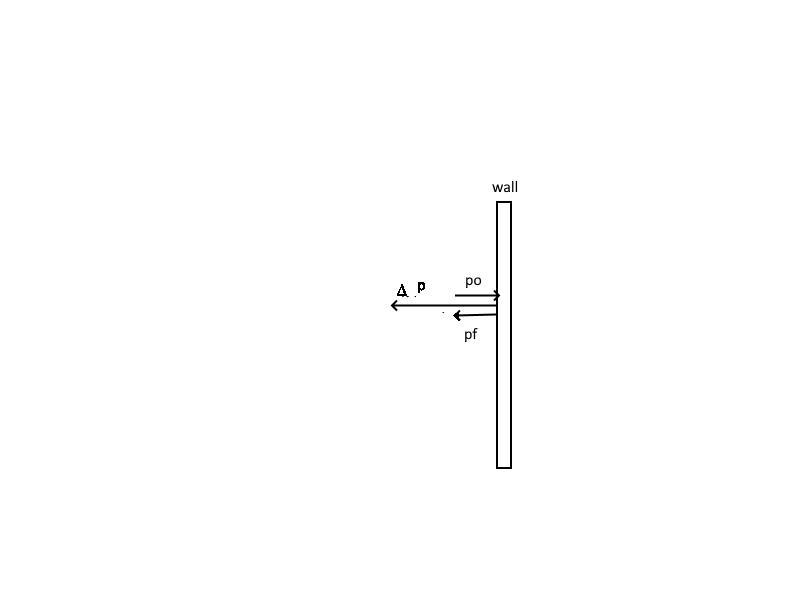
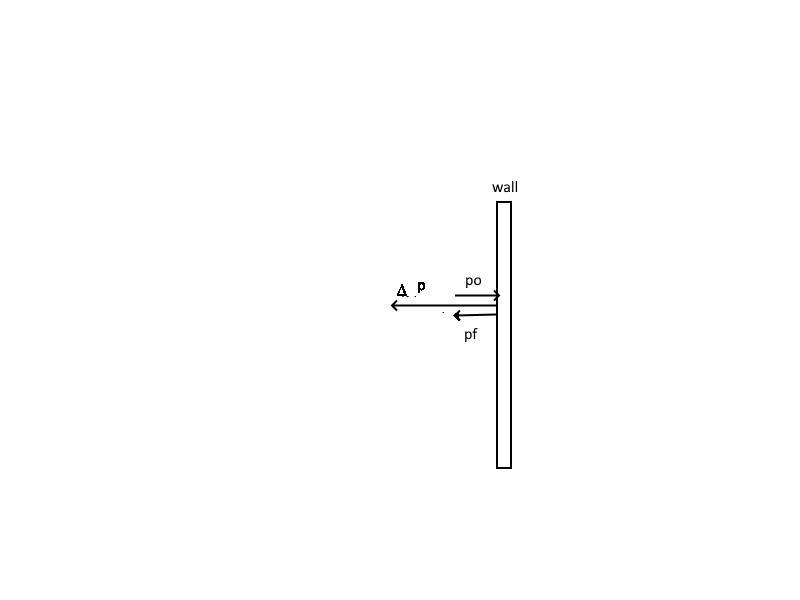
th the same speed v. the sketch below shows the initial velocity vector v⃗ i, final velocity vector v⃗ f, and the initial momentum vector p⃗ i. using the initial momentum vector as a basis, draw the change in momentum vector δp⃗ for the cart. you can obtain each vector's length and orientation by clicking on it to select it.

Physics
1 answer:
Softa [2K]7 hours ago
5 0

Answer:

Δp = -2 p₀

Explanation:

Momentum is defined as

         p = m v

In this instance, we denote the initial and final momentum, with positive direction considered towards the wall.

         p₀ = m v

         p_f = m (-v)

The negative sign indicates the car is rebounding off the wall.

The change in momentum is expressed as

       Δp = p_f - p₀

        Δp = - m v - m v

        Δp = -2 mv

        Δp = -2 p₀

This shows that the change in momentum equals twice the initial momentum; the vectors demonstrating these changes can be seen in the attachment, and the sign signifies the direction of this change.

You might be interested in
Point charge A with a charge of +4.00 μC is located at the origin. Point charge B with a charge of +7.00 μC is located on the x
ValentinkaMS [2433]

Response:

210.3 degrees

Justification:

The total force acting on charge A is 59.5 N

Apply the x and y components of the net force to determine the direction

atan (y/x)
8 0
1 day ago
Read 2 more answers
A solid conducting sphere carrying charge q has radius a. It is inside a concentric hollow conducting sphere with inner radius b
Softa [2035]

Response:

Clarification:

Refer to the diagram indicating the charges on the specified sphere (see attachment).

The electric field at the stated positions is

E(r) = 0 for r≤a.  Equation 1

E(r) = kq/r² for a<r<b.   Equation 2

E(r) = 0 for b<r<c.      Equation 3

E(r) = kq/r² for r>c.    Equation 4.

We understand that electric potential correlates with the electric field through

V = Ed

A. To compute the potential at the outer surface of the hollow sphere (r=c), we determine that the electric field there is

E = kQ / r²

Then,

V = Ed,

At d = r = c

Thus,

Vc = (kQ / c²) × c

Vc = kQ / c

As a result, the total charge Q consists of +q, -q, and +q

Hence, Q = q - q + q = q

V = kq / c

B. To calculate the potential at the inner surface of the hollow sphere (r=b), we have

V = kQ/r

V = kQ / b,   noting that r = b

So, Q = q

V = kq / b

C. At r = a

Following from equation 1:

E(r) = 0 for r≤a.  Equation 1

The electric field at the surface of the solid sphere is 0, E = 0N/C

Thus,

V = Ed = 0 V

Consequently, the electric potential at the solid sphere's surface is 0.

D. At r = 0

The electric potential can be determined by

V = kq / r

As r approaches 0,

V = kq / 0

V approaches infinity.

8 0
1 month ago
10. How far does a transverse pulse travel in 1.23 ms on a string with a density of 5.47 × 10⁻³ kg/m under tension of 47.8 ?????
serg [2598]

Answer: Tension = 47.8N, Δx = 11.5×10^{-6} m.

              Tension = 95.6N, Δx = 15.4×10^{-5} m

Explanation: The speed of a wave on a string under tension can be determined using the following:

|v| = \sqrt{\frac{F_{T}}{\mu} }

F_{T} denotes tension (N)

μ refers to linear density (kg/m)

Calculating the velocity:

|v| = \sqrt{\frac{47.8}{5.47.10^{-3}} }

|v| = \sqrt{0.00874 }

|v| = 0.0935 m/s

Distance a pulse traveled in 1.23ms:

\Delta x = |v|.t

\Delta x = 9.35.10^{-2}*1.23.10^{-3}

Δx = 11.5×10^{-6}

With a tension of 47.8N, the distance a pulse will cover is Δx = 11.5×10^{-6}  m.

When tension is doubled:

|v| = \sqrt{\frac{2*47.8}{5.47.10^{-3}} }

|v| = \sqrt{2.0.00874 }

|v| = \sqrt{0.01568}

|v| = 0.1252 m/s

Distance in the same time:

\Delta x = |v|.t

\Delta x = 12.52.10^{-2}*1.23.10^{-3}

\Delta x = 15.4×10^{-5}

With the increased tension, it moves \Delta x = 15.4×10^{-5} m

4 0
18 days ago
The amount of electric energy consumed by a 60.0-watt lightbulb for 1.00 minute could lift a
Sav [2230]

Answer:

Explanation:

For a 60W light bulb used for 1 minute:

P = 60 W

t = 1 minute = 60 seconds

This energy is capable of lifting an object weighing 10N.

W = 10N

This indicates conversion of electrical energy into potential energy.

Let's calculate the electrical energy:

Power describes the rate of work done.

Power = Work / time

Thus, work = power × time

Work = 60 × 60

Work = 3600 J

Potential energy calculation:

P.E = mgh

Where the weight is given by:

W = mg

Therefore, P.E = W·h

P.E = 10·h

Thus, we equate:

Potential energy = Electrical energy

P.E = Work

10·h = 3600

Dividing both sides by 10 gives:

h = 3600 / 10

h = 360m

The object can be lifted to a height of 360m.

6 0
27 days ago
A pressure cooker is a pot whose lid can be tightly sealed to prevent gas from entering or escaping. even without knowing how bi
Sav [2230]
Even if we lack details about the size of the pressure cooker or the altitude of its operation, we can reliably assess the force on the lid based on prior knowledge because, similar to boiling water, the pressure buildup inside the cooker increases in line with the rising temperature. 
5 0
22 days ago
Other questions:
  • Derive an expression for the acceleration of the car. Express your answer in terms of D and vt Determine the time at which the s
    10·1 answer
  • Imagine that the satellite described in the problem introduction is used to transmit television signals. You have a satellite TV
    11·1 answer
  • A box weighing 46 newtons rests on an incline that makes an angle of 25° with the horizontal. What is the magnitude of the compo
    5·1 answer
  • A charge of uniform volume density (40 nC/m3) fills a cube with 8.0-cm edges. What is the total electric flux through the surfac
    12·1 answer
  • A rocket is continuously firing its engines as it accelerates away from Earth. For the first kilometer of its ascent, the mass o
    10·2 answers
  • A parallel-plate capacitor is constructed of two square plates, size L×L, separated by distance d. The plates are given charge ±
    13·1 answer
  • A student must design an experiment to determine the relationship between the mass of an object and the resulting acceleration w
    8·1 answer
  • Write a conclusion to this lab in which you discuss when a person on a roller coaster ride would have sensations of weightlessne
    9·1 answer
  • What will be the final temperature if a 4.00 g silver ring at 41.0◦C if it gives off 18.0 J of heat to the surroundings? The spe
    8·1 answer
  • A windowpane is half a centimeter thick and has an area of 1.0 m2. The temperature difference between the inside and outside sur
    12·1 answer
Add answer
Login
Not registered? Fast signup
Signup
Login Signup
Ask question!