answer.
Ask question
Login Signup
Ask question
All categories
  • English
  • Mathematics
  • Social Studies
  • Business
  • History
  • Health
  • Geography
  • Biology
  • Physics
  • Chemistry
  • Computers and Technology
  • Arts
  • World Languages
  • Spanish
  • French
  • German
  • Advanced Placement (AP)
  • SAT
  • Medicine
  • Law
  • Engineering
iren
6 days ago
14

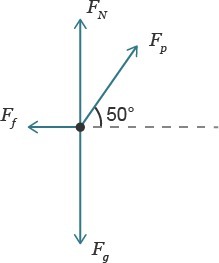
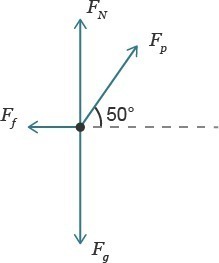
A sled that has a mass of 8 kg is pulled at a 50 degree angle with a force of 20 N. The force of friction acting on the sled is

2.4 N. The free-body diagram shows the forces acting on the sled.
What is the acceleration of the sled and the normal force acting on it, to the nearest tenth?

1) a = 1.3 m/s2; FN = 63.1 N
2) a = 1.6 m/s2; FN = 65.6 N
3) a = 1.9 m/s2; FN = 93.7 N
4) a = 2.2 m/s2; FN = 78.4 N

Physics
2 answers:
serg [1.1K]6 days ago
6 0

According to the problem, the sled has a mass of 8 kg.

The frictional force [F_{f} ] is quantified as 2.4 N.

A force [F_{p} ] of 20 N was applied to the sled at an angle of 50^{0}.

When resolving the force into both horizontal and vertical components, we arrive at -

F_{h} =F_{p} cos\theta and F_{v} =F_{p} sin\theta.

Here, F_{h} identifies the horizontal component while F_{v} indicates the vertical component.

F_{h} =20*cos50 =12.85575219 N.

Likewise, for F_{v} =20*sin50=15.32088886 N.

The free body diagram shows that the sum of the vertical forces amounts to zero since there’s no vertical movement.

Consequently, we can express it as F_{N} +F_{p} sin\theta=mg, where g symbolizes the acceleration due to gravity.

Thus, F_{N} =mg-F_{p} sin50.

Consequently, F_{N} =8*9.8-15.32088886, and we recognize that the value of g is 9.8 m/s^2.

This leads to a normal force of = 63.1 N.

The net movement of the sled is in the forward direction.

Hence, as acceleration of the sled is symbolized as F_{p} cos\theta -F_{f} =ma.

We can conclude that a=\frac{F_{p}cos\theta -F_{f} }{m}.

Finally, =\frac{12.85575219 -2.4}{8}.

Thus, option A is correct.


Keith_Richards [1K]6 days ago
4 0

A. a<span> = 1.3 m/s^2</span><span>; </span>FN<span> = 63.1 N</span>

You might be interested in
A vehicle ___________ occurs when the driver begins to back up and is unaware that a person is behind the vehicle.
Maru [1056]
I'm unaware of the term accident?
6 0
8 days ago
Read 2 more answers
a professional baseball player can pitch a baseball with a velocity of 44.7m/s towards home plate. If a baseball weighs 1.4 N, h
Sav [1105]
To find the mass using a weight of 1.4 N:
1.4/9.8 = 0.1428 kg
The momentum is calculated as 0.1428 multiplied by 44.7, which is 6.38 kgm/s.
3 0
9 days ago
Read 2 more answers
A sphere of radius 0.03m has a point charge of q= 7.6 micro C located at it’s centre. Find the electric flux through it?
Sav [1105]

Answer:

The electric flux going through the sphere is 8.58 *10^{5} \frac{Nm^2}{C}

Explanation:

Given

Radius,\ r = 0.03m\\Charge,\ q =7.6\µC

Required

Calculate the electric flux

Electric flux can be computed using the formula;

Ф = q/ε

Where ε stands for the electric constant permittivity

ε = 8.8542 * 10^{-12}

Substituting ε = 8.8542 * 10^{-12} and q =7.6\µC; the formula simplifies to

Ф = \frac{7.6\µC}{8.8542 * 10^{-12}}

Ф = \frac{7.6 * 10^{-6}}{8.8542 * 10^{-12}}

Ф = \frac{7.6}{8.8542} *\frac{10^{-6}}{10^{-12}}

Ф = \frac{7.6}{8.8542} *10^{12-6}}

Ф = 0.85834970974 *10^{12-6}}

Ф = 0.85834970974 *10^{6}}

Ф = 8.5834970974 *10^{5}}

Ф = 8.58 *10^{5} \frac{Nm^2}{C}

Thus, the electric flux through the sphere is 8.58 *10^{5} \frac{Nm^2}{C}

7 0
17 days ago
Which structure contains the lowest amount of oxygen?
ValentinkaMS [1149]
The structure with the least oxygen is the vena cava. I hope this information is useful!
3 0
2 days ago
Read 2 more answers
When water freezes, it expands about nine percent. What would be the pressure increase inside your automobile engine block if th
Keith_Richards [1034]

Answer:

The increase in pressure within the engine block of the car amounts to 1782.18 ATM.

Explanation:

Provided:

the volume change of water, ΔV = 9%

the bulk modulus for ice, K = 2 x 10⁹ N/m²

It is calculated using the bulk modulus formula;

K = -V\frac{dP}{dV}

so when the water freezes, the pressure increase in the automobile engine block is;

dP = K(\frac{dV}{V} )\\\\dP = K(\frac{0.09V}{V} )\\\\dP = 0.09K\\\\dP = 0.09 (2*10^9)\\\\dP = 1.8 *10^{8} \ N/m^2\\\\dP = 1782.18 \ ATM

Thus, the final pressure increase inside the automobile engine block is 1782.18 ATM.

6 0
12 days ago
Other questions:
  • A particular brand of gasoline has a density of 0.737 g/mLg/mL at 25 ∘C∘C. How many grams of this gasoline would fill a 14.9 gal
    10·1 answer
  • Which statements describe the relationship between the area and the biodiversity of an ecosystem? Check all that apply. Large ec
    13·2 answers
  • 1)After catching the ball, Sarah throws it back to Julie. However, Sarah throws it too hard so it is over Julie's head when it r
    9·1 answer
  • f a stadium pays $11,000 for labor and $7,000 for parking, what would the stadium's parking revenue have to be if the stadium is
    5·2 answers
  • When a perfume bottle is opened, some liquid changes to gas and the fragrance spreads around the room. Which sentence explains t
    14·2 answers
  • A block of mass m, initially held at rest on a frictionless ramp a vertical distance H above the floor, slides down the ramp and
    6·1 answer
  • Two parallel wires carry a current I in the same direction. Midway between these wires is a third wire, also parallel to the oth
    11·2 answers
  • A box of volume V has a movable partition separating it into two compartments. The left compartment contains 3000 particles, the
    15·1 answer
  • A 6.0-kg object moving 5.0 m/s collides with and sticks to a 2.0-kg object. after the collision the composite object is moving 2
    13·1 answer
  • Imagine you derive the following expression by analyzing the physics of a particular system: a=gsinθ−μkgcosθ, where g=9.80meter/
    6·1 answer
Add answer
Login
Not registered? Fast signup
Signup
Login Signup
Ask question!