answer.
Ask question
Login Signup
Ask question
All categories
  • English
  • Mathematics
  • Social Studies
  • Business
  • History
  • Health
  • Geography
  • Biology
  • Physics
  • Chemistry
  • Computers and Technology
  • Arts
  • World Languages
  • Spanish
  • French
  • German
  • Advanced Placement (AP)
  • SAT
  • Medicine
  • Law
  • Engineering
Yakvenalex
19 days ago
8

Which functions represent the arithmetic sequence 8, 1.5, –5, –11.5 . . . ? Check all that apply.

Mathematics
2 answers:
Leona [12.6K]19 days ago
8 0

Answer:

f(n)= -6.5n +14.5

f(1)= 8, f(n+1) = f(n) - 6.5

Explanatory steps:

the arithmetic sequence is 8, 1.5, –5, –11.5...

The first term is 8

Next, we calculate the difference between the terms

1.5 - 8= -6.5

-5-1.5= -6.5

The difference is -6.5

The formula is f(n)= a1 + (n-1)d

where a1 represents the first term and d denotes the difference

f(n)= 8 + (n-1)(-6.5)

f(n)= 8 -6.5n+6.5

f(n)= -6.5n +14.5

To derive the recursive formula, we employ

f(n+1) = f(n)+ difference

f(1)= 8, f(n+1) = f(n) - 6.5

lawyer [12.5K]19 days ago
4 0
f(n) = -6.5n + 14.5

&

f(1) = 8, f(n+1) = f(n) - 6.5
You might be interested in
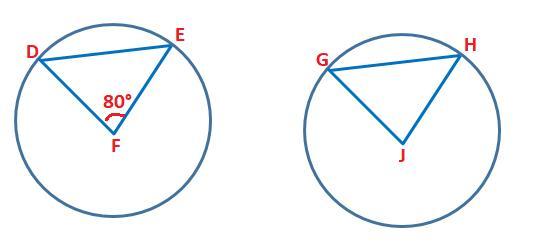
Circle F is congruent to circle J, and ∠EFD ≅ ∠GJH. Circles F and J are congruent. Line segments F E and F D are radii. A line c
Zina [12379]

Answer:

The measure of arc GH is 80 degrees.mGH=80^\circ

Step-by-step explanation:

Circles F and J are congruent.

\angle DFE \cong \angle GJH

Given that: m∠DFE = 80°

Angle DFE serves as the central angle of circle F.

Arc GH's measurement corresponds with the central angle from Circle J.

Since the two circles are congruent

mGH=\angle DFE = 80^\circ

The measure of arc GH, therefore, is 80 degrees.

8 0
1 month ago
Read 2 more answers
Machines at a factory produce circular washers with a specified diameter. The quality control manager at the factory periodicall
zzz [12365]

Answer:

A Type I error could occur if the test shows that the proportion is above 90%, while in reality, the actual proportion is 90%.

Step-by-step explanation:

Machines in a factory produce circular washers that meet a specific diameter.

The quality control manager routinely assesses samples of washers to ensure that more than 90% conform to the specified diameter.

Let p represent the proportion of washers that meet the specified diameter

Thus, Null hypothesis: p = 90% H_0

Alternative Hypothesis: p > 90%H_A

Here, the null hypothesis posits that the proportion is exactly 90%. In contrast, the alternative hypothesis suggests that the proportion exceeds 90%.

Now, a Type I error indicates the probability of rejecting the null hypothesis while it is actually true or, in simple terms, the likelihood of incorrectly rejecting a valid hypothesis.

Thus, based on our question, a Type I error would declare that the test convincingly indicates the proportion is over 90%, while in truth, it remains 90%.

0 0
25 days ago
The yearly income for an individual with an associate’s degree in 2001 was $53,166 and in 2003 it was $56,970. What is the ratio
Zina [12379]

Response:

8861: 9495

Detailed explanation:

The income ratio for the years 2001 to 2003:

53,166: 56,970

To simplify, divide both sides by 6:

8,861: 9,495

This can't be simplified further, so that is the final result!

8861: 9495

I hope this helps! Have a great day:)

6 0
29 days ago
Read 2 more answers
Return to the credit card scenario of Exercise 12 (Section 2.2), and let C be the event that the selected student has an America
zzz [12365]

Answer:

A. P = 0.73

B. P(A∩B∩C') = 0.22

C. P(B/A) = 0.5

P(A/B) = 0.75

D. P(A∩B/C) = 0.4

E. P(A∪B/C) = 0.85

Step-by-step explanation:

Denote A as the event of a student having a Visa card, B as the event of holding a MasterCard, and C as the event of owning an American Express card. Additionally, let A' indicate the event of not having a Visa card, B' signify not having a MasterCard, and C denote the event of not possessing an American Express card.

Thus, with the given probabilities, we can determine the following probabilities:

P(A∩B∩C') = P(A∩B) - P(A∩B∩C) = 0.3 - 0.08 = 0.22

Here, P(A∩B∩C') refers to the chance that a student has both a Visa and MasterCard but does not own an American Express, P(A∩B) indicates the probability that a student possesses both a Visa and a MasterCard, and P(A∩B∩C) represents the likelihood that a student has a Visa, MasterCard, and American Express. Similarly, we can find:

P(A∩C∩B') = P(A∩C) - P(A∩B∩C) = 0.15 - 0.08 = 0.07

P(B∩C∩A') = P(B∩C) - P(A∩B∩C) = 0.1 - 0.08 = 0.02

P(A∩B'∩C') = P(A) - P(A∩B∩C') - P(A∩C∩B') - P(A∩B∩C)

                   = 0.6 - 0.22 - 0.07 - 0.08 = 0.23

P(B∩A'∩C') = P(B) - P(A∩B∩C') - P(B∩C∩A') - P(A∩B∩C)

                   = 0.4 - 0.22 - 0.02 - 0.08 = 0.08

P(C∩A'∩A') = P(C) - P(A∩C∩B') - P(B∩C∩A') - P(A∩B∩C)

                   = 0.2 - 0.07 - 0.02 - 0.08 = 0.03

A. The likelihood that the selected student holds at least one of the three card types is calculated as follows:

P = P(A∩B∩C) + P(A∩B∩C') + P(A∩C∩B') + P(B∩C∩A') + P(A∩B'∩C') +              

     P(B∩A'∩C') + P(C∩A'∩A')

P = 0.08 + 0.22 + 0.07 + 0.02 + 0.23 + 0.08 + 0.03 = 0.73

B. The probability that the chosen student possesses both a Visa and a MasterCard without an American Express card can be represented as P(A∩B∩C') equaling 0.22

C. P(B/A) represents the chance that a student holds a MasterCard provided they have a Visa. This is calculated as:

P(B/A) = P(A∩B)/P(A)

By substituting in the values, we find:

P(B/A) = 0.3/0.6 = 0.5

In a similar manner, P(A/B) represents the probability a student has a Visa given they possess a MasterCard, calculated as:

P(A/B) = P(A∩B)/P(B) = 0.3/0.4 = 0.75

D. For a student with an American Express card, the likelihood they also hold both a Visa and a MasterCard is expressed as P(A∩B/C), calculated as:

P(A∩B/C) = P(A∩B∩C)/P(C) = 0.08/0.2 = 0.4

E. If the student has an American Express card, the probability they possess at least one of the other two card types is denoted as P(A∪B/C), computed as:

P(A∪B/C) = P(A∪B∩C)/P(C)

Where P(A∪B∩C) = P(A∩B∩C)+P(B∩C∩A')+P(A∩C∩B')

Consequently, P(A∪B∩C) equals 0.08 + 0.07 + 0.02 = 0.17

Ultimately, P(A∪B/C) equals:

P(A∪B/C) = 0.17/0.2 =0.85

4 0
21 day ago
Which of the following are exterior angles? Check all that apply.
Svet_ta [12734]

Answer:

A. C. E. F.

Which correspond to 2, 3, 5, and 6.

Step-by-step explanation:

Within geometry, exterior angles are defined as those angles formed between any side of a polygon and the extension of an adjacent side, as demonstrated in the diagram.

Observing the figure, angles 2 and 3 arise from a side of the triangle and a line extended from the following side. Likewise, angles 5 and 6 are created similarly. Thus, these four angles are classified as exterior angles.

8 0
2 months ago
Read 2 more answers
Other questions:
  • Tia shares 53 balloons equally among 4 children. How many balloons will be left over?
    13·1 answer
  • Two objects are moving along separate linear paths where each path is described by position, d, and time, t. The variable d is m
    6·2 answers
  • Valeria is playing with her accordion. The length of the accordion A(t)A(t)A, left parenthesis, t, right parenthesis (in \text{c
    11·1 answer
  • Consider △LNM. Triangle L M N is shown. Angle N M L is a right angle. Which statements are true for triangle LNM? Check all that
    9·2 answers
  • A parcel delivery company delivered 103,000 packages last year, when its average employment was 84 drivers. This year the firm h
    5·1 answer
  • All members of our painting team paint at the same rate. If $8$ members can paint a specific wall in $36$ minutes, then how long
    8·1 answer
  • Please Answer , question in the screenshot
    12·1 answer
  • At Laurita’s Bakery, 3/5 of the baked goods are pies, and the rest are cakes. 1/3 of the pies are coconut. 1/6 of the cakes are
    14·1 answer
  • A veterinarian does research on the causes of enteroliths, stones that develop in the colon of horses. She suspects that feeding
    12·1 answer
  • You put $500 in your bank account. With an interest rate of 5%, how long will it take the account to reach $600? Use the formula
    12·1 answer
Add answer
Login
Not registered? Fast signup
Signup
Login Signup
Ask question!