answer.
Ask question
Login Signup
Ask question
All categories
  • English
  • Mathematics
  • Social Studies
  • Business
  • History
  • Health
  • Geography
  • Biology
  • Physics
  • Chemistry
  • Computers and Technology
  • Arts
  • World Languages
  • Spanish
  • French
  • German
  • Advanced Placement (AP)
  • SAT
  • Medicine
  • Law
  • Engineering
egoroff_w
7 days ago
14

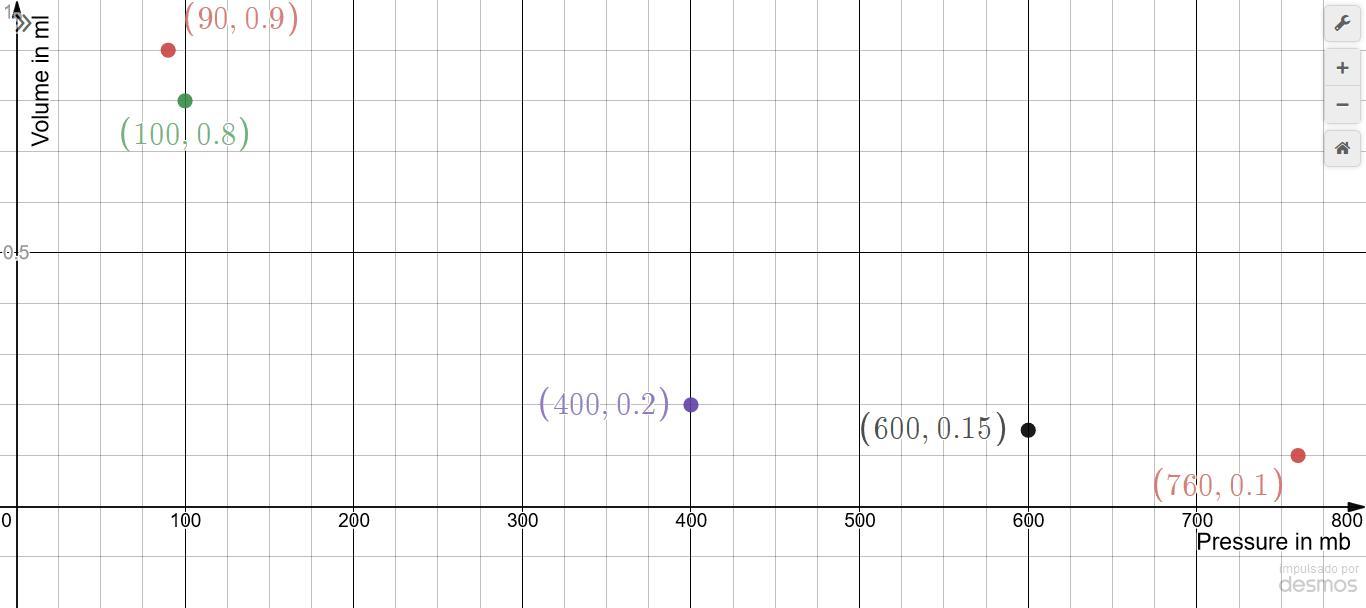
On the axes provided, label pressure on the horizontal axis from O mb to 760 mb and volume on the vertical axis from O to 1 mL.

Assign values to axes divisions in such a way that you occupy almost all the space on both axes. Now locate and label the points: (90, 0.9)
(100, 0.8)
(400, 0.2)
(600, 0.15)
(760, 0.1)

Chemistry
2 answers:
KiRa [2.8K]7 days ago
5 0

Answer:

  • Please refer to the attached image for the graph with labeled axes and points.

Explanation:

This is a guide to fulfilling the instructions along with essential notes for understanding how to create such graphs:

1) The horizontal axis should indicate pressure ranging from 0 mb to 760 mb, while the vertical axis corresponds to volume ranging from 0 to 1 mL.

The x-axis captures the independent variable, and the y-axis records the dependent variable. Both axes must be accurately labeled, showing the variable names and their respective units.

In this context, the origin, (0,0), signifies the intersection of the axes at a pressure of 0 mb and a volume of 0.0 milliliters.

2) Allocate values for the divisions on the axes to maximize the usage of space on both.

An effective graph aims to utilize the entire space on both axes; for this, identify the maximum values for pressure and volume, and determine the corresponding marks.

The pressure range along the x-axis is [90, 760 mb], suggesting large divisions of 100 mb, with the farthest right mark at 800 mb. You can then subdivide each 100 mb interval into 10 smaller sections, using small divisions of 10 mb (my example employs 4 sections of 25 mb, but 10 mb is preferable).

The volume's range for the vertical axis is [0.1, 0.8], so it’s best to use divisions set at 0.1 ml.

3) Next, identify and label the points as follows:

  • (90, 0.9) ⇒ 90 mb, 0.9 ml
  • (100, 0.8) ⇒ 100 mb, 0.8 ml
  • (400, 0.2) ⇒ 400 mb, 0.2 ml
  • (600, 0.15) ⇒ 600 mb, 0.15 ml
  • (760, 0.1) ⇒ 760 mb, 0.1 ml

The points represented as (x, y) are referred to as ordered pairs, indicating that the sequence is significant: the first number denotes the independent variable whereas the second denotes the dependent variable.

Thus, for the point (90, 0.9), 90 indicates a pressure of 90 mb and 0.9 indicates a volume of 0.9 ml.

To find (600, 0.15), since the horizontal increments are valued at 0.1, you should place the second coordinate of the point between the marks corresponding to 0.1 and 0.2 ml.

This allows you to accurately plot each point on the graph.
eduard [2.6K]7 days ago
4 0

Answer:

I agree with that statement

Explanation:

Absolutely

You might be interested in
Select the atoms or ions drawn with valid Lewis dot structures. A) A carbon has a dot on top, right, bottom and to the left.a ni
KiRa [2857]
Answer:

B, C

Explanation:

The Lewis dot structures that are valid are for B and C.

Regarding A;

The Lewis representation of carbon is correct. Each of the four dots symbolizes the four valence electrons.

However, the nitrogen with a single dot above, to the left, and below and a -3 charge isincorrect. For it to have a -3 charge, it must possess 8 Lewis dots (two on each side).

The nitrogen showing four dots (on top, right, bottom and left) is incorrect.

In B;

An oxygen having two dots positioned above and below with one dot on both sides is correct , as the 6 dots indicate oxygen's valence electrons.

In C;

A carbon shows two dots at each position and has a charge of +4. This is correct because the charge reflects that it has gained four electrons giving it 8 valence electrons.

In D;

An oxygen shows two dots above, to the left and below, with a charge of -2. This is incorrect as not all Lewis dots are present. Two are missing.

6 0
21 day ago
What features of this model will help Armando answer the question?
lions [2782]

Answer:

The adjustable legs along with the sand table.

Note: The question is incomplete. The full question is presented below.

Using Models to Address Questions Regarding Systems

Armando’s class was examining images of rivers shaped by flowing water. Most rivers appeared wide and shallow, except for one, which was narrow and deep. The students theorized that this river's narrowness and depth are due to:

  • the steepness of the hill from which the water descends, or
  • the diminutive size of the sand grains the water flows through.

To explore the answer to the question of why this river is so narrow and deep, Armando created the model outlined below.

Explanation:

The model constructed by Armando will facilitate addressing the question due to specific features:

1. Adjustable leg - as one theory proposed by the class suggests that the steep hill affecting the water's path could be the reason for the river's dimensions, the adjustable legs are designed to be raised or lowered to alter the slope, allowing testing of this theory.

2. Sand table - this acts as the streambed. By modifying the size of the sand grains, students can examine the second hypothesis that smaller sand grains contribute to the river's narrowness and depth.

The outcomes of their experimentation will lead them to a conclusion.

5 0
1 month ago
Read 2 more answers
Marie and Calvin dissolved 10 grams of KNO3 in 100 grams of water at 25oC. Next they added 5 grams more. Calvin told Marie that
Alekssandra [2891]
Hi there! Calvin informed Marie that they could still incorporate solute until reaching 40 grams because the solution remained unsaturated. Unsaturated solutions denote situations where the solvent (water in this instance) can further dissolve more solute (here, KNO₃) considering the current pressure and temperature. This can be visually confirmed when additional solute does not lead to visible solid residues settling at the bottom of the flask, indicating that the dissolving rate surpasses the crystallization rate. Wishing you a pleasant day!
8 0
7 days ago
An average copper penny minted in the 1960s contained about 3.000 g of copper. how much chalcopyrite had be mined to produce 100
lorasvet [2668]

To find the answer, start by calculating the total mass of the copper utilized:

Copper used = 100 pennies x 3.0g Cu per penny = 300.0 g Cu


Next, identify the path and molar ratios from Cu produced back to CuFeS2 needed using the established balanced reactions:

1 Cu2S from 2 CuS; 2Cu from 1 Cu2S; 2CuS from 2CuFeS2
Thus, 2Cu comes from 2CuFeS2, indicating a 1:1 molar ratio.


Then convert grams of Cu to moles and grams of CuFeS2:
= 300.0 g Cu * 1 mol Cu/63.546g Cu * 2 mol CuFeS2/2 moles Cu

= 4.72 moles CuFeS2


The required amount of chalcopyrite mined = 4.72 moles CuFeS2 * 183.54 g CuFeS2/1 mole CuFeS2 = 866.49 g CuFeS2

8 0
25 days ago
Read 2 more answers
The normal boiling point of c2cl3f3 is 47.6°c and its molar enthalpy of vaporization is 27.49 kj/mol. what is the change in entr
eduard [2645]
Based on the equation:

ΔG = ΔH - TΔS = 0

It follows that ΔS = ΔH/T

So, ΔS = n*ΔHVap / Tvap

- where n represents the number of moles calculated as mass/molar mass

For a mass of 24.1 g

and a molar mass of 187.3764 g/mol

substituting gives:

∴ n = 24.1 / 187.3764g/mol

      = 0.129 moles

The molar enthalpy of vaporization, ΔHvap, is 27.49 kJ/mol

The temperature in Kelvin, Tvap = 47.6 + 273 = 320.6 K

After substitution, we compute ΔS, the change in entropy:

∴ΔS = 0.129 mol * 27490 J/mol / 320.6 K

      = 11 J/K
7 0
1 month ago
Other questions:
  • HCl(aq)+NaOH(aq)→NaCl(aq)+H2O(l)
    7·1 answer
  • A student places a small amount of water in a glass dish and then carefully places a small paperclip on the surface of the water
    8·2 answers
  • 4.1 kg of a plastic, used to make plastic bottles, has a carbon footprint of 6.0 kg of carbon dioxide.
    13·1 answer
  • Predict what will observe in below mention experiment.
    10·1 answer
  • For each group of compounds listed, which is the strongest acid? I. HIO2, HIO3, HIO4 II. H2Se, H2S, H3As III. HPO2, HClO2, HBrO2
    14·1 answer
  • What functional feature(s) does the phosphate group contribute to the structure of a phospholipid? select all that apply. select
    13·1 answer
  • You want to test the effect of pH on the distribution of Artemia in your 35cm long testing chamber. If you measure a pH = 1 at o
    8·1 answer
  • What volume of beaker contains exactly 2.23x10^-2 mol of nitrogen gas at STP?
    6·1 answer
  • A 0.56 M solution of AlCl₃ is determined to have a concentration of particles of 1.79 M. What is the van't Hoff factor for AlCl₃
    11·1 answer
  • How many moles of O2 are produced when 0.500mol of KO2 reacts in this fashion?
    13·1 answer
Add answer
Login
Not registered? Fast signup
Signup
Login Signup
Ask question!