answer.
Ask question
Login Signup
Ask question
All categories
  • English
  • Mathematics
  • Social Studies
  • Business
  • History
  • Health
  • Geography
  • Biology
  • Physics
  • Chemistry
  • Computers and Technology
  • Arts
  • World Languages
  • Spanish
  • French
  • German
  • Advanced Placement (AP)
  • SAT
  • Medicine
  • Law
  • Engineering
Sindrei
2 days ago
13

In a rocket-propulsion problem the mass is variable. Another such problem is a raindrop falling through a cloud of small water d

roplets. Some of these small droplets adhere to the raindrop, thereby increasing its mass as it falls. The force on the raindrop is
Fext=dp/dt=m dv/dt+v dm/dt
Suppose the mass of the raindrop depends on the distance x that it has fallen. Then m = kx, where k is a constant, and dm/dt=kv
dm/dt=kv This gives, since Fext=mg
Fext​=mg,
mg=m dv/dt+v(kv)
Or, dividing by k,
xg=x dv/dt+v2
This is a differential equation that has a solution of the form v = at, where a is the acceleration and is constant. Take the initial velocity of the raindrop to be zero.
(a) Using the proposed solution for v find the acceleration a.
(b) Find the distance the raindrop has fallen in t = 3.00 s.
(c) Given that k = 2.00 g/m, find the mass of the raindrop at t = 3.00 s.
Physics
1 answer:
Keith_Richards [2.8K]2 days ago
6 0

Answer:

a) a = g / 3

b) x (3.0) = 14.7 m

c) m (3.0) = 29.4 g

Explanation:

Provided:-

- The differential equation related to (x) the distance traveled by a raindrop takes the following form:

x*g = x * \frac{dv}{dt} + v^2

- Where, v = Velocity of the raindrop

- Proposed solution for the provided ODE:

v = a*t

Where, a = raindrop's acceleration

Find:-

(a) Use the proposed solution for v to find the acceleration a.

(b) Find the distance the raindrop falls in t = 3.00 s.

(c) Given that k = 2.00 g/m, determine the mass of the raindrop at t = 3.00 s.

Solution:-

- We're aware that acceleration (a) corresponds to the first derivative of velocity (v):

a = dv / dt... Eq 1

- Similarly, velocity (v) is the first derivative of displacement (x):

v = dx / dt, v = a*t... proposed solution (Eq 2)

v.dt = dx = a*t. dt

- Integrate both sides:

∫a*t. dt = ∫dt

x = 0.5*a*t^2... Eq 3

- Substitute Eq1, 2, 3 into the original ODE:

0.5*a*t^2*g = 0.5*a^2 t^2 + a^2 t^2

= 1.5 a^2 t^2

a = g / 3

- Using the derived acceleration of the raindrop (a) and t = 3.00 seconds, plug into Eq 3:

x (t) = 0.5*a*t^2 x (t = 3.0) = 0.5*9.81*3^2 / 3

x (3.0) = 14.7 m

- Utilizing the relationship for mass with k = 2.00 g/m, find the mass of the raindrop at t = 3.0 s:

m (t) = k*x (t)

m (3.0) = 2.00*x(3.0) m (3.0) = 2.00*14.7

m (3.0) = 29.4 g

You might be interested in
Consider the uniform electric field E = (2.5 j + 3.5 k) × 103 N/C. (a) Calculate the electric flux through a circular area of ra
kicyunya [2911]
The desired electric flux Φ is calculated from the electric field E=(2.5• j + 3.5• k) ×10³ N/C and a circular path with a radius r=2.5m. The electric flux across a surface is represented as Φ=∮E•dA. Given the area A lies in the yz-plane, the normal orientation flows in the x-direction with A=πr² leading to dA=2πrdr •i. Thus, Φ evolves to Φ=∮(2.5j + 3.5k)×10³•(2πrdr i). Integrating from r=0 to r=2.5m and noting that components in different directions yield zero, results in Φ equaling 0 Nm²/C. Regarding the second part, when the area vector is at a 45° angle to the xy-plane, we redefine dA as (2πrCos45 i + 2πrSin45 j) dr, leading to the new flux calculation as Φ=10³∮ 5πrSin45 dr, integrating from 0 to 2.5m. With substitutions made, the result comes to Φ=34.71×10³ Nm²/C.
3 0
21 day ago
Consider a 4-mg raindrop that falls from a cloud at a height of 2 km. When the raindrop reaches the ground, it won't kill you or
inna [2723]

Answer:

The work performed by air resistance totals -0.0782 J

Explanation:

Hello!

According to the principle of conservation of energy, the energy of a raindrop must remain constant.

At the outset, the raindrop possesses only gravitational potential energy:

PE = m · g · h

Where:

PE = potential energy.

m = mass of the raindrop.

g = gravitational acceleration (9.8 m/s²)

h = height.

Let's determine the initial potential energy of the raindrop:

(4 mg should be converted into kg: 4 mg · 1 kg / 1 × 10⁶ mg = 4 × 10⁻⁶ kg)

PE = 4 × 10⁻⁶ kg · 9.8 m/s² · 2000 m

PE = 0.0784 J

As the raindrop descends, some of its potential energy converts into kinetic energy while the rest is lost to the air resistance. Upon reaching the ground, all initial potential energy has been either turned into kinetic energy or spent overcoming air resistance:

initial PE = final KE + Work by air

Where:

KE = kinetic energy.

Work by air = work done by air resistance.

The kinetic energy at ground level is computed as follows:

KE = 1/2 · m · v²

Where:

m = mass

v = velocity

<pThus:

KE = 1/2 · 4 × 10⁻⁶ kg · (10 m/s)²

KE = 2 × 10⁻⁴ J

Now, we can find the work done by air resistance:

initial PE = final KE + Work by air

0.0784 J = 2 × 10⁻⁴ J + Work by air

Work by air = 0.0784 J - 2 × 10⁻⁴ J

Work by air = 0.0782 J

Since work is performed in the opposite direction to movement, this results in a negative value. Therefore, the work done by air resistance is -0.0782 J.


5 0
1 month ago
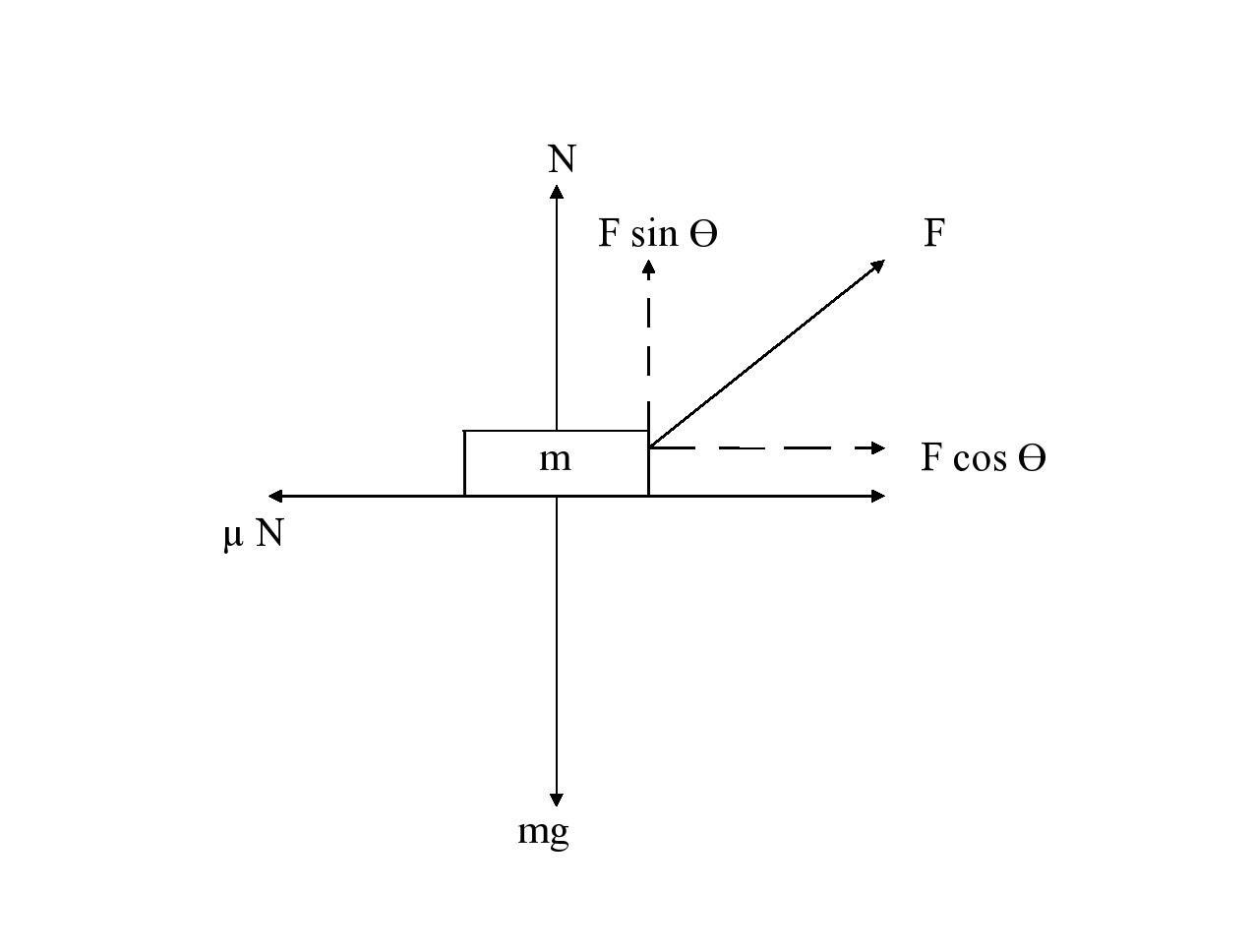
It's a snowy day and you're pulling a friend along a level road on a sled. You've both been taking physics, so she asks what you
Maru [2948]

Answer:

0.0984

Explanation:

The first diagram below illustrates a free body diagram that will aid in resolving this problem.

According to the diagram, the force's horizontal component can be expressed as:

F_X = F_{cos \ \theta}

Substituting 42° for θ and 87.0° for F

F_X =87.0 \ N \ *cos \ 42 ^\circ

F_X =64.65 \ N

Meanwhile, the vertical component is:

F_Y = Fsin \ \theta

Again substituting 42° for θ and 87.0° for F

F_Y =87.0 \ N \ *sin \ 42 ^\circ

F_Y =58.21 \ N

In resolving the vector, let A denote the components in mutually perpendicular directions.

The magnitudes of both components are illustrated in the second diagram provided and can be represented as A cos θ and A sin θ

The frictional force can be expressed as:

f = \mu \ N

Where;

\mu is the coefficient of friction

N = the normal force

Also, the normal reaction (N) is calculated as mg - F sin θ

Substituting F_Y \ for \ F_{sin \ \theta}. Normal reaction becomes:

N = mg \ - \ F_Y

By balancing the forces, the horizontal component of the force equals the frictional force.

The horizontal component is described as follows:

F_X = \mu \ ( mg - \ F_Y)

Rearranging the equation above to isolate \mu leads to:

\mu \ = \ \frac{F_X}{mg - F_Y}

Substituting in the following values:

F_X \ = \ 64.65 \ N

m = 73 kg

g = 9.8 m/s²

F_Y = \ 58.21 N

Thus:

\mu \ = \ \frac{64.65 N}{(73.0 kg)(9.8m/s^2) - (58.21 \ N)}

\mu = 0.0984

Therefore, the coefficient of friction is = 0.0984

5 0
1 month ago
A proton is released from rest at the origin in a uniform electric field that is directed in the positive xx direction with magn
Ostrovityanka [2807]
The alteration in potential energy is  \Delta PE = - 3.8*10^{-16} \ J

In the query, it is stated that

  The intensity of the uniform electric field equals E = 950 \ N/C

     The distance the electron covers is  x = 2.50 \ m

Typically, the force exerted on this electron is expressed mathematically as

     F = qE

Where F signifies the force and  q represents the charge of the electron, which is a fixed value of q = 1.60*10^{-19} \ C

    Thus  

      F = 950 * 1.60 **10^{-19}

      F = 1.52 *10^{-16} \ N

Generally, the work-energy theorem is mathematically framed as

          W = \Delta KE

Where W denotes the work done on the electron by the electric field and  \Delta KE  is the change in kinetic energy

Additionally, work done on the electron can also be described as

        W = F* x *cos( \theta )

Where  \theta = 0 ^o assuming that the electron's movement aligns with the x-axis  

        So

             \Delta KE = F * x cos (0)

Inserting values

         \Delta KE = 1.52 *10^{-16} * 2.50 cos (0)

          \Delta KE = 3.8*10^{-16} J

According to the conservation of energy

       \Delta PE = - \Delta KE

Where \Delta PE signifies the change  in  potential energy  

Thus  

        \Delta PE = - 3.8*10^{-16} \ J


7 0
10 days ago
A small 175-g ball on the end of a light string is revolving uniformly on a frictionless surface in a horizontal circle of diame
kicyunya [2911]
For motion in a circle.

Centripetal acceleration is calculated as mv²/r = mω²r

where v represents linear velocity, r equals radius which is diameter/2 equating to 1/2 or 0.5m

. Here, m is the mass of the object, which is 175g or 0.175kg.

The angular speed, ω, is derived from Angle covered / time

                         = 2 revolutions per 1 second

                         = 2 * 2π  radians for each second

                         = 4π  radians per second

Thus, Centripetal Acceleration = mω²r = 0.175*(4π)² * 0.5. Utilize a calculator

                                                         ≈13.817  m/s²

. The acceleration's magnitude is approximately 13.817  m/s² and it is oriented towards the center of the circular path.

The tension in the string equates to m*a

                                   = 0.175*13.817

                                   = 2.418 N
5 0
13 days ago
Read 2 more answers
Other questions:
  • Mo is on a baseball team and hears that a ball thrown at a 45 degree angle from the ground will travel the furthest distance. Ho
    13·1 answer
  • Which statements correctly describe forces? Check all that apply.
    10·2 answers
  • Calculate the change in the kinetic energy (KE) of the bottle when the mass is increased. Use the formula KE = mv2, where m is t
    9·3 answers
  • If the potential difference across the bulb in a certain flashlight is 3.0 V, What is the potential difference across the combin
    7·1 answer
  • For anti-ballistic missile system, the time of flight tf is determined by the initial speed v0 of the missile and the maximum ra
    6·1 answer
  • If you start with the number 3.0 and move the decimal point one unit to the left, you wind up with 0.30. If you move the decimal
    7·1 answer
  • A uniform electric field of 2 kNC-1 is in the x-direction. A point charge of 3 μC initially at rest at the origin is released. W
    8·1 answer
  • A rear window defroster consists of a long, flat wire bonded to the inside surface of the window. When current passes through th
    5·2 answers
  • A 72.0-kg person pushes on a small doorknob with a force of 5.00 N perpendicular to the surface of the door. The doorknob is loc
    15·1 answer
  • A force of 1000 n is exerted on a golf ball for 0.005 s . The Change In momentum of the golf ball is
    7·2 answers
Add answer
Login
Not registered? Fast signup
Signup
Login Signup
Ask question!