answer.
Ask question
Login Signup
Ask question
All categories
  • English
  • Mathematics
  • Social Studies
  • Business
  • History
  • Health
  • Geography
  • Biology
  • Physics
  • Chemistry
  • Computers and Technology
  • Arts
  • World Languages
  • Spanish
  • French
  • German
  • Advanced Placement (AP)
  • SAT
  • Medicine
  • Law
  • Engineering
Nataliya
1 month ago
10

Define a function pyramid_volume with parameters base_length, base_width, and pyramid_height, that returns the volume of a pyram

id with a rectangular base. Sample output with inputs: 4.5 2.1 3.0 Volume for 4.5, 2.1, 3.0 is: 9.45 Relevant geometry equations: Volume

Engineering
1 answer:
pantera1 [299]1 month ago
5 0

Hi, since you haven't mentioned the programming language needed for your code, I will illustrate how to accomplish it using Python, and you can then adapt the approach to any language you prefer.

Answer:

1. def pyramid_volume(base_length, base_width, pyramid_height):

2.     volume = base_length * base_width * pyramid_height / 3

3.     return volume

Step-by-step explanation:

  1. The function pyramid_volume is defined in the first line with its parameters.
  2. The subsequent line calculates the volume of a rectangular-based pyramid using the equation V = l * w * h / 3.
  3. Finally, the calculated volume is returned.

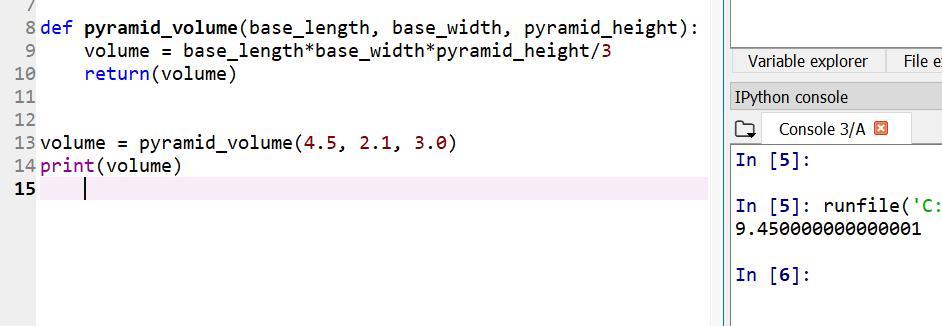
The output displayed below demonstrates the function's result with inputs 4.5, 2.1, and 3.0.

You might be interested in
An air duct heater consists of an aligned array of electrical heating elements in which the longitudinal and transverse pitches
Kisachek [338]

Answer:

a) q = 7671 W

T0 = 47.6°C

b) ΔP = 202.3 N/m²

P = 58.2 W

c) hDarray = 2 times hD of an isolated element.

Explanation:

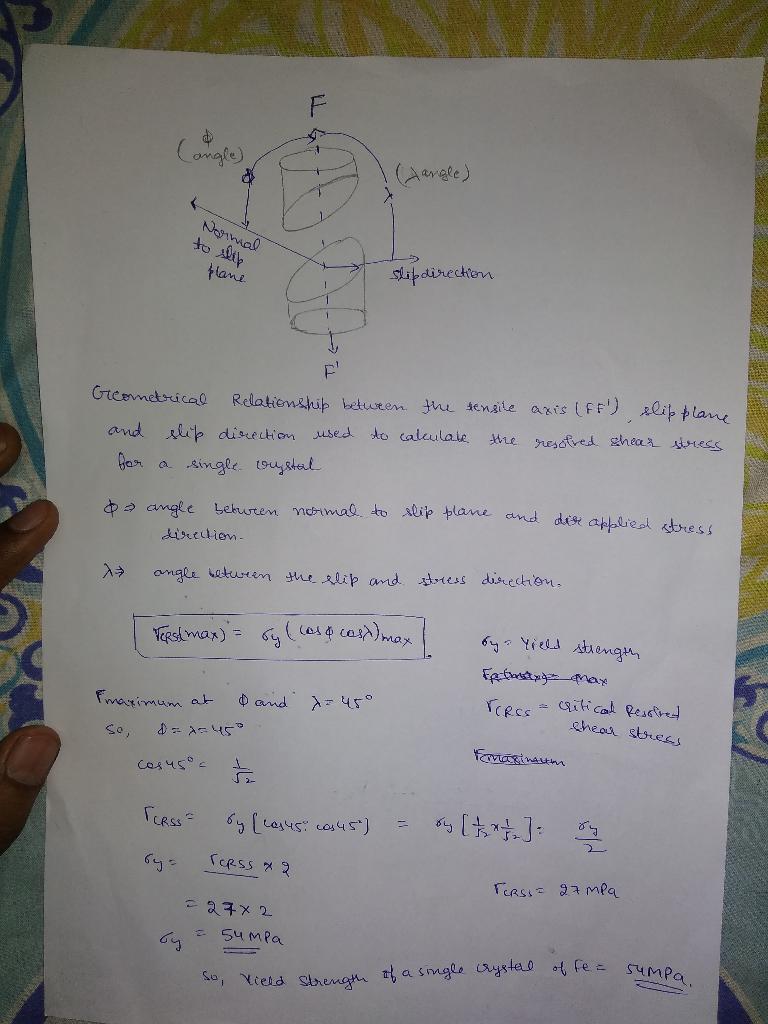
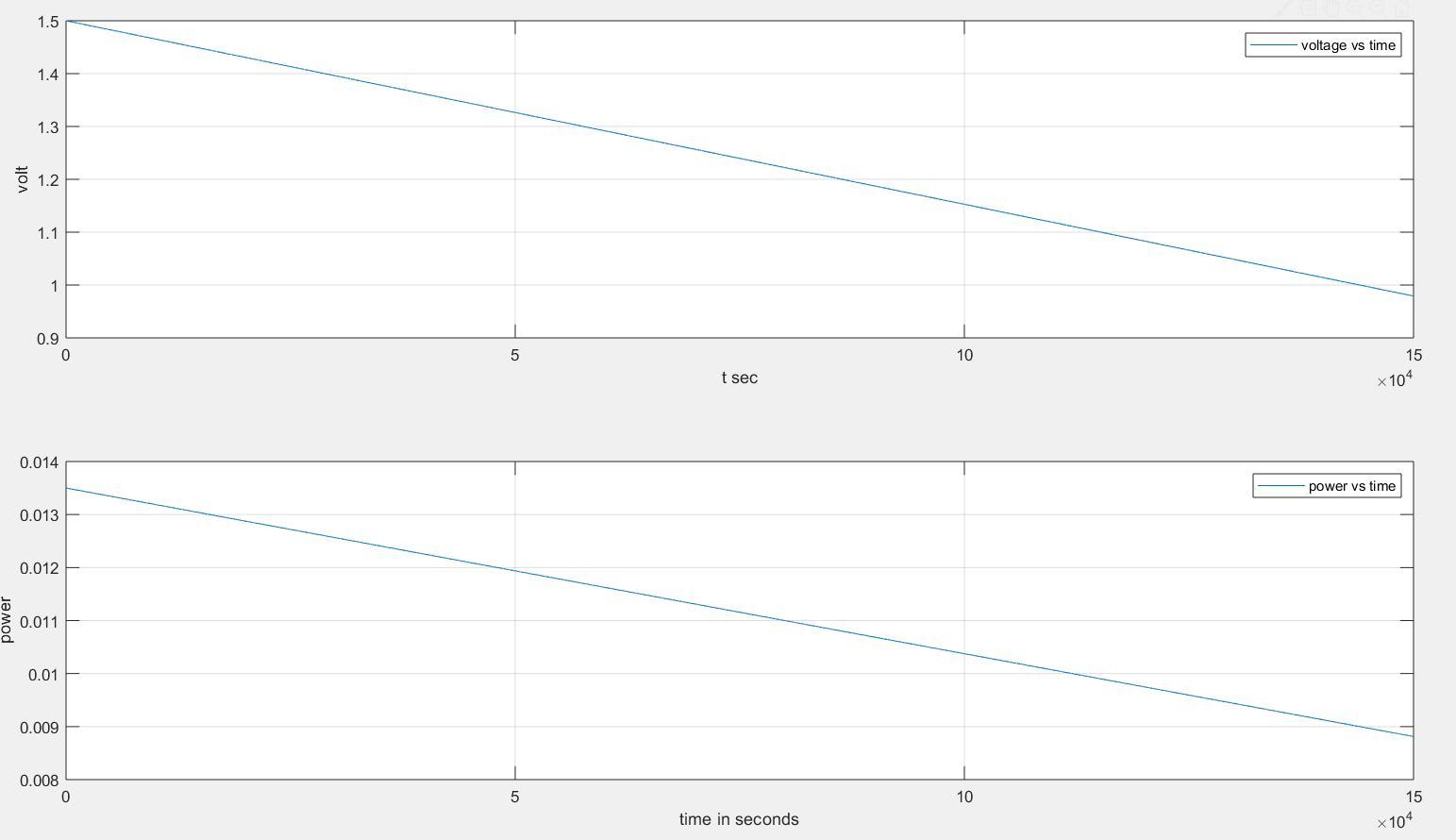
see the image for the solution.

4 0
29 days ago
A bar of 75 mm diameter is reduced to 73mm by a cutting tool while cutting orthogonally. If the mean length of the cut chip is 7
mote1985 [299]

Answer:

r=0.31

Ф=18.03°

Explanation:

Provided:

Original diameter of bar = 75 mm

Diameter post-cutting = 73 mm

Average diameter of the bar d= (75+73)/2=74 mm

Average length of uncut chip = πd

Average length of uncut chip = π x 74 =232.45 mm

Thus, cutting ratio r

Cutting\ ratio=\dfrac{Mean\ length\ of cut\ chip}{Mean\ length\ of uncut\ chip}

r=\dfrac{73.5}{232.45}   r=0.31

Therefore, the cutting ratio equals 0.31.

Now, the shearing angle is given as

tan\phi =\dfrac{rcos\alpha }{1-rsin\alpha }

Next by substituting the values

tan\phi =\dfrac{rcos\alpha }{1-rsin\alpha }

tan\phi =\dfrac{0.31cos15 }{1-0.31sin15 }\

Ф=18.03°

Concluding, the shearing angle is 18.03°.

4 0
1 month ago
Given num_rows and num_cols, print a list of all seats in a theater. Rows are numbered, columns lettered, as in 1A or 3E. Print
Viktor [368]

Answer:

This is the solution code in Python:

  1. alphabets = ['A', 'B', 'C', 'D', 'E', 'F', 'G', 'H', 'I', 'J']
  2. user_input = input("Enter number of rows and columns: ")
  3. myArr = user_input.split(" ")
  4. num_rows = int(myArr[0])
  5. num_cols = int(myArr[1])
  6. seats = []
  7. for i in range(num_rows):
  8. row = []
  9. for j in range(num_cols):
  10. row.append(alphabets[j])
  11. seats.append(row)
  12. output = ""
  13. for i in range(len(seats)):
  14. for j in range(len(seats[i])):
  15. output += str(i + 1) + seats[i][j] + " "
  16. print(output)

Explanation:

Initially, we create a small list of alphabets from A to J (Line 1).

We then request the user to enter the number of rows and columns (Line 3). Given that the input comes as a string (e.g., "2 3"), we utilize the split() method to separate the numbers into individual items in a list (Line 4). The first item (row number) is assigned to variable num_rows, while the second item (column number) goes to num_cols.

Subsequently, we construct the seats list with a nested for-loop (Lines 10-15). Once the seats list is formed, another nested for-loop generates the required output string as per the question (Lines 19-21).

Finally, the output is printed (Line 23). For example, an input of 2 3 results in the output:

1A 1B 1C 2A 2B 2C

8 0
1 month ago
A well-insulated rigid tank contains 1.5 kg of a saturated liquid–vapor mixture of water at 200 kPa. Initially, three-quarters o
Daniel [317]

Answer:

The change in entropy of the steam is 2.673 kJ/K

Explanation:

The mass of the liquid-vapor mixture is 1.5 kg

The mass in the liquid phase is calculated as 3/4 × 1.5 kg = 1.125 kg

The mass in the vapor phase is calculated as 1.5 - 1.125 = 0.375 kg

According to the steam tables

At a pressure of 200 kPa (200/100 = 2 bar), the specific entropy of steam is found to be 7.127 kJ/kgK

The entropy of steam can be calculated as specific entropy multiplied by mass = 7.127 × 0.375 = 2.673 kJ/K

6 0
16 days ago
Read 2 more answers
Who want to play "1v1 lol unblocked games 76"
Daniel [317]

Answer:I want to know what game to play?

Explanation:

3 0
1 month ago
Read 2 more answers
Other questions:
  • A. Calculate the fraction of atom sites that are vacant for lead at its melting temperature of 327°C (600 K). Assume an energy f
    5·1 answer
  • A sign erected on uneven ground is guyed by cables EF and EG. If the force exerted by cable EF at E is 46 lb, determine the mome
    13·1 answer
  • A fireboat is to fight fires at coastal areas by drawing seawater with a density of 1030 kg/m through a 20-cm-diameter pipe at a
    13·1 answer
  • Which of the following ranges depicts the 2% tolerance range to the full 9 digits provided?
    6·1 answer
  • As shown, a load of mass 10 kg is situated on a piston of diameter D1 = 140 mm. The piston rides on a reservoir of oil of depth
    9·1 answer
  • Write multiple if statements. If car_year is 1969 or earlier, print "Few safety features." If 1970 or later, print "Probably has
    12·1 answer
  • Water is flowing in a metal pipe. The pipe OD (outside diameter) is 61 cm. The pipe length is 120 m. The pipe wall thickness is
    9·1 answer
  • 1 At a certain location, wind is blowing steadily at 10 m/s. Determine the mechanical energy of air per unit mass and the power
    11·1 answer
  • The basic barometer can be used to measure the height of a building. If the barometric readings at the top and the bottom of a b
    15·1 answer
  • 1. A glass window of width W = 1 m and height H = 2 m is 5 mm thick and has a thermal conductivity of kg = 1.4 W/m*K. If the inn
    8·1 answer
Add answer
Login
Not registered? Fast signup
Signup
Login Signup
Ask question!