answer.
Ask question
Login Signup
Ask question
All categories
  • English
  • Mathematics
  • Social Studies
  • Business
  • History
  • Health
  • Geography
  • Biology
  • Physics
  • Chemistry
  • Computers and Technology
  • Arts
  • World Languages
  • Spanish
  • French
  • German
  • Advanced Placement (AP)
  • SAT
  • Medicine
  • Law
  • Engineering
dezoksy
1 month ago
15

A player throws a football 50.0 m at 61.0° north of west. what is the westward component of the displacement of the football?

Physics
1 answer:
inna [3.1K]1 month ago
7 0

Answer: 24.24 m

Explanation:

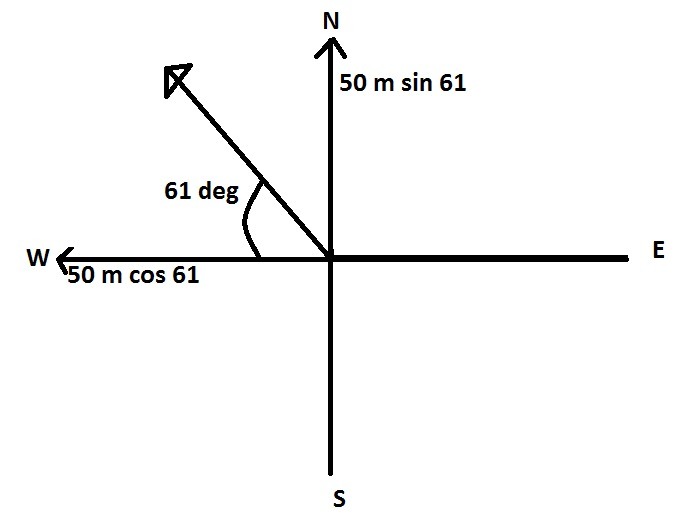
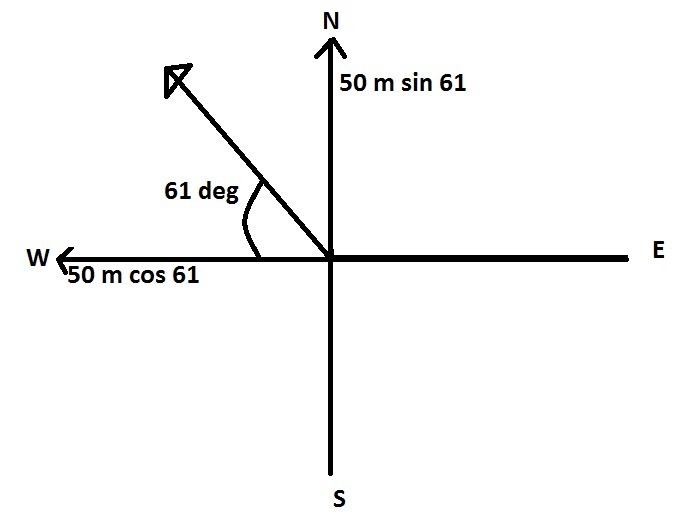
A player launches a football 50.0 m at an angle of 61° to the north of west. We will break this down into vertical and horizontal elements.

Horizontal component: 50 cos 61° = 24.24 m directed westward

Vertical component: 50 sin 61° = 43.73 m directed toward the north.

Refer to the diagram below.

Therefore, the westward displacement of the football corresponds to the horizontal component of the displacement, which is 24.24 m.

You might be interested in
A dinner plate falls vertically to the floor and breaks up into three pieces, which slide horizontally along the floor. immediat
serg [3582]
<span>We will apply the momentum-impulse theorem here. The total momentum along the x-direction is defined as p_(f) = p_(1) + p_(2) + p_(3) = 0.
Therefore, p_(1x) = m1v1 = 0.2 * 2 = 0.4. Additionally, p_(2x) = m2v2 = 0 and p_(3x) = m3v3 = 0.1 *v3, where v3 represents the unknown speed and m3 signifies the mass of the third object, which has an unspecified velocity.
In the same way, for the particle of 235g, the y-component of the total momentum is described with p_(fy) = p_(1y) + p_(2y) + p_(3y) = 0.
Thus, p_(1y) = 0, p_(2y) = m2v2 = 0.235 * 1.5 = 0.3525 and p_(3y) = m3v3 = 0.1 * v3, where m3 is the mass of the third piece.
Consequently, p_(fx) = p_(1x) + p_(2x) + p_(3x) = 0.4 + 0.1v3; yielding v3 = 0.4/-0.1 = - 4.
Similarly, p_(fy) = 0.3525 + 0.1v3; thus v3 = - 0.3525/0.1 = -3.525.
Therefore, the x-component of the speed of the third piece is v_3x = -4 and the y-component is v_3y = 3.525.
The overall speed is calculated as follows: resultant = âš (-4)^2 + (-3.525)^2 = 5.335</span>
4 0
2 months ago
Read 2 more answers
The stomach lining is made up of deep muscular grooves.How might these structures help the stomach to break down food?
Sav [3153]
I sincerely hope this information proves useful to you.

7 0
1 month ago
A hard rubber rod with an electric potential energy of 5.2 × 10⁻³ J has a charge of 4.0 µC at the tip. What is the electric pote
Keith_Richards [3271]
1) The electric potential energy can be defined as the product of the electric potential and the associated charge:
U=q V
where
q refers to the charge
V denotes the electric potential

In this scenario, the charge on the rod is q=4.0 \mu C = 4.0 \cdot 10^{-6}C, and the potential energy is U=5.2 \cdot 10^{-3} J, thus we may rearrange the earlier formula to find the electric potential at the tip:
V= \frac{U}{q}= \frac{5.2 \cdot 10^{-3}J}{4.0 \cdot 10^{-6} C}=1300 V=1.3 \cdot 10^3 V

2) Using this same formula, if the charge changes to q=2.0 \mu C = 2.0 \cdot 10^{-6} C, the resulting electric potential will be:
V= \frac{U}{q}= \frac{5.2 \cdot 10^{-3} J}{2.0 \cdot 10^{-6}C}=2600 V = 2.6 \cdot 10^{3}V
8 0
2 months ago
Read 2 more answers
The magnitude J(r) of the current density in a certain cylindrical wire is given as a function of radial distance from the cente
Softa [3030]
J(r) = Br. We know that the area of a small segment, dA, is represented as 2 π dr. Thus, I = J A and dI = J dA. Plugging in the values gives us dI = B r. 2 π dr which simplifies to dI= 2π Br² dr. Now, integrating the above equation: Given that B= 2.35 x 10⁵ A/m³, with r₁ = 2 mm and r₂ equal to 2 + 0.0115 mm, or 2.0115 mm.
7 0
2 months ago
Read 2 more answers
A person who weighs 625 N is riding a 98-N mountain bike. Suppose that the entire weight of the rider and bike is supported equa
Keith_Richards [3271]

Answer:

A = 4.76 x 10⁻⁴ m²

Explanation:

Given data:

Person's weight = 625 N

Bike's weight = 98 N

Pressure per tire = 7.60 x 10⁵ Pa

Find: Contact area per tire

Total system weight = 625 + 98 = 723 N

Let F represent the force supported by each tire

2F = 723 N

Therefore, F = 361.5 N

Using the formula F = P × A

A = \dfrac{F}{P}

A = \dfrac{361.5}{7.60 \times 10^5}

Contact area, A = 4.76 x 10⁻⁴ m²

7 0
3 months ago
Other questions:
  • What is the maximum value the string tension can have before the can slips? The coefficient of static friction between the can a
    7·1 answer
  • A large crate with mass m rests on a horizontal floor. The static and kinetic coefficients of friction between the crate and the
    5·2 answers
  • The position of a particle is r⃗ (t)=(3.0t2iˆ+5.0jˆ−6.0tkˆ)m. (a) Determine its velocity and acceleration as functions of time.
    10·1 answer
  • At a football game, an air gun fires T-shirts into the crowd. The gun is fired at an angle of 46 degree from the horizontal with
    14·1 answer
  • At a location where the acceleration due to gravity is 9.807 m/s2, the atmospheric pressure is 9.891 × 10⁴ Pa. A barometer at th
    5·2 answers
  • The wavelength of red light is about 700 nm: λred = 700 nm. Which is larger, a grain of sand (diameter roughly 0.2 mm) or a wave
    14·1 answer
  • Roseanne heated a solution in a beaker as part of a laboratory experiment on energy transfer. After a while, she noticed the liq
    5·1 answer
  • A person pushes on the handle of a lawnmower with a force of 280. n. if the handle makes an angle of 40.0 degrees with the groun
    14·2 answers
  • When numbers are very small or very large, it is convenient to either express the value in scientific notation and/or by using a
    7·1 answer
  • A pile driver drops from a height of 35 meters
    11·2 answers
Add answer
Login
Not registered? Fast signup
Signup
Login Signup
Ask question!