answer.
Ask question
Login Signup
Ask question
All categories
  • English
  • Mathematics
  • Social Studies
  • Business
  • History
  • Health
  • Geography
  • Biology
  • Physics
  • Chemistry
  • Computers and Technology
  • Arts
  • World Languages
  • Spanish
  • French
  • German
  • Advanced Placement (AP)
  • SAT
  • Medicine
  • Law
  • Engineering
77julia77
16 days ago
9

Air is compressed from 100 kPa, 300 K to 1000 kPa in a two-stage compressor with intercooling between stages. The intercooler pr

essure is 300 kPa. The air is cooled back to 300 K in the intercooler before entering the second compressor stage. Each compressor stage is isentropic. Please calculate the total compressor work per unit of mass flow (kJ/kg). Repeat for a single stage of isentropic compression from the given inlet to the final pressure.
Engineering
You might be interested in
cubical tank 1 meter on each edge is filled with water at 20 degrees C. A cubical pure copper block 0.46 meters on each edge wit
grin007 [323]

Answer:

final temperature = 26.5°

Explanation:

The water's initial volume is calculated as 1 x 1 x 1 = 1 m^{3}

The starting temperature of the water is 20° C

Water density = 1000 kg/m^{3}

Volume of the copper block is determined as 0.46 x 0.46 x 0.46 = 0.097 m^{3}

The copper block's initial temperature is 100° C

Copper density = 8960 kg/m^{3}

The water's final volume after accounting for the copper block is 1 - 0.097 = 0.903 m^{3}

Assumptions:

  • the tank is adiabatic, meaning there’s no heat exchange through its walls
  • the tank is completely filled, lacking space for any air to cool the water
  • the total thermal energy in the tank is comprised of both the water’s heat energy and that of the copper block.

The mass of the remaining water in the tank can be calculated using density x volume = 1000 x 0.903 = 903 kg

The specific heat capacity for water, c = 4186 J/K-kg

Total heat content of the water Hw = mcT = 903 x 4186 x 20 = 75.59 Mega-joules

The copper's mass is calculated as density x volume = 8960 x 0.097 = 869.12 kg

Copper's specific heat capacity is 385 J/K-kg

The heat content of copper Hc = mcT = 869.12 x 385 x 100 = 33.46 Mega-joules

The overall heat in the system totals up to 75.59 + 33.46 = 109.05 Mega-joules

This heat will be evenly dispersed across the system

The heat energy of the water in the system is expressed as mcT

where T signifies the final temperature

= 903 x 4186 x T = 3779958T

For copper, the heat will be

mcT = 869.12 x 385 = 334611.2T

The combined heat from both will equal the total heat of the system, meaning

3779958T + 334611.2T = 109.05 x 10^{6}

4114569.2T = 109.05 x 10^{6}

Thus, the final temperature T = (109.05 x 10^{6})/4114569.2 = 26.5°

3 0
2 months ago
Consider a process carried out on 1.00 mol of a monatomic ideal gas by the following two different pathways.
grin007 [323]

Answer:

90 L.atm

Explanation:

According to the provided details:

First pathway:

A( 3 atm, 20 L) → C ( 1 atm, 20 L) → D (1 atm, 50 L)

Second pathway:

A(3 atm, 20 L) → B( 3 atm, 50 L) → D ( 1 atm, 50 L)

As the number of moles is 1.00 moles

To calculate wAB;

A → B signifies the transformation is happening at a steady pressure;

Thus,

wAB = pressure multiplied by the change in volume

wAB = P(V₂ - V₁)

wAB = 3 atm (50 L - 20 L)

wAB = 3 atm (30 L)

wAB = 90 L.atm

7 0
2 months ago
The top 3 most popular male names of 2017 are Oliver, Declan, and Henry according to babynames. Write a program that modifies th
Viktor [391]

Answer:

The Python code is provided below with suitable comments

Explanation:

# convert list to set

male_names = set(['Oliver','Declan','Henry'])

# get name for removal and addition from user

remove_name = input("Enter remove name: ")

add_name = input("Enter add name: ")

# remove specified name from set

male_names.remove(remove_name)

# add new name to set

male_names.add(add_name)

# sort the resulting set

a = sorted(male_names)

# output the sorted set

print(a)

7 0
3 months ago
Consider the following program:
Daniel [329]

Answer:

The resolution for this question is below in the explanation section.

Explanation:

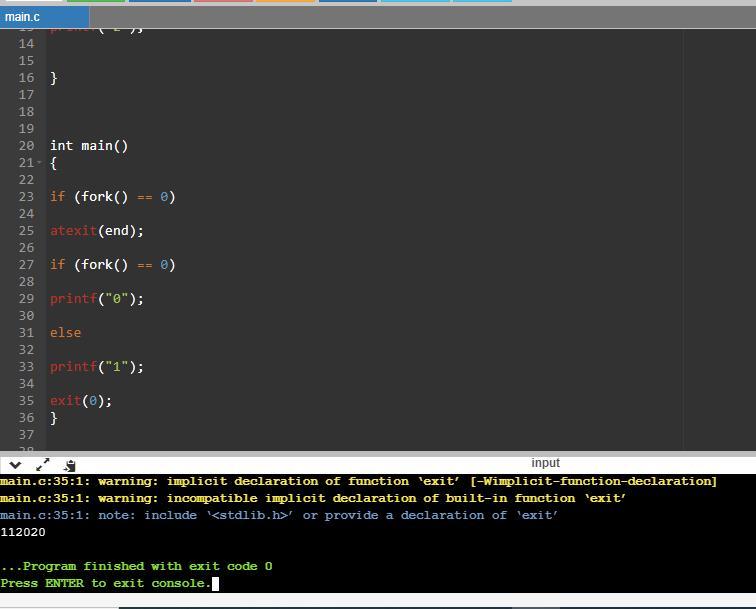
The right response to this question is A, which is 112002.

The correct code relating to this question is presented below

#include  <stdio.h>

#include  <string.h>

#include  <sys/types.h>

//#include "csapp.h"

void end(void)

{

printf("2");

}

int main()

{

if (fork() == 0)

atexit(end);

if (fork() == 0)

printf("0");

else

printf("1");

exit(0);

}

/* $end forkprob2 */

When this program is executed, the fork function will yield varying results.

However, it should be noted that running it multiple times will produce inconsistent values. The most common output the program will generate is A.

Attached is an image of the program's execution for further clarification.

5 0
1 month ago
Can a 1½ " conduit, with a total area of 2.04 square inches, be filled with wires that total 0.93 square inches if the maximum f
Kisachek [356]
It is not feasible to install the wires within the conduit. Explanation: The given dimensions show that the total area is 2.04 square inches while the wires occupy 0.93 square inches. The maximum allowable fill for the conduit is 40%. To determine if placement is possible, compute the conduit’s area at 40% which equates to 0.816 square inches, less than the required area of the wires.
4 0
2 months ago
Other questions:
  • Which of the following ranges depicts the 2% tolerance range to the full 9 digits provided?
    6·1 answer
  • Radioactive wastes are temporarily stored in a spherical container, the center of which is buried a distance of 10 m below the e
    13·1 answer
  • Small droplets of carbon tetrachloride at 68 °F are formed with a spray nozzle. If the average diameter of the droplets is 200 u
    10·1 answer
  • 11 Notează, în caiet, trăsăturile personajelor ce se pot
    13·1 answer
  • An inventor claims to have devised a cyclical engine for use in space vehicles that operates with a nuclear fuel generated energ
    14·1 answer
  • Using Java..
    6·1 answer
  • A thermocouple element when taken from a liquid at 50°C and plunged into a liquid at 100° C at time t = 0 gave the following e.m
    11·1 answer
  • A composite wall consists of 20 mm thick steel plate backed by insulation brick (k = 0.39 W/mK) of 50 cm thickness and overlaid
    6·1 answer
  • 5. Which of these materials in a shop contain metals and toxins and can pollute the environment? A) Antifreeze B) Solvents C) Ba
    9·2 answers
  • Prove that "a perfect conductor cannot contain an electrostatic field within it".​
    14·1 answer
Add answer
Login
Not registered? Fast signup
Signup
Login Signup
Ask question!