answer.
Ask question
Login Signup
Ask question
All categories
  • English
  • Mathematics
  • Social Studies
  • Business
  • History
  • Health
  • Geography
  • Biology
  • Physics
  • Chemistry
  • Computers and Technology
  • Arts
  • World Languages
  • Spanish
  • French
  • German
  • Advanced Placement (AP)
  • SAT
  • Medicine
  • Law
  • Engineering
Andru
1 month ago
13

A radioactive source has a half life of 80s.

Physics
1 answer:
kicyunya [3.1K]1 month ago
6 0
Let's assume that the initial quantity of nuclides is 100.

If 7/8 of 100 has decayed, we conclude that 87.5 has decayed.

\frac{7}{8} \times 100 = 87.5

This means that 1/8 remains from the original amount of 100, which results in 12.5 remaining.

100 - 87.5 =12.5

\frac{1}{8} \times 100 = 12.5

To find out how many Half-lives it took for the sample to drop from 100 to 12.5, we can establish that 3 Half-Lives have elapsed.

100 \div 2 \div 2 \div 2 = 12.5

Given that each Half-Life is 80 seconds, the total time taken would be 240 seconds.

3 \times 80 = 240 Therefore, the conclusion is that it will take 240 seconds.
You might be interested in
Potential energy matter has a result of its ____ or ____.
Yuliya22 [3221]
Position or composition
3 0
29 days ago
Read 2 more answers
What is the freezing point of radiator fluid that is 50% antifreeze by mass? k f for water is 1.86 ∘ c/m?
Maru [3263]
Ethylene glycol is known as the main component found in antifreeze.
The molecular formula for ethylene glycol is C₂H₆O₂.
Its molar mass is calculated as C₂H₆O₂ = (2×12) +(6×1) + (216) = 62g/mol
Given that antifreeze comprises 50% by weight, there exists 1 kg of ethylene glycol mixed with 1 kg of water.
ΔTf = Kf×m
ΔTf refers to the change in the freezing point.
= starting temperature of water - freezing temperature of the solution
= 0°C - Tf
= -Tf
Kf stands for the freezing point depression constant of water, which is 1.86°C/m
m is the molarity of the solution.
=(mass/molar mass) where mass of solvent is in kg
=1000g/62 (g/mol) /1kg
=16.13m
Substituting the value into the equation gives us
-Tf = 1.86 × 16.13 = 30
thus Tf = -30°C
7 0
13 days ago
Read 2 more answers
The Lamborghini Huracan has an initial acceleration of 0.75g. Its mass, with a driver, is 1510 kg.
Maru [3263]

Answer:

11109.825 N

Explanation:

Provided Information:

mass = m = 1510 kg

initial acceleration (a) = 0.75g (where g = 9.81 m/s²)

Using the formula F=ma

  = (1510)*(0.75*9.81)

  = 11109.825 N

4 0
1 month ago
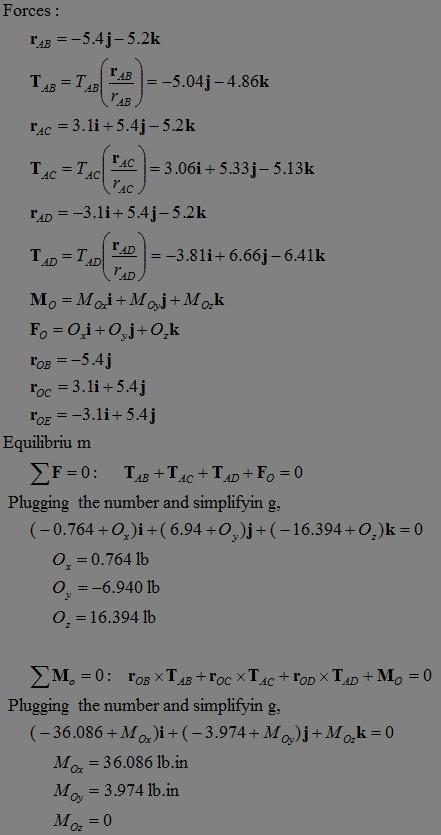
The young tree was bent and has been brought into a vertical position by the three guy cables. If tension at AB = 0, AC = 10 lb,
Keith_Richards [3146]

Answer:

The initially bent young tree has been straightened by adjusting the tensions of the three guy wires to AB = 7 lb, AC = 8 lb, and AD = 10 lb. Please calculate the force and moment reactions at the trunk's base point O, disregarding the weight of the tree.

C and D are situated 3.1' from the y-axis, while B and C are located 5.4' from the x-axis, and A has a height of 5.2'.

Explanation:

Refer to the attached image.

3 0
1 month ago
Five metal samples, with equal masses, are heated to 200oC. Each solid is dropped into a beaker containing 200 ml 15oC water. Wh
ValentinkaMS [3343]
Part 1) Which metal will cool the fastest?
To determine this, we need to consider the heat flow rate formula, which indicates the speed at which a substance can gain or lose heat:
\frac{\Delta Q}{\Delta t} = -k \frac{A \Delta T}{x}
where:
\Delta Q denotes the heat exchanged
\Delta t indicates the duration
k represents the thermal conductivity of the material
A is the area over which heat transfer takes place
\Delta T shows the change in temperature
x is the thickness of the substance
It is evident that the heat flow rate \frac{\Delta Q}{\Delta t} is directly related to k, the thermal conductivity. Thus, a higher value of k means that the metal will cool more quickly.
Upon examining the thermal conductivity values for each metal, we observe:
- Aluminium: 237 W/(mK)
- Copper: 401 W/(mK)
- Gold: 314 W/(mK)
- Platinum: 69 W/(mK)
Consequently, copper has the highest heat flow rate, making it the metal that cools the fastest.

Part 2) Which sample of copper demonstrates the greatest increase in temperature
To address this part, we can examine how the heat exchanged Q correlates with temperature increase \Delta T:
Q=m C_S \Delta T
where m indicates the mass and Cs represents the specific heat capacity of the material. By rearranging the equation, we derive
\Delta T= \frac{Q}{m C_s}
As a result, it becomes clear that the temperature increase is inversely related to the mass m. Thus, the block exhibiting the highest temperature rise will be the one with the least mass, hence the right choice is A) 0.5 kg.

4 0
19 days ago
Other questions:
  • To avoid an accident, a driver steps on the brakes to stop a 1000-kg car traveling at 65km/h. if the braking distance is 35 m, h
    7·1 answer
  • Rita has two small containers, one holding a liquid and one holding a gas. Rita transfers the substances to two larger container
    10·2 answers
  • If a 50.0-kg mass weighs 554 n on the planet saturn, calculate saturn’s radius
    14·1 answer
  • A water-skier with weight Fg = mg moves to the right with acceleration a. A horizontal tension force T is exerted on the skier b
    8·1 answer
  • Light from a monochromatic source shines through a double slit onto a screen 5.00 m away. The slits are 0.180 mm apart. The dark
    13·1 answer
  • A vacuum tube diode consists of concentric cylindrical electrodes, the negative cathode and the positive anode. Because of the a
    11·1 answer
  • A car covers 72 kilometers in the first hour of its journey. In the next hour, it covers 90 kilometers. What is the amount of wo
    14·1 answer
  • A baseball player exerts a force of 100 N on a ball for a distance of 0.5 mas he throws it. If the ball has a mass of 0.15 kg, w
    12·1 answer
  • A 450g mass on a spring is oscillating at 1.2Hz. The totalenergy of the oscillation is 0.51J. What is the amplitude.
    9·1 answer
  • The potential energy of a 40 kg cannon ball is 14000 J. How high was the cannon ball to have this much potential energy?
    14·1 answer
Add answer
Login
Not registered? Fast signup
Signup
Login Signup
Ask question!