answer.
Ask question
Login Signup
Ask question
All categories
  • English
  • Mathematics
  • Social Studies
  • Business
  • History
  • Health
  • Geography
  • Biology
  • Physics
  • Chemistry
  • Computers and Technology
  • Arts
  • World Languages
  • Spanish
  • French
  • German
  • Advanced Placement (AP)
  • SAT
  • Medicine
  • Law
  • Engineering
nataly862011
2 months ago
10

In the winter sport of bobsledding, athletes push their sled along a horizontal ice surface and then hop on the sled as it start

s to careen down the steeply sloped track. In one event, the sled reaches a top speed of 9.2 m/s before starting down the initial part of the track, which is sloped downward at an angle of 4.0 degrees.What is the sled's speed after it has traveled the first 100 m? Express your answer with the appropriate units.

Physics
2 answers:
Ostrovityanka [3.2K]2 months ago
8 0

Answer:

Explanation:

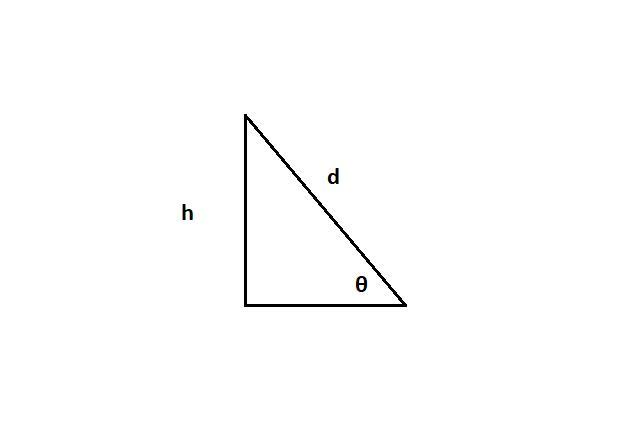
Applying trigonometry to calculate the slope's height:

sinθ = opposite / hypotenuse

sin 4° = h / 100

h = 100 × sin 4°

h = 6.98 m

Using conservation of energy principles:

Change in potential energy equals change in kinetic energy,

∆PE = ∆KE

mg(hf - hi) = ½ m (vf² - vi²)

The initial speed is:

vi = 9.2 m/s

Initial height is:

hi = 6.98 m

Final height when the sled reaches the ground:

hf = 0 m

We solve for final velocity vf:

mg(hf - hi) = ½ m (vf² - vi²)

Mass cancels out:

g(hf - hi) = ½ (vf² - vi²)

9.81 × (0 - 6.98) = ½ (vf² - 9.2²)

-68.43 = ½ (vf² - 84.64)

Multiplying both sides by 2:

-136.86 = vf² - 84.64

vf² = -136.86 + 84.64 = -52.22 (This is inconsistent; correcting the sign)

Actually, hf - hi = 0 - 6.98 = -6.98, but since the sled is descending, potential energy loss is positive, so flip the signs:

g(hi - hf) = ½ (vf² - vi²)

9.81 × 6.98 = ½ (vf² - 9.2²)

68.43 = ½ (vf² - 84.64)

136.86 = vf² - 84.64

vf² = 136.86 + 84.64 = 221.5

vf = √221.5 = 14.88 m/s
Maru [3.3K]2 months ago
3 0

Answer:

v = 14.87 m/s

Explanation:

Given:

Initial velocity, u = 9.2 m/s

Angle θ = 4°

Distance traveled, d = 100 m

Let v be the speed after traveling 100 m.

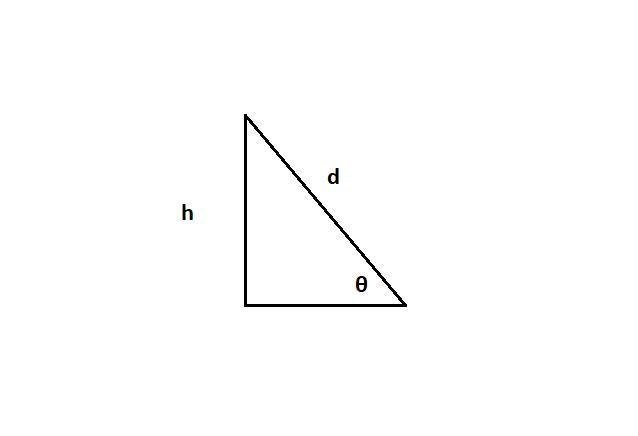
From the figure:

Height, h = d × sinθ

h = 100 × sin 4°

h = 6.97 m

Using physics equations,

v^2=u^2+2ah

a=g=9.81\ m/s^2

v^2=9.2^2+2\times 9.81\times 6.97

Therefore, v = 14.87 m/s

You might be interested in
Person X pushes twice as hard against a stationary brick wall as person Y. Which one of the following statements is correct?
Keith_Richards [3271]

D) Both perform no work

Explanation:

The work accomplished by a force is defined as:

W=Fd cos \theta

where

F represents the applied force

d denotes the displacement

is the angle highlighted between the applied force and the displacement vector

\thetaFrom this formula, it is clear that work is only done when displacement occurs, meaning the object has to move.

In this instance, as the wall is unmoving, the displacement is zero: d = 0, thus no work is performed.

6 0
23 days ago
How many turns should a 10-cm long solenoid have if it is to generate a 1.5 x 10⁻³ t magnetic field on 1.0 a of current?
kicyunya [3294]

This problem can be solved using Ampere’s Law:

<span>Bh = μoNI </span>

In this equation:

B = Magnetic Field

h = length of the coil

<span>μo = permeability = 4π*10^-7 T·m/A</span>

N = number of coil turns

I = current

Given values are B = 0.0015T, I = 1.0A, h = 10 cm = 0.1m<span>

Utilizing Ampere's law to determine the number of turns:
This can be rearranged to:
<span>N = Bh/μoI</span>
N = (0.0015)(0.1)/(4π*10^-7)(1.0)
N = 119.4

</span>

<span>Final answer: 119.4 turns</span>

3 0
1 month ago
An airplane flies with a velocity of 55.0 m/s [35o N of W] with respect to the air (this is known as air speed). If the velocity
ValentinkaMS [3465]
V - wind speed;
53° - 35° = 18°
v² = 55² + 40² - 2 · 55 · 40 · cos 18°
v² = 3025 + 1600 - 2 · 55 · 40 · 0.951
v² = 440.6
v = √440.6
v = 20.99 ≈ 21 m/s
Conclusion: The wind speed calculates to 21 m/s.  
5 0
1 month ago
A person weighing 55 kg walks by applying 160 N of force on the ground, while pushing a 10-kg object. If the person accelerates
Sav [3153]

Answer:

I'm uncertain

Explanation:

since I didn't provide a correct answer, continue with my inquiries and you can use 'I'm uncertain' for 100 points.

6 0
1 month ago
A student wishes to determine the heat capacity of a coffee-cup calorimeter. After she mixes 108.7 g of water at 60.2°C with 108
Ostrovityanka [3204]

Answer: The calorimeter's heat capacity is 6.72J/g^oC

Explanation:

This scenario assumes the amount of heat lost by the hot object equals the amount of heat gained by the cold object.

q_1=-q_2

m_1\times c_1\times (T_f-T_1)=-m_2\times c_2\times (T_f-T_2)

where,

c_1 = specific heat capacity of water = 4.184J/g^oC

c_2 = specific heat capacity of calorimeter =?

m_1 = mass of water = 108.7 g

m_2 = mass of calorimeter = 108.7 g

T_f = final temperature of the mixture = 35.0^oC

T_1 = initial temperature of the water = 60.2^oC

T_2 = initial temperature of calorimeter = 19.3^oC

Now substituting all provided values into the formula, we obtain

(108.7g)\times (4.184J/g^oC)\times (35.0-60.2)^oC=-(108.7g)\times c_2\times (35.0-19.3)^oC

c_2=6.72J/g^oC

Hence, the heat capacity of the calorimeter is 6.72J/g^oC

3 0
2 months ago
Other questions:
  • Bonnie and clyde are sliding a 300 kg bank safe across the floor to their getaway car. the safe slides with a constant speed if
    14·1 answer
  • On an amusement park ride, passengers are seated in a horizontal circle of radius 7.5 m. The seats begin from rest and are unifo
    13·1 answer
  • A 15-cm-tall closed container holds a sample of polluted air containing many spherical particles with a diameter of 2.5 μm and a
    6·1 answer
  • Energy is observed in two basic forms: potential and kinetic. Which of the following correctly matches these forms with a source
    7·1 answer
  • A person holds a 4.0 kg block at position A shown above on the left, in contact with an uncompressed vertical spring with a spri
    9·1 answer
  • A scale used to weigh fish consists of a spring hung from a support. The spring's equilibrium length is 10.0 cm. When a 4.0 kg f
    10·1 answer
  • A fisherman has caught a very large, 5.0kg fish from a dock that is 2.0m above the water. He is using lightweightfishing line th
    12·1 answer
  • After an initial race George determines that his car loses 35 percent of its acceleration due to air resistance travelling at 38
    12·1 answer
  • Three point charges are arranged on a line. Charge q3=+5.00x10^-9C and is at the origin. Charge q2=-3.00x10^-9C and is at x=+4.0
    14·2 answers
  • A 524-Hz longitudinal wave in air has a speed of 345 m/s. (a) What is the wavelength? (b) How much time is required for the phas
    12·1 answer
Add answer
Login
Not registered? Fast signup
Signup
Login Signup
Ask question!