answer.
Ask question
Login Signup
Ask question
All categories
  • English
  • Mathematics
  • Social Studies
  • Business
  • History
  • Health
  • Geography
  • Biology
  • Physics
  • Chemistry
  • Computers and Technology
  • Arts
  • World Languages
  • Spanish
  • French
  • German
  • Advanced Placement (AP)
  • SAT
  • Medicine
  • Law
  • Engineering
ASHA 777
9 days ago
10

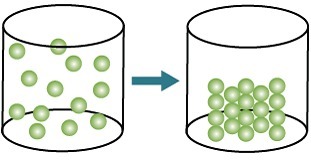
Which change of state is shown in the model?

Chemistry
2 answers:
alisha [964]9 days ago
7 0

\boxed{\text{Deposition}} is depicted in the provided model.

Further Explanation:

Condensation

This is the process where a gas or vapor transitions to a liquid state. It is essentially the inverse of evaporation. The chaotic movement of gas particles decreases, allowing them to coalesce into a liquid. This transformation is influenced by changes in temperature and pressure.

Deposition

This refers to the phase change where a gas or vapor transforms directly into a solid without entering the liquid state. This process is thermodynamic in nature. Deposition occurs when water vapor loses sufficient thermal energy to become solid without going through the liquid phase. This process is the opposite of sublimation and is often referred to as desublimation.

Boiling

This phase change allows a liquid to turn into a gas or vapor state, which occurs when the liquid is heated to its boiling point.

Freezing

This conversion changes a substance from a liquid state to a solid state. It is the opposite of melting. In this phase transition, heat is released, causing the liquid particles to move closer together and form a solid, such as in the formation of ice.

In the model shown, the gaseous or vapor state is converted into a solid state, illustrating deposition. Hence, deposition is shown in the given model.

Learn more:

  1. Identify the phase change in which crystal lattice is formed:
  2. The main purpose of conducting experiments:

Answer details:

Grade: Senior School

Chapter: Phase transition

Subject: Chemistry

Keywords: deposition, freezing, boiling, solid, liquid, vapor, condensation, desublimation, thermodynamic process.
Alekssandra [968]9 days ago
5 0

I think the state change illustrated in the diagram is deposition. 
Deposition is the transformation of gases into solids without transitioning through a liquid phase. It is the reverse process of sublimation.
A key distinction between gases and solids lies in the spacing of molecules; gases have large spaces between molecules, whereas solids have very minimal spacing, resulting in solids being more densely packed. This is illustrated in the diagram showing the transition from gases to solids.

 
You might be interested in
Identify one disadvantage to each of the following models of electron configuration:
lions [985]

Answer:

Below are the downsides of each electron configuration model:

1). Dot Structures - They consume more space and fail to convey the electron distribution within orbitals.

2). Arrow and line diagrams complicate electron counting and also take up excessive space.

3). Written Configurations do not illustrate electron distribution in orbitals, leading to possible errors in counting electrons.

6 0
3 days ago
Read 2 more answers
a nurse practitioner orders Medrol to be given 1.5 mg/kg of body weight. if a child weighs 72.6lb and the available stock of Med
KiRa [971]
The amount to administer to the child is 2,469 mL.
To convert to kilograms (kg), the child's weight in pounds (lb) is multiplied by 0.45359237: m(child) = 72.6 · 0.045359237 = 32.93 kg.
To find m(Medrol), the child's mass in kilograms is multiplied by 1.5 mg/kg.
Thus, m(Medrol) = 32.93 kg · 1.5 mg/kg = 49.39 mg.
The concentration of Medrol is d(Medrol) = 20.0 mg/mL.
To find the volume of Medrol needed, use V(Medrol) = m(Medrol) ÷ d(Medrol).
So, V(Medrol) = 49.39 mg ÷ 20 mg/mL = 2,469 mL.

8 0
7 days ago
For the chemical reaction HCN ( aq ) + KOH ( aq ) ⟶ H 2 O ( l ) + KCN ( aq ) HCN(aq)+KOH(aq)⟶H2O(l)+KCN(aq) write the net ionic
lions [985]

Answer:

H+(aq) + OH-(aq) ⟶ H2O(l)

Explanation:

Step 1: The balanced equation can be presented as

HCN(aq) + KOH(aq) ⟶ H2O(l) + KCN(aq)

H+(aq) + CN-(aq) + K+(aq) + OH-(aq) ⟶ H2O(l) + K+(aq) + CN-(aq)

Step 2: The net ionic equation is formed by removing the spectator ions — those that appear on both sides of the equation — leading us to the final representation:

H+(aq) + OH-(aq) ⟶ H2O(l)

4 0
3 days ago
Primordial swamps decomposing under ancient seas and tons of rock layers gave rise to an important fuel used today. That fuel is
lorasvet [956]
I think the right choice is C. Coal, as it's utilized in making a multitude of products across the globe. I trust this information is useful to you.:)
8 0
21 hour ago
Read 2 more answers
A characteristic feature of any form of chromatography is the ________.a. calculation of an Rf value for the molecules separated
castortr0y [923]

Answer: The right choice is (c) application of both a mobile phase and a stationary phase.

Explanation:

Chromatography: This refers to a technique for separating a mixture where the mixture is distributed between two phases at varying rates, one being stationary and the other moving.

Mobile phase: The component in which the mixture is dissolved is referred to as the mobile phase.

Stationary phase: This is an adsorbent medium that remains in place while a liquid or gas passes over its surface, thus remaining stationary.

Consequently, a key characteristic of any chromatography technique involves utilizing both a mobile and a stationary phase.

4 0
2 days ago
Other questions:
  • (g) On the graph in part (d) , carefully draw a curve that shows the results of the second titration, in which the student titra
    14·1 answer
  • Why did we use a mixture of ethanol and water to perform the reaction between the oil and naoh?
    8·1 answer
  • During a combustion reaction, 9.00 grams of oxygen reacted with 3.00 grams of CH4.
    5·1 answer
  • What is the mass of 0.75 moles of (NH4)3PO4?
    6·2 answers
  • The equilibrium constant k for the synthesis of ammonia is 6.8x10⁵ at 298 k. what will k be for the reaction at 375 k?
    5·2 answers
  • In a certain compound of iron and oxygen, FexOy, it is found that a sample of this compound weighing 6.285 g contains 4.396 g of
    5·1 answer
  • A gas at 928 kpa, 129 C occupies a volume of 569 L. Calculate the volume at 319 kpa and<br> 32 C.
    10·1 answer
  • Why is sucrose insoluble in dichloromethane?
    12·1 answer
  • Exactly 500 grams of ice are melted at a temperature of 32°f. (lice = 333 j/g.) calculate the change in entropy (in j/k). (give
    5·1 answer
  • Draw the four structures of the compounds with molecular formula C5H10O that contain a carbon-carbon double bond, an unbranched
    12·1 answer
Add answer
Login
Not registered? Fast signup
Signup
Login Signup
Ask question!
