answer.
Ask question
Login Signup
Ask question
All categories
  • English
  • Mathematics
  • Social Studies
  • Business
  • History
  • Health
  • Geography
  • Biology
  • Physics
  • Chemistry
  • Computers and Technology
  • Arts
  • World Languages
  • Spanish
  • French
  • German
  • Advanced Placement (AP)
  • SAT
  • Medicine
  • Law
  • Engineering
Eddi Din
6 days ago
11

A ship sailing in the Gulf Stream is heading 25.0º west of north at a speed of 4.00 m/s relative to the water. Its velocity rela

tive to the Earth is 4.80 m/s 5.00º west of north. What is the velocity of the Gulf Stream? (The velocity obtained is typical for the Gulf Stream a few hundred kilometers off the east coast of the United States.)
Physics
You might be interested in
Sharks are generally negatively buoyant; the upward buoyant force is less than the weight force. This is one reason sharks tend
Ostrovityanka [3204]
The required lift force is approximately 866.92 N. To determine this, we first establish the shark's mass at 92 kg and its density at 1040 kg/m³. The volume of the shark is calculated by dividing mass by density, yielding 0.08846 m³. The buoyant force acting on the shark is then determined by multiplying the volume by the density of water and gravity, resulting in a lift force of 866.92 N.
4 0
2 months ago
A simple harmonic wave of wavelength 18.7 cm and amplitude 2.34 cm is propagating along a string in the negative x-direction at
Ostrovityanka [3204]

Answer

Given:

Wavelength = λ = 18.7 cm

                  = 0.187 m

Amplitude, A = 2.34 cm

Velocity, v = 0.38 m/s

A)  Calculate the angular frequency.

     f = \dfrac{v}{\lambda}

     f = \dfrac{0.38}{0.187}

     f =2.03\ Hz

Angular frequency,

ω = 2π f

ω = 2π x 2.03

ω = 12.75 rad/s

B) Calculate the wave number:

      K = \dfrac{2\pi}{\lambda}

     K= \dfrac{2\pi}{0.187}

    K =33.59\ m^{-1}

C)

Since the wave is traveling in the -x direction, the sign is positive between x and t

y (x, t) = A sin(k x - ω t)

y (x, t) = 2.34 sin(33.59 x - 12.75 t)

4 0
3 months ago
A brick is dropped (zero initial speed) from the roof of a building. The brick strikes the ground in 1.90 s. You may ignore air
Sav [3153]

Answer:

Height (h) = 17 m

Velocity (v) = 18.6 m/s

Explanation: This problem can be solved using kinematic motion equations.

Given Data

Initial velocity (u) = 0

Acceleration (a) = g

Time (t) = 1.9 seconds

First, we calculate the height.

s=ut+0.5at^2\\h=ut+0.5at^2\\h=0*1.9+0.5*9.81*1.9^2\\h=17.707 m

Then, we find the final velocity

v=u+at\\v=0+9.81*1.9\\v=18.639

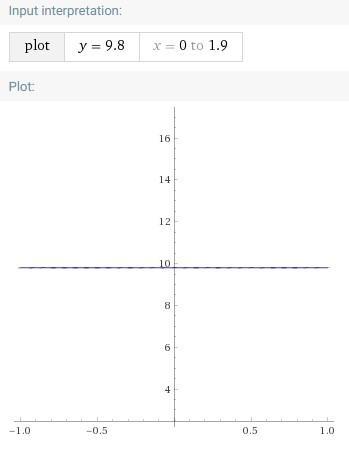
The acceleration graph is a linear representation described by y=9.8, as it remains constant:

The velocity graph can be represented by y=9.8x (where y signifies velocity and x indicates time):

The displacement graph can be described as y=4.9x^2 (with x as time and y as displacement):

These graphs apply exclusively from x=0 to x=1.9, so disregard other sections of the graphs.

5 0
3 months ago
Select the areas that would receive snowfall because of the lake effect.
Keith_Richards [3271]

Result:

- Grand Marais

- Two Harbors

- Duluth

Explanation:

The locations likely to receive snowfall due to lake effect include Grand Marais, Two Harbors, and Duluth. These areas are situated directly along the shores of Lake Superior, one of the world’s largest lakes. Its substantial water volume significantly influences the local climate, generating a lot of humidity in the air and considerable evaporation, both of which lead to cloud formation and, when temperatures drop adequately, result in significant snowfall rather than rain.

8 0
2 months ago
What happens to the particles of a liquid when energy is removed from them?
Softa [3030]

Response:

D: The distance among the particles diminishes

Clarification:

Removing energy reduces the activity of molecules, similar to how one slows down in cold temperatures (I believe).


3 0
3 months ago
Other questions:
  • A motorist enters a freeway at 45 km/h and accelerates uniformly to 99 km/h. From the odometer in the car, the motorist knows th
    9·1 answer
  • A distance of 2.00 mm separates two objects of equal mass. If the gravitational force between them is 0.0104 N, find the mass of
    10·2 answers
  • A glass beaker of unknown mass contains of water. The system absorbs of heat and the temperature rises as a result. What is the
    9·1 answer
  • A force of 150 N accelerates a 25 kg wooden chair across a wood floor at 4.3 m/s2 . How big is the frictional force on the block
    11·1 answer
  • "if a stream flow measures 12 meters in 60 seconds, what is the stream's average rate of flow?"
    13·1 answer
  • You are at the park with your little brother, when you notice a small merry-go-round with a radius that looks to be about 1.5 m.
    12·1 answer
  • Two identical grasshoppers jump into the air with the same initial speed and experience no air resistance. Grasshopper A goes st
    7·1 answer
  • Alice and tom dive from an overhang into the lake below. tom simply drops straight down from the edge, but alice takes a running
    10·1 answer
  • Our Sun emits most of its radiation at a wavelength of 550 nm. If a star were 3.50 times hotter than our Sun, it would emit most
    12·1 answer
  • In the diagram, q1 = -6.39*10^-9 C and q2 = +3.22*10^-9 C. What is the electric field at point P? Include a + or - sign to indic
    10·1 answer
Add answer
Login
Not registered? Fast signup
Signup
Login Signup
Ask question!